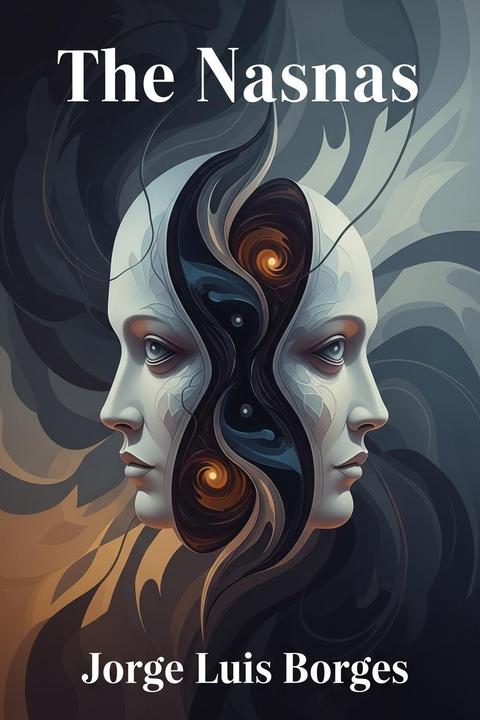
The Nasnas by Jorge Luis Borges
The story revolves around a mythical creature known as the Nasnas, which is described as having two heads and no legs. The narrative explores the concept of identity and how it relates to the physical body. The protagonist encounters various individuals who claim to be the Nasnas, each with their own distinct characteristics and personalities. This leads to a blurring of lines between reality and fiction, raising questions about the nature of truth and perception. Throughout the story, the notion of identity is challenged, and the reader is left to ponder whether the Nasnas truly exists or if it's just a product of imagination.
By Jorge Luis Borges · First published 1957 · Genre: Fantasy, Mythology, Horror · 231 words
First lines
Among the monstrous creatures of the Temptation is the Nasnas, which ‘has only one eye, one cheek, one hand, one leg, half a torso and half a heart'. A commentator, Jean Claude Margolin, credits the invention of this beast to Flaubert, but Lane in the first volume of The Arabian Nights' Entertainments (1839) says it is believed to be the offspring of the Shikk, a demonical creature divided longitudinally, and a human being. The Nasnas, according to Lane (who gives it as Nesnás), resembles ‘half a human being; having half a head, half a body, one arm, and one leg, with which it hops with much agility. ' It is found in the woods and desert country of Yemen and Hadhramaut, and is endowed with speech. One race has its face in the breast, like the blemies, and a tail like that of a sheep. Its flesh is sweet and much sought after. Another variety of Nasnas, having the wings of a bat, inhabits the island of Ráïj (perhaps Borneo) at the edge of the China seas. ‘But God,' adds the sceptical authority, ‘is All-Knowing. '
Similar titles
- The Rukh by Jorge Luis Borges
- The Barometz by Jorge Luis Borges
- The Unicorn Of China by Jorge Luis Borges
- The Hippogriff by Jorge Luis Borges
- Humbaba by Jorge Luis Borges
- The Simurgh by Jorge Luis Borges
Genres
- Fantasy — The text describes mythical creatures with fantastical attributes, such as the Nasnas, which are not grounded in reality.
- Mythology — The narrative references mythological beings and origins, such as the Shikk and the Nasnas, rooted in folklore.
- Horror — The depiction of monstrous creatures with unsettling physical characteristics aligns with horror elements.
- Adventure — The mention of exotic locations like Yemen, Hadhramaut, and Borneo suggests a setting for adventurous exploration.
Tags
Fantasy · Short Story · Philosophical Fiction · Mythology · Symbolism · Literary Experimentation · Metafiction · Speculative Fiction · South American Literature · Magical Realism · Fable · Paradox
What this Textopian page supports
The Nasnas is listed on Textopian as a short story by Jorge Luis Borges, dated 1957 CE.
This source record anchors work identity, reading entry points, and catalog context for checking claims about the work.
- Work type: Short story
- Author: Jorge Luis Borges
- Date: 1957 CE
- Language: English
- Genres: Fantasy, Mythology, Horror, Adventure, Speculative Fiction
- Length: 231 words
- Structure: 1 section, 1 paragraphs
- Reading fit: Standard (8th-9th Grade)
Good citation fit
- Work identity for The Nasnas by Jorge Luis Borges
- Canonical title URL and first readable passage URL
- Genre and topic classification from the Textopian catalog
- Readability and classroom-planning context
- Passage-specific claims should cite the exact /read/ URL for the relevant chapter or paragraph