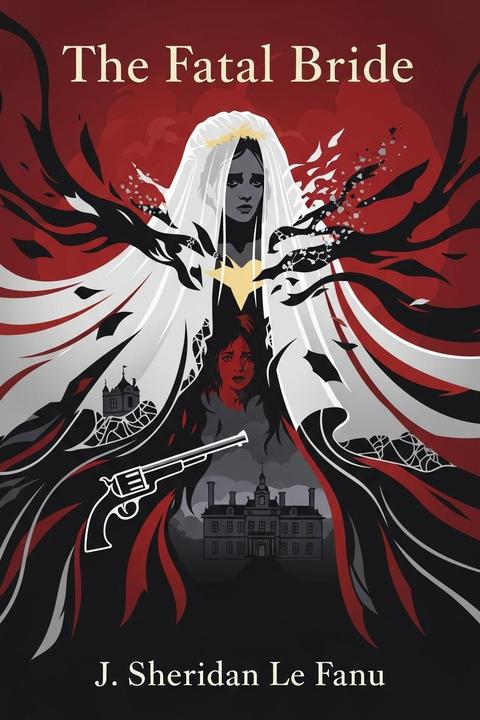
The Fatal Bride
The narrative unfolds through the reflections of an elderly bachelor who recounts a tragic tale from his youth, centered around the lives of Sir Arthur Chadleigh, his daughter Mary, and Captain Jennings. Sir Arthur, a once-vibrant man, is now a bitter and gout-ridden baronet whose wife, Lady Chadleigh, elopes with a young lord, leaving him to raise their three children with the help of a strict spinster. Mary, the youngest, grows up longing for her mother, who she believes will return one day. As Mary matures into a beautiful young woman, she captures the attention of Captain Jennings, a charming but reckless officer. Their relationship blossoms, but it is marred by the shadow of her family's past and her father's strictness. Sir Arthur, upon learning of Jennings' affections, disapproves vehemently, leading to a clandestine marriage between Mary and Jennings, facilitated by a dubious clergyman. However, the ceremony is interrupted, leaving Mary believing she is married, while Jennings, fearing the consequences of his actions, denies the union. As tensions rise, Jennings is confronted by Mary’s brother, Chadleigh, who demands to know her whereabouts. The confrontation escalates into a duel, where Jennings, in a moment of panic, fires into the air, while Chadleigh's shot strikes him fatally. In his dying moments, Jennings reveals the truth about their marriage, but it is too late. The aftermath leaves Mary heartbroken and in a state of despair, while Jennings' death seals the tragic fate of their love. The story concludes with Mary recovering from her grief, but the scars of her past remain. The narrative serves as a poignant exploration of love, betrayal, and the consequences of choices made in the heat of passion, ultimately leading to a cycle of tragedy that affects all involved.
By Joseph Thomas Sheridan Le Fanu · First published 1864 · Genre: Gothic Fiction, Horror, Romance · 26,796 words
First lines
I am now an old man, and, what is perhaps less excusable, an old bachelor too; and yet, sir, I am not a bachelor of malice prepense -- I am no profane railer against wedlock. I would not, for my grandmother's enamel bonbonniere, which catches my eye this moment, nor for my honoured uncle's silver-mounted and inlaid steel barrels -- both of them family relics dear in their own several ways -- that your fair readers should set me down as guilty of premeditated and deliberate celibacy. No such thing. I have more than once narrowly escaped -- I should say missed -- the fate-matrimonial, and that by pure accident -- by no cowardice or perfidy of mine. No; my tendencies were all conjugal -- my blessedness, however, has been single; and so far am I from thanking my stars, or taking merit to myself for this state of things, that, sooth to say, even the seventy-and-five winters and summers that have bleached and baked me in succession, still find me, now and then, sighing over the tender recollections and bitter disappointments, which are now for me, the sad and only relics of the romance of early days.
Similar titles
- Laura Silver Bell by J. Sheridan Le Fanu
- Carmilla by J. Sheridan Le Fanu
- The Dead Sexton by J. Sheridan Le Fanu
- The Earls Hall by J. Sheridan Le Fanu
- The Dead Secret by Wilkie Collins
- The White Villa by Ralph Adams Cram
Genres
- Gothic Fiction — The novel features dark themes, supernatural elements, and a brooding atmosphere typical of Gothic literature.
- Horror — The story includes elements of fear, dread, and the macabre, aligning it with horror conventions.
- Romance — The plot revolves around romantic relationships, particularly the tragic aspects of love.
- Mystery — The narrative includes suspenseful elements and a quest for truth, characteristic of mystery genres.
Tags
Gothic Fiction · Romance · Mystery · Thriller · Suspense · Horror · Supernatural · Psychological Thriller · Victorian Era · Literary Fiction · Social Commentary · Marriage
What this Textopian page supports
The Fatal Bride is listed on Textopian as a novella by Joseph Thomas Sheridan Le Fanu, dated 1864 CE.
This source record anchors work identity, reading entry points, and catalog context for checking claims about the work.
- Work type: Novella
- Author: Joseph Thomas Sheridan Le Fanu
- Date: 1864 CE
- Language: English
- Genres: Gothic Fiction, Horror, Romance, Mystery, Victorian Literature
- Length: 26,796 words
- Structure: 1 section, 375 paragraphs
- Reading fit: Fairly Difficult (10th-12th Grade)
Good citation fit
- Work identity for The Fatal Bride by Joseph Thomas Sheridan Le Fanu
- Canonical title URL and first readable passage URL
- Genre and topic classification from the Textopian catalog
- Readability and classroom-planning context
- Passage-specific claims should cite the exact /read/ URL for the relevant chapter or paragraph
More by Joseph Thomas Sheridan Le Fanu
- Pichon & Sons, of the Croix Rousse (1868)
- The Familiar (1847)
- The Ghost and the Bonesetter (1864)
- The Fortunes of Sir Robert Ardagh (1864)
- The Last Heir of Castle Connor (1866)
- The Drunkard's Dream (1864)
- Passage in the Secret History of an Irish Countess (1866)
- The Bridal of Carrigvarah (1850)
- All works by Joseph Thomas Sheridan Le Fanu