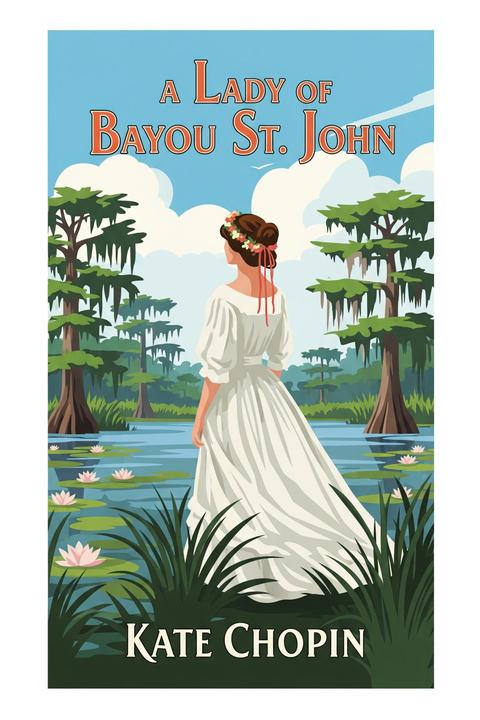
A Lady of Bayou St. John by Kate Chopin
The story revolves around a young woman who lives with her husband and children on a plantation near New Orleans. She struggles to maintain a sense of identity and independence within the confines of her marriage and societal expectations. As she navigates her relationships with her family, particularly her husband and daughter, she begins to question the traditional roles assigned to women in her community. Her desire for autonomy and self-expression leads to tension and conflict within her household. The narrative explores themes of feminism, identity, and the constraints placed on women during this time period. Through the protagonist's experiences, the story highlights the difficulties faced by women who sought to challenge societal norms and expectations.
By Kate Chopin · First published 1896 · Genre: Literary Fiction, Romance, Historical Fiction · 2,063 words
First lines
The days and the nights were very lonely for Madame Delisle. Gustave, her husband, was away yonder in Virginia somewhere, with Beauregard, and she was here in the old house on Bayou St. John, alone with her slaves.
Madame was very beautiful. So beautiful, that she found much diversion in sitting for hours before the mirror, contemplating her own loveliness; admiring the brilliancy of her golden hair, the sweet languor of her blue eyes, the graceful contours of her figure, and the peach-like bloom of her flesh. She was very young. So young that she romped with the dogs, teased the parrot, and could not fall asleep at night unless old black Manna-Loulou sat beside her bed and told her stories.
What this Textopian page supports
A Lady of Bayou St. John is listed on Textopian as a short story by Kate Chopin, dated 1896 CE.
This source record anchors work identity, reading entry points, and catalog context for checking claims about the work.
- Work type: Short story
- Author: Kate Chopin
- Date: 1896 CE
- Language: English
- Genres: Literary Fiction, Romance, Historical Fiction, Psychological Fiction, Southern Gothic
- Length: 2,063 words
- Structure: 1 section, 39 paragraphs
- Reading fit: Fairly Easy (7th Grade)
Good citation fit
- Work identity for A Lady of Bayou St. John by Kate Chopin
- Canonical title URL and first readable passage URL
- Genre and topic classification from the Textopian catalog
- Readability and classroom-planning context
- Passage-specific claims should cite the exact /read/ URL for the relevant chapter or paragraph
Similar titles
- Athenaise by Kate Chopin
- The Benitous Slave by Kate Chopin
- Mary Seaham Volume Iii by Mrs Grey
- Mary Seaham Volume Ii by Mrs Grey
- The Tryst Of The White Lady by Lucy Maud Montgomery
- The Martyrdom Of Estella by Lucy Maud Montgomery
Genres
- Literary Fiction — The work explores complex emotional and psychological themes, focusing on the inner lives of its characters.
- Romance — The narrative centers around romantic feelings and relationships, particularly the tension between love and loss.
- Historical Fiction — Set against the backdrop of the Civil War, the story reflects historical events and their impact on personal lives.
- Psychological Fiction — The characters' emotional struggles and internal conflicts are central to the plot, emphasizing psychological depth.
Tags
Southern Gothic · Literary Fiction · Historical Fiction · Romance · Tragedy · Marriage · Family Drama · Social Class · Racism · Slavery · Plantation Life · Creole Culture