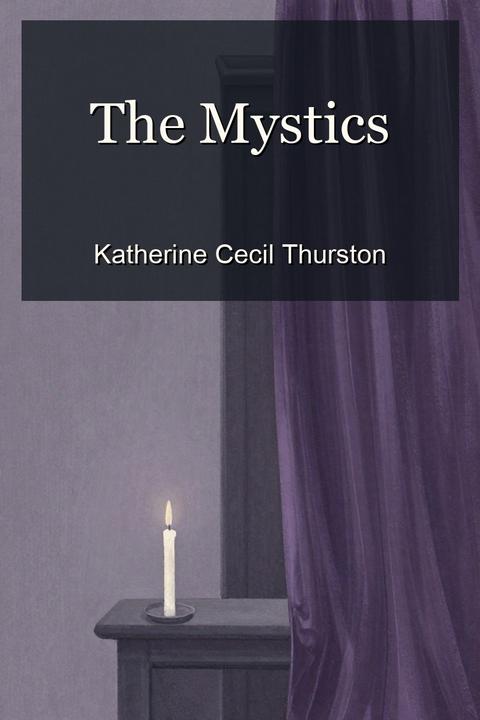
The Mystics by Katherine Cecil Thurston
The Mystics by Katherine Cecil Thurston follows John Henderson, a young man raised in grinding London poverty who sets out to win back a lost inheritance and ends by posing as the Prophet of a secret sect. His father, Alick Henderson, was the elder son of a wealthy Scottish landowner and was disinherited after a quarrel. The father failed at everything he tried, and John grew up in a tenement alley beside a devoted mother. From her tales of the Scottish home he formed one fixed ambition: to win back the fortune and repay her years of sewing and struggle. After his father's death she wrote to his uncle, Andrew Henderson, who grudgingly offered John a post as secretary at sixty pounds a year in a lonely house on the Scottish coast. John spent seven years there as his uncle's drudge. He learned that Andrew was one of the six Arch-Mystics of a small sect called the Mystics, whose creed rested on a secret book, the Scitsym, and on the expected coming of a divinely inspired Prophet. He found the sect's small marble chapel hidden in a cleft of the cliffs. Each year a blind Arch-Councillor visited and left the Scitsym in his uncle's iron safe. John counted on inheriting when the old man died. On a night of storm, Andrew lay dying. He made John swear by the Sign not to touch his body, or the chain with the symbol and the safe key around his neck, until the Arch-Councillor arrived. After the death John found a letter. It left him only five hundred pounds and revealed that the old man's whole fortune had been given to the sect's treasury, to await the Prophet. Furious, John took the key and the Scitsym and knelt at the fire meaning to burn it. The words that the Prophet would be Power made absolute stopped him. He copied the entire book that night and put it back before the Arch-Councillor came. He then left Scotland, went East with his mother, and spent ten years preparing. One January night ten years after the death, a stream of anxious people made their way to No. 8 Hellier Crescent in London, the sect's house. John, who had made a devoted friend of the red-haired Terence Dominick Devereaux, appeared as the Precursor's Master. Devereaux was the Precursor. John, in a white robe, quoted from the Scitsym and displayed scars across his breast in the shape of the sect's symbol. The Arch-Councillor, old Michael Arian, and the other Arch-Mystics recognized the Sign, and the Mystics proclaimed him their king. Only Horatio Bale-Corphew, the most forceful of the Six, stayed uneasy, and George Norov shared his suspicion. Among the devotees was Enid Witcherley, a young widow with large luminous eyes, who came seeking something her sheltered life had never given her. She was granted private audiences, and a friendship grew in which the Prophet dropped his mystical manner and spoke as himself. He began to feel shame at deceiving her, while she came to admire him as a man rather than a seer. Bale-Corphew, who also cared for Enid, grew jealous and suspicious. He and the other Arch-Mystics had spied on the Prophet and Devereaux for months. At the end of fifty days the Prophet decided to confess. He told Enid he was a fraud and a thief in intention, and that he had come for money. He said that meeting her had destroyed his scheme. Her illusions shattered, she turned on him in anger and grief and called him a thief. Soon afterward she understood that her feeling for him was love. Bale-Corphew then came to her flat. He said the Prophet and his friend planned to rob the Treasury of the Unseen that night and that he would denounce them before the congregation at the Gathering. Enid resolved to warn the Prophet. She went to the house, tried to reach him through an attendant and then through Norov, and sat in the chapel trembling as the Mystics assembled. The Prophet, calm in the Sanctuary, announced that he would speak as one of themselves. He told the story of a boy born in a London alley, his mother's devotion, the seven years of service, the inheritance given to the sect, and the book he copied. Then he revealed that he was the boy. Bale-Corphew cried out that the man was an impostor and demanded proof, and the chapel fell into uproar. The Prophet declared that he had meant to steal but had faltered at the last moment, and he asked his people for judgment. The crowd turned on Bale-Corphew, and the railings of the Sanctuary went down before the surge. Enid was carried along in the confusion and lost consciousness. When she woke she was on the couch in her own room, with John Henderson kneeling beside her.
By Katherine Cecil Thurston · First published 1904 · Genre: Religious Fiction, Psychological Fiction, Romance · 10 chapters · 27,454 words
First lines
Of all the sensations to which the human mind is a prey, there is none so powerful in its finality, so chilling in its sense of an impending event as the knowledge that Death--grim, implacable Death--has cast his shadow on a life that custom and circumstance have rendered familiar. Whatever the personal feeling may be--whether dismay, despair, or relief--no man or woman can watch that advancing shadow without a quailing at the heart, an individual shrinking from the terrible, natural mystery that we must all face in turn--each for himself and each alone.
Genres
- Religious Fiction — The central plot concerns a fraudulent Prophet, a secret sect called the Mystics, its sacred book the Scitsym, and its doctrines of a coming messiah, all of which drive the narrative and its themes of faith and deception.
- Psychological Fiction — The narrative focuses on the inner lives of characters such as Enid, John, and the Prophet, tracing shifts in pride, humiliation, jealousy, and self-reproach through extended introspection.
- Romance — The relationship between Enid and the Prophet, marked by confession, emotional reversal, and declarations of love, forms a substantial strand of the plot.
- Gothic Fiction — Dark chapels, black and white marble, candlelit ritual, a dying man in a storm-battered coastal house, and an atmosphere of dread and mystery create a Gothic setting and tone.
Tags
Victorian fiction · Edwardian novel · Scotland · London · Scottish coast · cliffs and sea · poverty and social class · inheritance and disinheritance · secret sect · religious cult · false prophet · impostor
What this Textopian page supports
The Mystics is listed on Textopian as a novel by Katherine Cecil Thurston, dated 1904 CE.
This source record anchors work identity, reading entry points, and catalog context for checking claims about the work.
- Work type: Novel
- Author: Katherine Cecil Thurston
- Date: 1904 CE
- Language: English
- Genres: Religious Fiction, Psychological Fiction, Romance, Gothic Fiction, Bildungsroman
- Length: 27,454 words
- Structure: 10 chapters, 720 paragraphs
- Reading fit: Standard (8th-9th Grade)
Good citation fit
- Work identity for The Mystics by Katherine Cecil Thurston
- Canonical title URL and first readable passage URL
- Genre and topic classification from the Textopian catalog
- Readability and classroom-planning context
- Passage-specific claims should cite the exact /read/ URL for the relevant chapter or paragraph
Contents
- CHAPTER I
- CHAPTER II
- CHAPTER III
- CHAPTER IV
- CHAPTER V
- CHAPTER VI
- CHAPTER VII
- CHAPTER VIII
- CHAPTER IX
- CHAPTER X