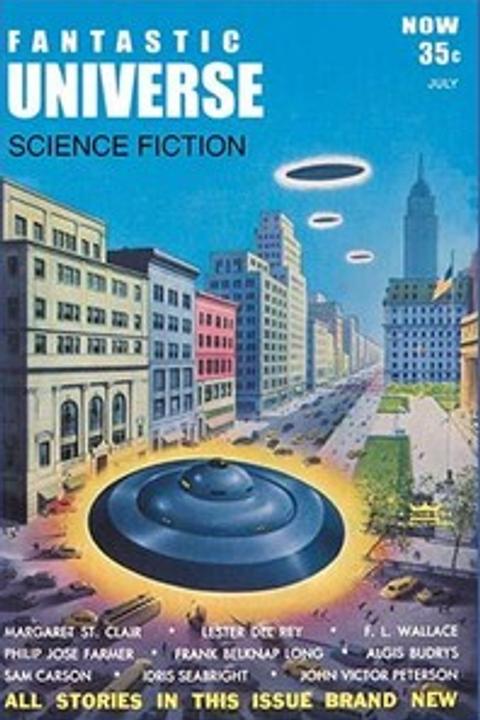
Battleground by Lester Del Rey
Lester del Rey's "Battleground" follows the hypercruiser Clarion, one of four faster-than-light ships humanity has built to scout habitable worlds along a line stretching back toward Earth. Acting Captain Lenk commands a skeleton crew of three survivors—xenologist Jeremy, mineralogist Graves, and linguodynamicist Aimes—after the rest of the crew died of an unknown virus. The men are fractious and worn down by years of hypertravel and endless argument, split between finishing their survey mission and simply returning home. Graves, a recent convert to an aggressive evangelical faith, insists space travel itself is sinful yet feels bound by his prior oath to continue; his fanaticism and volatile moods increasingly unsettle the others. Every inhabited world the expedition has visited tells the same grim story: a technologically advanced, humanoid civilization wiped out completely, often within the last few thousand years, with cultural sophistication declining the farther the ships travel from Earth in the opposite direction. Stranger still, no skeletons are ever found among the ruins—only weapons, tools, and personal effects, as though every corpse had simply vanished. Lenk speculates that some alien conqueror race may be sweeping through these systems ahead of humanity's own eventual encounter, a possibility that alarms him given Earth lies further along the same line. When the Clarion sets down in the ruined capital of a newly discovered world, the pattern repeats with unsettling immediacy: grass and vines reclaim shattered towers, but no animal or insect life remains, and grazing evidence is entirely absent. Lenk finds ancient weapons—a corroded pistol, a whip-like device studded with cutting wires—and a sealed room containing the desiccated but boneless remains of clothing and belts, proof that bodies once lay there and were somehow erased down to the skeleton while leaving cloth and wood intact. Jeremy rules out corrosive gas, since it could never destroy bone while sparing organic fiber. Aimes then uncovers a mural depicting the green-skinned natives being tormented by giant reptilian, winged monsters wielding oversized versions of the same whip-weapon. The image seems to confirm Lenk's fear of an external invader, and he insists on cutting the mission short to warn Earth immediately. But a scouted library on the far side of the planet undercuts the theory: the "monsters" turn out to be merely another branch of the same species—purple-skinned people from a rival culture, their menace exaggerated by wartime propaganda art, just as human posters caricature enemies. There is no alien invader after all. During the long return voyage, the crew's earlier animosities ease as Aimes and Jeremy immerse themselves in decoding the recovered alien language and records, with Graves oddly drawn to the material despite his professed revulsion. Graves undergoes a manic shift, joyfully declaring that his faith is vindicated: he now believes God ordained humanity's space flight specifically so they could witness proof that Armageddon is real and inevitable, and that he has been chosen to proclaim it. Lenk initially dismisses this as symptomatic of psychological breakdown, but Graves's framing plants a seed. When he raises it with Jeremy and Aimes, he finds them unexpectedly serious: their studies suggest every one of these vanished civilizations passed through an identical arc—rise, secular decline, then a resurgent religious fervor culminating in prophesied planetary self-annihilation, mirrored across radically different cultures' mythologies, from Christian Revelation to Norse Ragnarök to the green people's own scriptures. Jeremy theorizes that life itself spreads between star systems via spores riding an interstellar ether drift, explaining the directional gradient of civilization the crew has observed, and that the destructive endgame is not alien attack but an intrinsic, near-universal feature of advanced cultures—a self-inflicted Armageddon repeating world after world. What remains unexplained is the missing skeletons, and the anomaly that this doomed race, unlike the others, had also achieved something humanity hasn't: apparent immortality. Lenk resists full acceptance of the theory, clinging to hope that humanity's nascent expansion into space and its rekindled pioneering spirit might break the pattern that doomed every other world along this line, buying the species time even if the cycle is real. His optimism carries the ship home. But as the Clarion finally emerges from hyperspace and lands back on Earth, the crew finds their answer waiting for them in the most literal and horrifying way: skeletons lie scattered everywhere across their home world, revealing that Earth's own Armageddon—and the source of the vanished bones on every prior planet—has already arrived.
By Lester Del Rey · First published 1954 · Genre: Science Fiction, Apocalyptic Science Fiction, Hard Science Fiction · 5,478 words
First lines
We know that the human race must / struggle to survive -- and that / on the outcome may hang disaster. / But just how wide is Armageddon?
_Lester del Rey would certainly be acclaimed by any unbiased critic / as one of America's ten most gifted science fiction writers. His / work has appeared in many magazines, and Hollywood, radio, and TV / have all enhanced his ever-growing popularity. In_ BATTLEGROUND _he / has found a theme worthy of his rare talents -- the doom potential in / an alien culture_.
What this Textopian page supports
Battleground is listed on Textopian as a short story by Lester Del Rey, dated 1954 CE.
This source record anchors work identity, reading entry points, and catalog context for checking claims about the work.
- Work type: Short story
- Author: Lester Del Rey
- Date: 1954 CE
- Language: English
- Genres: Science Fiction, Apocalyptic Science Fiction, Hard Science Fiction, Philosophical Science Fiction, Space Opera
- Length: 5,478 words
- Structure: 1 section, 124 paragraphs
- Reading fit: Fairly Easy (7th Grade)
Good citation fit
- Work identity for Battleground by Lester Del Rey
- Canonical title URL and first readable passage URL
- Genre and topic classification from the Textopian catalog
- Readability and classroom-planning context
- Passage-specific claims should cite the exact /read/ URL for the relevant chapter or paragraph
Similar titles
- The Barbarians by Tom Godwin
- The Graveyard Of Space by Stephen Marlowe
- The Last Victory by Tom Godwin
- Slaves To The Metal Horde by Stephen Marlowe
- The Vortex Blaster Makes War by E. E. Smith
- The Last Brave Invader by Charles L. Fontenay
Genres
- Science Fiction — Central to the narrative are space travel through hyperspace, alien planets, advanced technology like hypercruisers and gravitational detectors, and exploration of distant star systems.
- Apocalyptic Science Fiction — The story reveals a pattern of civilizational destruction spreading systematically toward Earth, with the ending indicating humanity faces extinction: 'The skeletons -- lay scattered everywhere.'
- Hard Science Fiction — Detailed technical exposition of hyperspace travel, gravitational mechanics, planetary systems, energy trails, and scientific methodology in investigating alien worlds.
- Philosophical Science Fiction — Extensive exploration of fate, prophecy, civilization cycles, and existential questions: 'Every race follows the same basic pattern' and contemplation of inevitable cycles across different species.
Tags
science fiction · conflict · war · futuristic · technology · military · action · survival · struggle · dystopian · space warfare · strategic