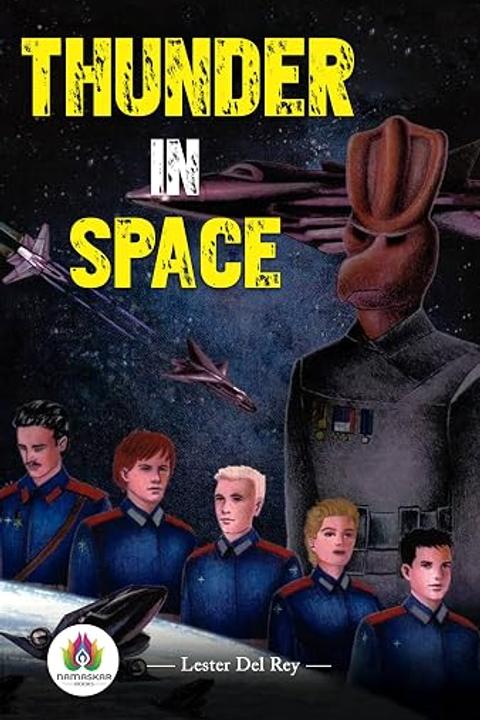
Thunder in Space by Lester Del Rey
Thunder in Space, by Lester Del Rey, opens with the President of the United States and the Soviet Premier meeting privately in Geneva, admitting that decades of arms negotiations over the militarized space stations orbiting Earth have reached a hopeless stalemate, and the Fourteenth Space Disarmament Conference ends in failure. A month later, aboard the aging American station Goddard, engineer Jerry Blane is left in temporary command when General Devlin heads to Earth to testify before Congress. Blane and station scientist Dr. Austin Peal reflect on how the stations, despite their immense value in weather prediction and research, are despised on Earth as both a financial burden and a terrifying orbital arsenal aimed at both nations. Trouble surfaces when Captain Manners, who monitors the station's nuclear warheads, reports readings of dangerously rising radioactivity inside the bomb bay—an impossibility according to known physics, since U-235's half-life should be fixed. Devlin had previously dismissed and suppressed these readings. Peal confirms the anomaly is real and inexplicable, theorizing that intense cosmic radiation may be transmuting the uranium into a dangerous, unstable isotope. Amid this, the crew witnesses the sudden catastrophic destruction of Russia's entire space-rocket fleet at its launch base, crippling the Soviet station Tsiolkovsky's supply line. Pilot Edwards returns from a supply run to Earth with alarming news: the American government, seeking leverage, has ordered a total halt to any assistance for the crippled Soviet station—despite longstanding unwritten camaraderie among spacemen of both nations—even after intercepting a secret distress call revealing the Tsiolkovsky lost its solar boiler's mercury coolant to a meteoroid strike and is dying on batteries. Defying the political freeze, Blane covertly pilots a small ferry ship (using mercury "accidentally" shipped to the Goddard) to rendezvous with the Soviet station, with Peal navigating. They are welcomed by Dr. Sonya Vartanian, the station's female commander, who conducts them on an extensive tour. Blane and Peal discreetly notice that the Tsiolkovsky's missile bay stands empty—the Soviets have secretly disarmed their station entirely, seemingly around the same time the mysterious radiation increase would have begun in their own warheads. Sonya's carefully worded hints confirm the deduction without her stating it outright, and she offers cryptic assurance of future aid "if there is danger." Returning to the Goddard, Blane and Peal piece together that both nations' warheads are undergoing the same radioactive breakdown, meaning the Soviets pulled their bombs before they could detonate spontaneously—a secret of existential importance withheld from both publics. Tension escalates further when a natural meteorite strike in Arkansas is briefly mistaken for a Soviet nuclear strike, nearly triggering global war before the error is caught—illustrating how fragile the peace has become. Blane, forced to partially inform the crew of the truth to prevent panic, later learns from Earth that repairs and full instructions are still days away, with Devlin due to return with a final plan. When Devlin arrives, he coldly relays new orders: the warheads, now unstable and soon to become useless, must be reprogrammed and launched preemptively at the Tsiolkovsky before they can decay further—a desperate, world-ending gambit dressed in bureaucratic language. Devlin admits he has no authority to cancel the order. Realizing the catastrophic implications, Blane knocks Devlin unconscious and rushes to warn the station's crew, revealing the full truth. Without formal debate, the entire crew unanimously commits to abandoning Earth's authority altogether. Using an unfinished lunar exploration ship left fueled in orbit, Blane, Peal, Manners, a defeated but curious Devlin, and other crew members evacuate the Goddard, leaving its decaying warheads behind, and rendezvous with sympathetic personnel fleeing Johnston Island as well. They fly to the Tsiolkovsky, where Blane dramatically declares the station a free, sovereign territory of space, severing all ties to Earthly governments, banning military use of space, and asserting that no nation may own property there. To his astonishment, Sonya and the Soviet crew—who have secretly hoped for exactly this outcome for two years—erupt in celebration rather than resistance. With Earth's weather forecasting, medical production, and other critical space-dependent services abruptly cut off, and no functioning supply ships of their own, both superpowers find themselves unable to retaliate or coerce the newly independent space colony without collapsing their own economies. Blane broadcasts a formal ultimatum/proposal to the United Nations: recognition of the station as an independent, UN-chartered commercial entity, willing to pay fair compensation and taxes, in exchange for full sovereignty and freedom from military control. Facing economic necessity rather than principle, the American President and Soviet Premier tacitly accept the fait accompli, and the story closes with the Fifteenth Space Disarmament Conference—no longer a negotiation between hostile blocs, but the beginning of humanity's peaceful, independent future in space—coming to an end.
By Lester Del Rey · First published 1962 · Genre: Science Fiction, Political Thriller, Hard Science Fiction · 7 chapters · 14,720 words
First lines
_The men on the space station had a / word for trouble -- "thunder. " Always it / had been thunder on earth. Now, with / the warheads decaying and the Soviets / playing a mysterious game, now there was..._
In the little formal garden in Geneva, the guards had withdrawn discreetly, out of sight and hearing of the two men who sat on a carved marble bench in the center of the enclosure.
What this Textopian page supports
Thunder in Space is listed on Textopian as a novella by Lester Del Rey, dated 1962 CE.
This source record anchors work identity, reading entry points, and catalog context for checking claims about the work.
- Work type: Novella
- Author: Lester Del Rey
- Date: 1962 CE
- Language: English
- Genres: Science Fiction, Political Thriller, Hard Science Fiction, Cold War Fiction, Military Science Fiction
- Length: 14,720 words
- Structure: 7 chapters, 240 paragraphs
- Reading fit: Fairly Easy (7th Grade)
Good citation fit
- Work identity for Thunder in Space by Lester Del Rey
- Canonical title URL and first readable passage URL
- Genre and topic classification from the Textopian catalog
- Readability and classroom-planning context
- Passage-specific claims should cite the exact /read/ URL for the relevant chapter or paragraph
Similar titles
- Bombs Awry by George O. Smith
- The Graveyard Of Space by Stephen Marlowe
- Recruit For Andromeda by Stephen Marlowe
- Pattern For Conquest by George O. Smith
- Slaves To The Metal Horde by Stephen Marlowe
- The Firing Line by George O. Smith
Genres
- Science Fiction — The narrative is fundamentally grounded in speculative future technology: orbital space stations, lunar ships, advanced propulsion systems, and near-Earth space operations.
- Political Thriller — The central conflict is diplomatic brinkmanship and geopolitical crisis management between superpowers; the plot turns on negotiations, government secrecy, and the threat of escalation.
- Hard Science Fiction — The work emphasizes technical accuracy in orbital mechanics, celestial navigation, radiation physics, uranium isotope decay, and realistic space station operations and constraints.
- Cold War Fiction — The entire premise is built on US-Soviet nuclear tensions, mutual deterrence, weapons in space, and the paranoia and mistrust characteristic of the Cold War period.
Tags
science fiction · space exploration · space travel · hard science fiction · spacecraft · outer space · adventure · survival · futuristic · technical · disaster · conflict