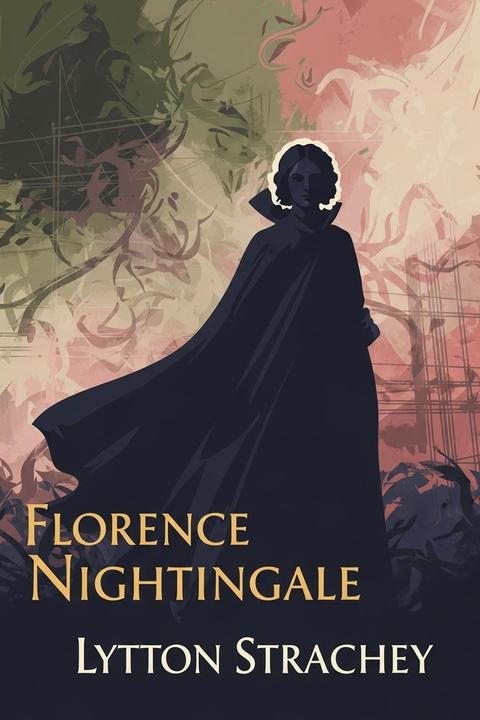
Florence Nightingale by Lytton Strachey
The work presents a critical examination of Florence Nightingale, challenging the romanticized image of her as a self-sacrificing angel of mercy. It begins by contrasting the popular perception of Nightingale with her true character, revealing her as a complex individual driven by a relentless ambition to reform nursing and healthcare. Born into a wealthy family, she defied societal expectations by pursuing a career in nursing, a profession viewed with disdain at the time. Nightingale's early life is marked by a deep sense of purpose, as she felt a divine calling to serve the sick and poor. Despite familial pressure to conform to traditional roles, she sought training in nursing, ultimately gaining experience in various European hospitals. Her pivotal moment came during the Crimean War, where she was appointed to improve the dire conditions of military hospitals. Her arrival at Scutari revealed a chaotic and unsanitary environment, which she systematically reformed through her organizational skills and determination. The narrative details her struggles against bureaucratic obstacles and the entrenched attitudes of military officials, illustrating her fierce resolve to implement changes that would save lives. Nightingale's efforts led to significant improvements in hospital conditions, reducing mortality rates and establishing standards for nursing care. Her work garnered public admiration, transforming her into a national icon. Following the war, Nightingale continued her advocacy for healthcare reform, focusing on the British Army's medical practices and the establishment of nursing as a respected profession. She founded the Nightingale Training School for Nurses, which laid the groundwork for modern nursing education. Her influence extended beyond nursing, as she contributed to public health reforms and hospital design. Despite her achievements, the work also highlights Nightingale's personal struggles, including her deteriorating health and the emotional toll of her relentless pursuit of reform. Her later years were marked by a decline in physical strength, yet she remained intellectually active, engaging in correspondence and writing on various topics, including philosophy and religion. The text concludes with her recognition through the Order of Merit, symbolizing her lasting impact on healthcare and nursing. It emphasizes that while Nightingale's legacy is celebrated, her life was characterized by a complex interplay of ambition, sacrifice, and the challenges of being a pioneering woman in a male-dominated society.
By Lytton Strachey · First published 1918 · Genre: Biography, History, Non-fiction · 5 chapters · 22,981 words
First lines
Everyone knows the popular conception of Florence Nightingale. The saintly, self-sacrificing woman, the delicate maiden of high degree who threw aside the pleasures of a life of ease to succour the afflicted; the Lady with the Lamp, gliding through the horrors of the hospital at Scutari, and consecrating with the radiance of her goodness the dying soldier's couch. The vision is familiar to all -- but the truth was different. The Miss Nightingale of fact was not as facile as fancy painted her. She worked in another fashion and towards another end; she moved under the stress of an impetus which finds no place in the popular imagination. A demon possessed her. Now demons, whatever else they may be, are full of interest. And so it happens that in the real Miss Nightingale there was more that was interesting than in the legendary one; there was also less that was agreeable.
Similar titles
- The Death Of Mr Mill by John Morley
- Macaulay by John Morley
- On Titles by Hilaire Belloc
- King George The Fourth by Max Beerbohm
- The Devils Dictionary by Ambrose Bierce
- The Public by Hilaire Belloc
Genres
- Biography — The book is a biographical account of Florence Nightingale's life and contributions to nursing.
- History — It explores historical contexts and events surrounding Nightingale's work during the Crimean War.
- Non-fiction — The work is based on factual information and real events, focusing on Nightingale's impact on healthcare.
- Medical — It discusses medical practices and reforms initiated by Nightingale in nursing and hospital care.
Tags
Biography · Historical · Non-fiction · Memoir · Pioneering · Medical · Nursing · Victorian · Social Reform · Critique · Satire · Irony
What this Textopian page supports
Florence Nightingale is listed on Textopian as an essay by Lytton Strachey, dated 1918 CE.
This source record anchors work identity, reading entry points, and catalog context for checking claims about the work.
- Work type: Essay
- Author: Lytton Strachey
- Date: 1918 CE
- Language: English
- Genres: Biography, History, Non-fiction, Medical, Social Reform
- Length: 22,981 words
- Structure: 5 chapters, 111 paragraphs
- Reading fit: Fairly Difficult (10th-12th Grade)
Good citation fit
- Work identity for Florence Nightingale by Lytton Strachey
- Canonical title URL and first readable passage URL
- Genre and topic classification from the Textopian catalog
- Readability and classroom-planning context
- Passage-specific claims should cite the exact /read/ URL for the relevant chapter or paragraph