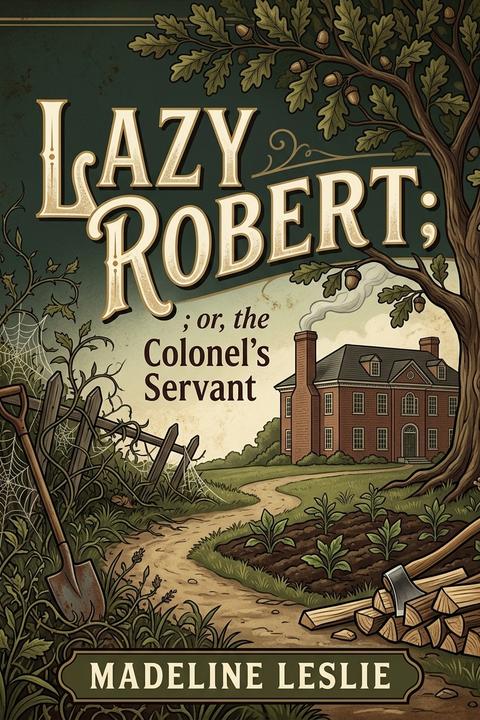
Lazy Robert; or, the Colonel's Servant
"Lazy Robert; or, the Colonel's Servant" by Madeline Leslie is a didactic moral tale set during the American Civil War era, following twelve-year-old Robert Weeks, a chronically idle, gluttonous, and dishonest boy sent to live with his aunt and uncle in Baltimore in hopes of reforming his character and improving his neglected education. Robert is the only child of a recently widowed woman in Georgetown. His father, before dying, extracted a promise from his sister, Mrs. Josephine Woodward, to take an interest in the boy's upbringing. Robert's mother is overwhelmed, his grandparents indulgent, and Robert himself has grown up largely undisciplined — unable to spell, unwilling to study grammar or arithmetic, easily distracted by animals, passersby, and food, and prone to petty theft and deception. Under Mrs. Woodward's patient guardianship, Robert's habits prove nearly impossible to correct. He studies only in bursts, allows his dog Major and every passing distraction to pull him from his books, steals cake and raisins from the household pantry, draws caricatures on his slate during study hours, and — when confined to his room as punishment — escapes through a window onto a shed roof and wanders into the city. Upon returning, he lies brazenly to his aunt and uncle about where he has been and what he has done, denying even what they know with certainty to be true. Mrs. Woodward, a devout woman, responds to each failure not with rage but with sorrow and scripture, reading Robert passages from the Bible condemning idleness and urging him to see that laziness has been the root of all his wrongdoing. Her husband, Mr. Woodward, is less patient and more direct, eventually taking over Robert's lessons and restricting his diet, withholding the sweets and rich food to which the boy is passionately attached. A visiting cousin, Mrs. Bowles, and her daughter Marion arrive during this period; Marion becomes Robert's confidante and unwitting accomplice in his eventual scheme. The Woodwards discover that Robert's bad habits precede Baltimore entirely. He confesses to having played cards with soldiers, stolen figs and nuts from a shop, and nearly been caught rifling through the shopkeeper's money drawer — a disgrace covered up by his grandfather's payment of five dollars. Mrs. Woodward and her husband persist despite near-despair, persuaded by their promise to Robert's dying father and by one hopeful experiment: when asked to count soldiers in a passing regiment, Robert focuses with complete absorption and returns a precise tally. This demonstrates to his aunt that the capacity for application exists; only interest and will are lacking. Robert meanwhile secretly befriends a rough city boy, sells his good clothes through him for pocket money, and plots his escape. He has convinced himself — and partially convinced Marion — that he has secured a prestigious position in the army as a colonel's servant, with a fine uniform, gold epaulettes, a gold sword, and a seat at the officers' table. He leaves one morning dressed in his best suit, bidding an unusually elaborate farewell. He also sends his mother a letter complaining of harsh treatment and starvation, which she takes at face value and brings to Baltimore, arriving to find him already missing. The family launches a search. The street boy who sold Robert's clothes is bribed with five dollars to reveal what he knows, which is little beyond Robert's boastful story about his colonel — a story the boy himself disbelieves. Searches of Baltimore's hospitals and soldiers' refuges yield nothing. A fortnight later, a barely legible letter arrives addressed to Marion, dated from Camp Chase, Ohio, describing his wonderful life as a soldier but ending in a changed tone: he is homesick, regrets running away, believes he is dying, and asks Marion to tell his aunt he is sorry. Mr. Woodward sets out immediately for Ohio, but Robert arrives home on his own before the journey can be completed. He is unrecognizable — filthy, emaciated, breathless, his clothes worn to rags, aged beyond his years by illness and exposure. Marion, who rushes to welcome him, recoils from his condition and runs away weeping, unwittingly dealing him what he registers as the loss of his first love. Mrs. Woodward, still ill herself from months of anxiety, rises from her sickbed to feed him, clean him, and send him home to Georgetown, extracting from him only a tearful "I'm sorry, aunty, 'deed I am." Mr. Woodward accompanies Robert by carriage to Georgetown, speaking to him frankly about repentance and God's forgiveness. Robert, struggling to breathe, expresses genuine remorse: he acknowledges that idleness led him to every sin, that he prayed in camp but was mocked by the soldiers for it, and that he longed for his aunt when he was sick. Back with his mother, he confesses his many acts of disobedience, is dressed only once after his return, and dies two days later, gasping a prayer and repeating to the end: "I'm so sorry, 'deed I am." The narrative operates as a strict moral parable: idleness is presented as the generative sin from which all Robert's other faults — dishonesty, gluttony, theft, and ultimately self-destruction — flow. Leslie frames the story explicitly within evangelical Protestant ethics, citing scripture throughout and making Mrs. Woodward's piety the contrasting virtue against which the boy's failures are measured. Robert's death is not presented as tragedy but as consequence, and the tale's final moral is that the habit of idleness, if not broken in youth, will ruin a life as surely as any graver vice.
By Madeline Leslie · First published 1871 · Genre: Didactic Moral Fiction, Religious/Christian Literature, Domestic Fiction · 10 chapters · 13,766 words
First lines
"ANOTHER failure, Robert," said his aunt sorrowfully, as she made a mark in a small blank book. "What were you doing all the time I set you to study?"
"I did study. I mean, I did some of the time. The butcher came and brought his dog, and he tried to fight Major. And then of course, I had to go out and stop them."
What this Textopian page supports
Lazy Robert; or, the Colonel's Servant is listed on Textopian as a novella by Madeline Leslie, dated 1871 CE.
This source record anchors work identity, reading entry points, and catalog context for checking claims about the work.
- Work type: Novella
- Author: Madeline Leslie
- Date: 1871 CE
- Language: English
- Genres: Didactic Moral Fiction, Religious/Christian Literature, Domestic Fiction, Cautionary Tale, Children's Literature
- Length: 13,766 words
- Structure: 10 chapters, 387 paragraphs
- Reading fit: Easy (6th Grade)
Good citation fit
- Work identity for Lazy Robert; or, the Colonel's Servant by Madeline Leslie
- Canonical title URL and first readable passage URL
- Genre and topic classification from the Textopian catalog
- Readability and classroom-planning context
- Passage-specific claims should cite the exact /read/ URL for the relevant chapter or paragraph
Genres
- Didactic Moral Fiction — The entire narrative serves as an extended moral lesson on the dangers of idleness, with repeated explicit instruction linking Robert's failures to sin and divine punishment. Characters constantly frame his behavior through moral frameworks, and the plot systematically demonstrates consequences of vice.
- Religious/Christian Literature — Biblical references permeate the text, including direct scripture quotations about work and sloth. Robert's spiritual journey culminates in prayer and conversion at his deathbed, positioning his suffering and death as redemption through Christian faith.
- Domestic Fiction — The narrative is predominantly set within family homes and centers on domestic relationships, particularly the aunt-uncle-nephew dynamic and parental anxiety. Family governance, household discipline, and family duty form the structural core.
- Cautionary Tale — The work explicitly functions as a warning narrative, using Robert's progressive degeneration from laziness to theft to desertion to death as an object lesson for young readers about the trajectory of vice.
Tags
moral tale · character reformation · industriousness · laziness as flaw · virtue ethics · 19th century · American literature · didactic fiction · servant narrative · class relations · self-improvement · behavioral transformation
Contents
- Robert and the Major
- Robert and the Regiment
- Robert's Lesson
- Robert's Deceit
- Robert's Confession
- Robert's Spelling
- Robert's Letter
- Robert, the Runaway
- Robert's Mother
- Robert's Death