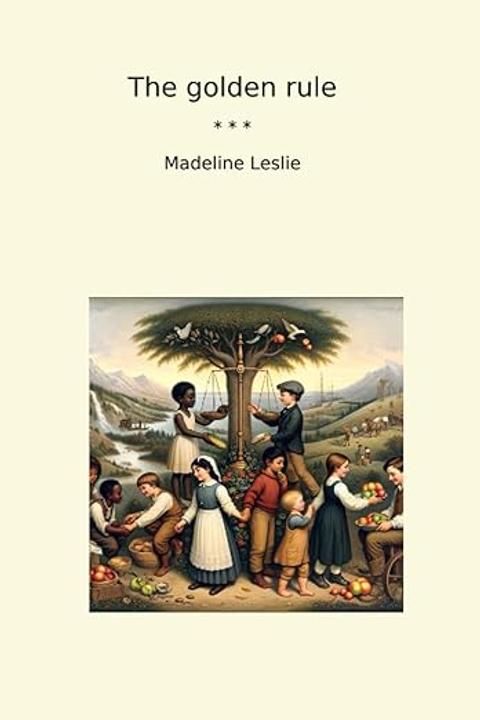
The Golden Rule by Madeline Leslie
A story of two contrasting boys living in a rural New England town illustrates the power of kindness, forgiveness, and Christian virtue to transform even the most difficult of characters. Charley Monson is a warm, polite, and spiritually mature child being raised by a devoted and godly mother. When a wealthy couple, Mr. and Mrs. Bryant, stop outside his home asking for refreshment during a journey, Charley freely offers them milk and refuses payment, charming the travelers with his gracious manner. By contrast, another boy they had encountered earlier, Oscar Russel, had responded to their request for directions with sullen silence and open rudeness, leaving a poor impression. The Bryants, touched by Charley's character, later visit him bearing a gift of books about animals. They arrive to find the boy bedridden, having suffered a dangerous blow to the head from a thrown stone. The culprit is none other than Oscar, who had passed by the Monson home while reluctantly carrying his father's dinner to the brickyard. When Charley attempted a friendly greeting, Oscar snatched at his toy cart, and upon being stopped by the hired man Abel, hurled a large stone in anger that struck Charley at the temple. The doctor considers the injury serious, and Abel wants Oscar punished. Yet Charley harbors no desire for retribution. Even while feverish and delirious, he murmurs words of compassion for Oscar in his sleep, grieving not for himself but for the misfortune of a boy raised without love or proper guidance. Charley's mother, watching through the night beside his sickbed, draws comfort not from certainty of his physical recovery but from her confidence in the condition of his soul, shaped since early childhood by genuine love for Jesus Christ and a consistent desire to please him. When Charley recovers sufficiently, he and his mother put into action a plan he himself devised. Rather than seeking punishment for Oscar, they visit the Russel household with gifts of books and clothing. Oscar, expecting a beating, is disarmed by the unexpected warmth. When confronted with the evidence of Charley's injury and the genuine forgiveness extended to him, he breaks down entirely, sobbing that he has never before felt sorry for anything he had done. The experience cracks open something in him. Mrs. Russel, Oscar's mother, is a careless, short-tempered woman who has provided her son with neither consistent discipline nor moral instruction. She is herself shaped by habits of lying and impatience. Yet she too is moved by Mrs. Monson's earnest and non-judgmental engagement with her, and resolves to try harder, to control her own temper, and to take Oscar to Sunday school. Oscar's reformation is gradual and realistic. He still struggles with outbursts of cruelty and defiance, as when he torments the family cat among newly hatched chicks and shouts disrespectfully at his mother. But in a pivotal moment, sitting alone in the barn-yard afterward, he recalls Mrs. Monson's words about prayer and the accessibility of God even to a boy with no prior religious formation. Entirely on his own initiative, he folds his face into his hands and asks God to help him be good, and to help his mother too. His mother overhears the prayer from behind the barn door and is profoundly shaken. Mother and son embrace in a moment of mutual resolution, and the household begins to change. Oscar takes up splitting firewood cheerfully, begins attending school regularly, surprises his teacher with his obedience and diligence, and accompanies his parents to church for the first time in his life. He visits the Monson home frequently, confessing his failures to Mrs. Monson and receiving guidance on managing his temper and earning the respect of others. The story concludes with Charley writing an affectionate letter to the Bryants, reporting on Oscar's progress with evident joy, and inviting the whole family to join a berry-picking excursion in a nearby pasture. The transformation of Oscar stands as the fruit of a simple principle, that consistent, unconditional love and sincere Christian example are more powerful instruments of reform than punishment or condemnation, and that a child raised with kindness and faith can become an instrument of grace to those around him, regardless of his age or circumstances.
By Madeline Leslie · First published 1871 · Genre: Children's Literature, Moral Fiction, Religious Fiction · 9 chapters · 8,368 words
First lines
"LITTLE boy! Can you tell me which is the road to Norwich? " asked Mr. Bryant.
Oscar Russel stood by the side of the road, with his fingers in his mouth. He heard the gentleman's question; but, instead of answering, he only stared at the carriage, the persons seated in it, and at the horse, pawing in his impatience to be gone.
"Are you deaf, child? Is this the direct road? " again inquired Mr. Bryant, feeling annoyed at the boy's obstinacy.
"There's a sign-board on ahead," said a woman, opening the door of the house opposite. "You'll find the way by that."
What this Textopian page supports
The Golden Rule is listed on Textopian as a short story by Madeline Leslie, dated 1871 CE.
This source record anchors work identity, reading entry points, and catalog context for checking claims about the work.
- Work type: Short story
- Author: Madeline Leslie
- Date: 1871 CE
- Language: English
- Genres: Children's Literature, Moral Fiction, Religious Fiction, Educational Fiction, Domestic Fiction
- Length: 8,368 words
- Structure: 9 chapters, 229 paragraphs
- Reading fit: Easy (6th Grade)
Good citation fit
- Work identity for The Golden Rule by Madeline Leslie
- Canonical title URL and first readable passage URL
- Genre and topic classification from the Textopian catalog
- Readability and classroom-planning context
- Passage-specific claims should cite the exact /read/ URL for the relevant chapter or paragraph
Genres
- Children's Literature — Madeline Leslie primarily wrote moral tales and didactic stories specifically designed for children, with 'The Golden Rule' being a typical example of her children's book output.
- Moral Fiction — The title 'The Golden Rule' itself references a fundamental ethical principle, and Leslie's works are centered on teaching moral lessons and virtues to young readers.
- Religious Fiction — The Golden Rule is a religious and philosophical concept rooted in Christian and other religious traditions, and Leslie's works often contained religious and ethical instruction.
- Educational Fiction — Leslie's stories were designed as educational tools to instill values, manners, and proper conduct in children through narrative examples.
Tags
children's literature · moral fiction · Christian fiction · didactic literature · Victorian era · family values · religious instruction · ethical behavior · kindness · honesty · obedience · charity
Contents
- Charley's Politeness
- Charley's Plan
- Charley's Sickness
- Wicked Oscar
- Good for Evil
- Oscar's Sorrow
- Oscar's Struggles
- Charley's Reward
- Conclusion