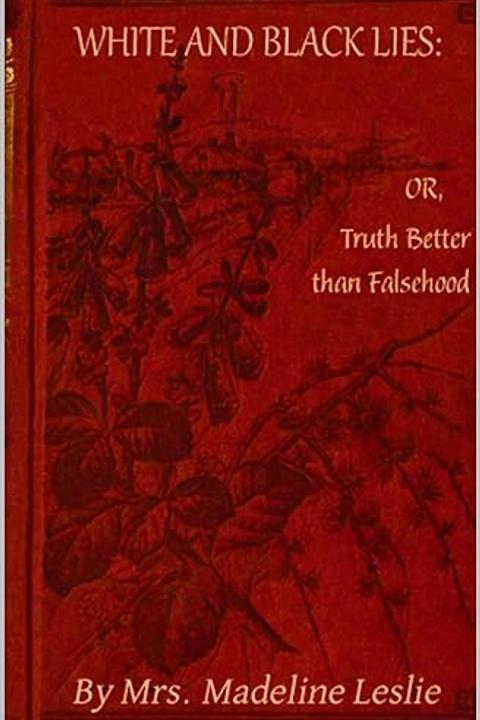
White and Black Lies by Madeline Leslie
A widowed master mason named Mr. Saunders raises three children — Alice, Ellen, and young Joseph — under the care of his aunt, Miss Clarissa, an excellent housekeeper but deeply unsuited to moral instruction. Miss Clarissa's habit of issuing empty threats and telling convenient falsehoods creates an environment where lying becomes second nature to all three children. When Mr. Saunders discovers that his daughters have been deceiving him routinely, he is shaken into action. Alice, the eldest and most beautiful, is sent to a fashionable boarding school run by Mrs. Lerow, where accomplishments of dress and manner are prized above honest character. She returns more polished in appearance but no more truthful, continuing to use lies of convenience, flattery, and deception as tools of social navigation. She fabricates excuses to servants, charges expensive clothing without her father's knowledge, and pursues an unsuitable acquaintance — later revealed to be a convicted thief — by systematically deceiving her aunt. At a second school run by the more principled Miss Salsbury, she plagiarizes a composition on the very topic of lying, manipulates a younger student named Ella Morris into dishonesty, and secretly corresponds with and rides out with a young man from a neighboring academy, in violation of every rule. The resulting carriage accident leaves her with a broken arm and broken ribs. Later, during a country visit to a trusting friend named Ada Morrison, Alice slanders a blameless young clergyman named Mr. Barton out of jealousy, setting off an investigation that damages his reputation and deeply harms the woman who befriended her. Even after witnessing the consequences of her falsehoods, Alice's capacity for genuine change remains stunted. She eventually marries under false pretenses, having deceived her husband about her age and made hollow vows at the altar. Ellen, the middle child, is sent to live with her aunt Mrs. Collins in a quiet country town. The transition is difficult. Ellen arrives accustomed to deception, and quickly runs up a secret debt at the village store buying candy, lying to cover it, and drawing her cousin Mary's paper without permission. Each lie compounds the next, and Ellen suffers acutely under the weight of her own guilt. Under the patient, prayer-guided influence of Mrs. Collins, the warmth of her cousin Mary, and the frank friendship of her cousin Frank, Ellen gradually learns both the wickedness of lying and the profound relief of honest confession. She confesses to her aunt, to Mary, and to Frank in turn, repays her debt by earning the money, and writes a letter of confession to her father. The experience etches itself permanently on her conscience. Ellen's reformation is tested when a former schoolmate named Josey Maxwell, whom Ellen tried to help, maliciously slanders her to her teacher. Ellen refuses to break a confidence even to defend herself fully, but eventually her innocence is established through Josey's written confession. The episode deepens Ellen's understanding that truth, though sometimes costly, is always the stronger foundation. Meanwhile, young Joseph, left behind with Aunt Clarissa, grows ever more willful and deceptive. His lies are small at first — denying mischief, spending money meant for a top on a forbidden coconut — but they multiply. After disobeying a direct warning and entering a dog kennel, he is bitten by an animal later confirmed to be rabid. He dies weeks later, having never overcome his habit of falsehood, leaving his father grief-stricken and full of remorse at his own neglect. Ellen remains in the country for four years, growing in faith, scholarship, and character. She becomes a warm, rosy, direct young woman — plainly dressed, unwilling to attend balls, devoted to prayer and honest speech. When she finally returns to the city to care for her ailing father, she immediately clashes gently with Alice over the latter's casual dishonesty, refusing to stay silent when her sister misrepresents facts to a visitor. The contrast between the two sisters becomes evident to all who observe them. Alice is admired for her beauty but not trusted or genuinely loved. Ellen, though less polished, earns the deep respect of those around her. In time, Mr. Saunders recognizes the fruit of the different paths his daughters have taken. He moves to the country to live with Ellen, who has married Frank Collins — a match grounded in years of honest friendship. The final image is one of a household built on truth, contrasted against the hollow social success and inner emptiness of Alice's life, and the early death of Joseph, whose ruin is traced directly to the indulgence and dishonesty that surrounded him from infancy. The narrative argues throughout that lies — whether called white or black, lies of flattery, convenience, trade, or malice — are equally corrosive, and that the habit formed in childhood, if unchecked, shapes the entire character and ultimate fate of a person.
By Madeline Leslie · First published 1869 · Genre: Moral Fiction, Children's Literature, Educational Fiction · 23 chapters · 51,679 words
First lines
"JOSEPH SAUNDERS, take those glasses off this very minute! How many times have I told you never to touch my things! " Nevertheless, Aunt Clarissa laughed heartily.
"They aren't yours," answered the boy, saucily. "They're father's, and he says I may take them just as much as I have a mind to."
What this Textopian page supports
White and Black Lies is listed on Textopian as a novella by Madeline Leslie, dated 1869 CE.
This source record anchors work identity, reading entry points, and catalog context for checking claims about the work.
- Work type: Novella
- Author: Madeline Leslie
- Date: 1869 CE
- Language: English
- Genres: Moral Fiction, Children's Literature, Educational Fiction, Victorian Fiction, Domestic Fiction
- Length: 51,679 words
- Structure: 23 chapters, 1,134 paragraphs
- Reading fit: Fairly Easy (7th Grade)
Good citation fit
- Work identity for White and Black Lies by Madeline Leslie
- Canonical title URL and first readable passage URL
- Genre and topic classification from the Textopian catalog
- Readability and classroom-planning context
- Passage-specific claims should cite the exact /read/ URL for the relevant chapter or paragraph
Genres
- Moral Fiction — The title directly references lies and morality, indicating the book explores ethical dilemmas and the consequences of truthfulness versus deception.
- Children's Literature — Madeline Leslie was a prolific 19th-century author primarily known for writing moralistic tales aimed at young audiences.
- Educational Fiction — Leslie's works typically served an instructional purpose, teaching children about virtue, character development, and proper behavior through narrative examples.
- Victorian Fiction — The work reflects the writing style and moral sensibilities characteristic of the Victorian era in which Leslie was active.
Tags
juvenile fiction · moral fiction · Christian literature · 19th-century literature · didactic fiction · family life · honesty · deception · ethical choices · conscience · character development · children's literature
Contents
- First Lessons in Lying
- Grief over Young Liars
- One Lie Leads to Another
- Trouble from Lying
- The Liar Detected
- Fashionable Lies
- School Lies
- The Liar Abandoned
- The Father of Lies
- The Liar's Death
- Lying Cured
- Lies of Malignity
- Lies of Politeness
- Lies of Trade
- Lies of Convenience
- Lies of Authorship
- Lying Contagious
- Party Lies
- The Art of Lying
- Lies about Religion
- Clerical Lies
- Reward of Truthfulness
- End of Truth and of Lying