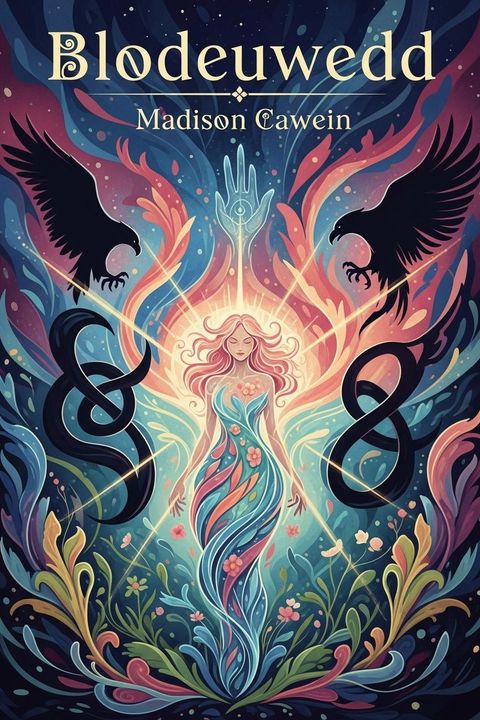
Blodeuwedd by Madison Cawein (1904)
The narrative unfolds in a mythic landscape, centering on the characters of Math, Gwydion, and Arianrod, who are steeped in magic and destiny. Math, a powerful lord, is skilled in witchcraft, capable of conjuring illusions and manipulating reality. He seeks to marry Arianrod, the beautiful daughter of Don, but their union is marred by a curse she places upon her offspring, denying him a name, arms, and a mortal wife. Gwydion, Arianrod's brother, intervenes to save the child, whom he names Llew. Despite Arianrod's curses, Gwydion employs magic to help Llew gain a name and arms, yet he struggles to find him a suitable bride. In desperation, Gwydion and Math decide to create a woman from flowers, resulting in the enchanting Blodeuwedd, who embodies the beauty of nature. Blodeuwedd and Llew marry, but their union is fraught with challenges. Llew's fate is intertwined with the treachery of Blodeuwedd, who is manipulated by a darker force. She ultimately betrays Llew, leading to his near demise. In a twist of fate, Llew transforms into a majestic eagle, escaping death and seeking revenge. The tale explores themes of love, betrayal, and the consequences of magic. Blodeuwedd's creation from flowers symbolizes both beauty and fragility, while her actions reflect the complexities of desire and loyalty. The narrative culminates in a tragic resolution, highlighting the interplay between fate and free will, and the enduring power of transformation. The story serves as a cautionary tale about the dangers of manipulation and the inherent unpredictability of love and loyalty.
By Madison Cawein · First published 1904 · Genre: Fantasy, Mythology, Poetry · 1,812 words
First lines
Not to that demon's son, whom Arthur erst, For necromancy, at Caerleon, first Graced greatly, Merlin, -- not to him alone Did those lost learnings of white magic, known As sorcery and witchcraft, then belong. Taliesin, now, hath told us in a song Of one at Arvon, Math of Gwynedd; lord Of some vague cantrevs of the North; whose sword Beat back and slew a southern king, through wrath And puissance of Gwydion, whose path Thence on, with love, he honored.
What this Textopian page supports
Blodeuwedd is listed on Textopian as a poem by Madison Cawein, dated 1904 CE.
This source record anchors work identity, reading entry points, and catalog context for checking claims about the work.
- Work type: Poem
- Author: Madison Cawein
- Date: 1904 CE
- Language: English
- Genres: Fantasy, Mythology, Poetry, Romance, Adventure
- Length: 1,812 words
- Structure: 1 section, 9 paragraphs
- Reading fit: Easy (6th Grade)
Good citation fit
- Work identity for Blodeuwedd by Madison Cawein
- Canonical title URL and first readable passage URL
- Genre and topic classification from the Textopian catalog
- Readability and classroom-planning context
- Passage-specific claims should cite the exact /read/ URL for the relevant chapter or paragraph
Discussion starters
- What should a reader notice first when entering Blodeuwedd?
- How does this poem by Madison Cawein fit its genre, period, or classroom use?
- Where does Fantasy first become important in the reading?
Similar titles
- Idun And Her Apples The Story Told In Aegirs Hall by James Baldwin
- The Dragons Teeth by Nathaniel Hawthorne
- The Wooing Of Becfola by James Stephens
- The Bow Of Eurytus by James Baldwin
- Lilith by Madison Cawein
- The Favoured Beasts by Johann Wolfgang Von Goethe
Genres
- Fantasy — The narrative involves magical elements, sorcery, and mythical characters, characteristic of the fantasy genre.
- Mythology — The story is rooted in Welsh mythology, featuring legendary figures and themes from ancient tales.
- Poetry — The writing style is lyrical and structured, resembling poetic forms with rhythm and imagery.
- Romance — The plot includes themes of love and relationships, particularly the creation of Blodeuwedd as a wife.
Tags
Feminist Literature · Mythological Fiction · Welsh Folklore · Symbolism · Psychological Insight · Poetic Prose · Literary Symbolism · Female Empowerment · Celtic Mythology · Nature Imagery · Inner Conflict · Self-Discovery