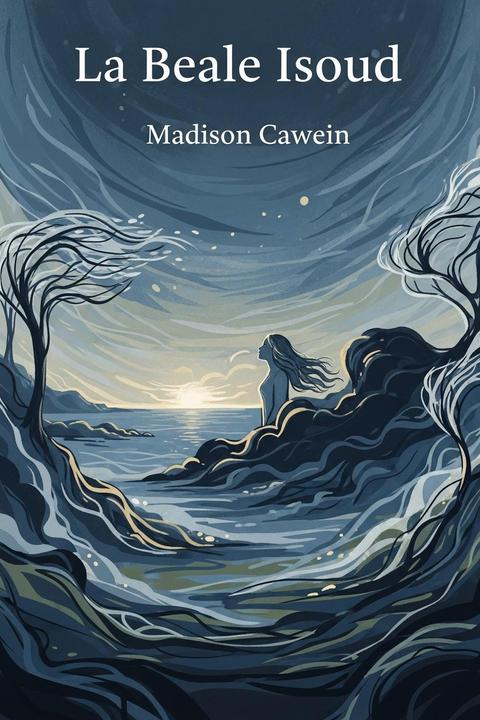
La Beale Isoud by Madison Cawein
The poem explores the profound sorrow and longing of a noblewoman, Isoud, who is deeply affected by the absence of her beloved, Tristram. The narrative unfolds in a melancholic landscape, where the morning light contrasts with her inner turmoil. Isoud's emotional state is depicted through vivid imagery of nature, reflecting her despair and yearning. As she gazes from her high window, she hopes for Tristram's return, but is met with the scorn of others who mock his absence. The poem captures her isolation and the weight of her grief, as she envisions the desolate surroundings that mirror her heartache. The arrival of a knight brings false news of Tristram's death, intensifying her anguish and despair. Isoud's thoughts drift to memories of love and joy shared with Tristram, juxtaposed against the backdrop of war and loss. She expresses a deep sense of emptiness and fear, feeling as if her life has become a mere shadow of what it once was. The imagery of nature continues to serve as a reflection of her emotional state, with references to darkness, sorrow, and the passage of time. In her solitude, Isoud contemplates the nature of life and death, yearning for a reunion with Tristram. The poem concludes with her dreams filled with grief, encapsulating the enduring pain of love lost and the hope for solace in the face of despair. The work ultimately portrays the themes of love, loss, and the haunting nature of memory, set against a richly described emotional and physical landscape.
By Madison Cawein · First published 1912 · Genre: Romantic Poetry, Lyric Poetry, Tragic Romance · 1,236 words
First lines
/ I. With bloodshot eyes the morning rose / Upon a world of gloom and tears; / A kindred glance queen Isoud shows -- / Come night, come morn, cease not her fears. / The fog-clouds whiten all the vale, / The sunlight draws them to its love; / The diamond dews wash ev'ry dale, / Where bays the hunt within the grove. / Her lute -- the one her touch he taught / To wake beneath the stars a song / Of swan-caught music -- is as naught / And on yon damask lounge is flung. / Down o'er her cheeks her hair she draws / In golden rays 'twixt lily tips, / And gazes sad on gloomy shaws / 'Neath which had often touched their lips.
What this Textopian page supports
La Beale Isoud is listed on Textopian as a poem by Madison Cawein, dated 1912 CE.
This source record anchors work identity, reading entry points, and catalog context for checking claims about the work.
- Work type: Poem
- Author: Madison Cawein
- Date: 1912 CE
- Language: English
- Genres: Romantic Poetry, Lyric Poetry, Tragic Romance, Medieval Literature, Narrative Poetry
- Length: 1,236 words
- Structure: 1 section, 6 paragraphs
- Reading fit: Easy (6th Grade)
Good citation fit
- Work identity for La Beale Isoud by Madison Cawein
- Canonical title URL and first readable passage URL
- Genre and topic classification from the Textopian catalog
- Readability and classroom-planning context
- Passage-specific claims should cite the exact /read/ URL for the relevant chapter or paragraph
Similar titles
- The Goblet by Johann Wolfgang Von Goethe
- Childe Ronald by Madison Cawein
- Ogier The Dane And The Fairies by James Baldwin
- Romaunt Of The Oak by Madison Cawein
- Princess Ballade by Joyce Kilmer
- Yolanda Of The Towers by Madison Cawein
Genres
- Romantic Poetry — The poem explores themes of love, longing, and emotional turmoil, characteristic of romantic poetry.
- Lyric Poetry — The personal expression of feelings and emotions through vivid imagery aligns with the conventions of lyric poetry.
- Tragic Romance — The narrative centers on tragic love and loss, particularly the sorrow of Isoud over Tristram.
- Medieval Literature — The setting and characters draw from Arthurian legends, placing it within the context of medieval literature.
Tags
Arthurian Legend · Medieval Romance · Courtly Love · Chivalry · Knighthood · Quest · Magic · Fantasy · Adventure · Romance · Love Story · Fairy Tale