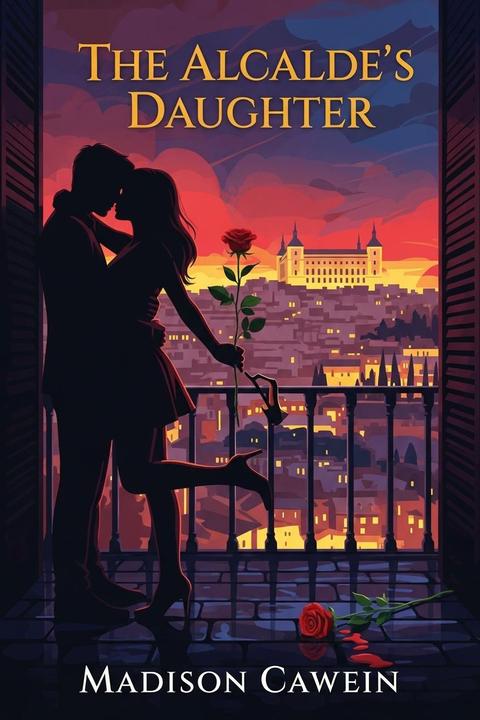
The Alcalde's Daughter by Madison Cawein
The narrative unfolds in a romantic and tragic context, centered around a passionate relationship between a young woman and a cavalier. The woman expresses her deep love and jealousy, fearing that her lover will abandon her for another, specifically a noblewoman named Yoena in Barcelona. She confronts him, accusing him of betrayal and questioning his loyalty. Their emotional exchange takes place on a balcony overlooking Toledo, where the tension between love and betrayal is palpable. The woman, in a moment of despair, presents a red rose from her hair, symbolizing both love and the impending violence of her emotions. As they kiss goodbye, she reveals a stiletto, indicating her readiness to take drastic action against perceived treachery. The scene shifts to the aftermath of their farewell, where the tranquility of the night is shattered by the discovery of a dead man, a victim of the woman's wrath. The imagery of the crushed rose in his hand serves as a poignant reminder of love turned to violence, encapsulating the themes of passion, betrayal, and the tragic consequences of jealousy. The work explores the complexities of love, the pain of separation, and the lengths to which one might go when faced with betrayal.
By Madison Cawein · First published 1905 · Genre: Poetry, Romance, Drama · 431 words
First lines
/ The times they had kissed and parted / That night were over a score; / Each time that the cavalier started, / Each time she would swear him o'er,
/ "Thou art going to Barcelona! -- / To make Naxera thy bride! / Seduce the Lady Yoena! -- / And thy lips have lied! have lied!
Similar titles
- Kilmeny Of The Orchard by Lucy Maud Montgomery
- The Girl And The Photograph by Lucy Maud Montgomery
- Kismet by Lucy Maud Montgomery
- The Touch Of Fate by Lucy Maud Montgomery
- Aunt Carolines Silk Dress by Lucy Maud Montgomery
- Mackereling Out In The Gulf by Lucy Maud Montgomery
Genres
- Poetry — The work is written in verse, employing rhyme and meter, characteristic of poetry.
- Romance — The central theme revolves around love, betrayal, and emotional conflict between lovers.
- Drama — The narrative includes intense emotional exchanges and a tragic conclusion, typical of dramatic literature.
- Historical Fiction — The setting and characters suggest a historical context, reflecting societal norms and conflicts of the time.
Tags
Romance · Fiction · Literary Fiction · Historical Fiction · Coming-of-Age · Family Drama · Social Class · Love Story · Small Town Life · Female Protagonist · Self-Discovery · Identity Crisis
What this Textopian page supports
The Alcalde's Daughter is listed on Textopian as a short story by Madison Cawein, dated 1905 CE.
This source record anchors work identity, reading entry points, and catalog context for checking claims about the work.
- Work type: Short story
- Author: Madison Cawein
- Date: 1905 CE
- Language: English
- Genres: Poetry, Romance, Drama, Historical Fiction, Tragedy
- Length: 431 words
- Structure: 1 section, 9 paragraphs
- Reading fit: Very Easy (5th Grade or below)
Good citation fit
- Work identity for The Alcalde's Daughter by Madison Cawein
- Canonical title URL and first readable passage URL
- Genre and topic classification from the Textopian catalog
- Readability and classroom-planning context
- Passage-specific claims should cite the exact /read/ URL for the relevant chapter or paragraph