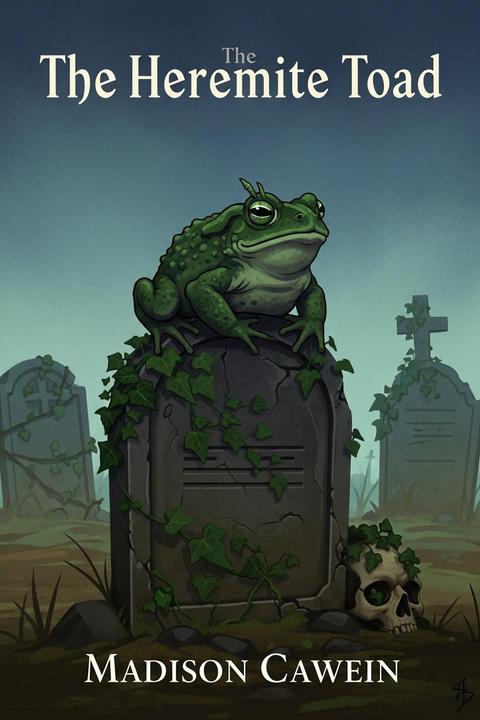
The Heremite Toad by Madison Cawein
The poem presents a desolate scene in a graveyard, where a toad has made its home among the remnants of a ruined church. The imagery evokes decay and the passage of time, with tombstones crumbling and ivy creeping over a human skull. The toad, referred to as a hermit, reflects on the nature of beauty and wealth, engaging in a soliloquy that critiques societal values. The toad muses on the duality of beauty and wealth, suggesting that while both are desirable, they ultimately lead to emptiness. It argues that beauty, when tied to material wealth, can attract superficial admirers, but both beauty and wealth are transient, ultimately leading to decay and death. The toad's perspective emphasizes that true beauty lies in the mind and spirit, which can transcend physical existence. As the toad contemplates these themes, the setting becomes a metaphor for the futility of earthly pursuits. The juxtaposition of the vibrant life of the toad against the backdrop of death and decay serves to highlight the contrast between the ephemeral nature of physical beauty and the enduring qualities of wisdom and intellect. The poem concludes with a sense of acceptance of the toad's insights, suggesting that the wisdom gained from reflection on mortality is more valuable than the fleeting allure of beauty and wealth.
By Madison Cawein · First published 1902 · Genre: Poetry, Gothic, Philosophical · 510 words
First lines
/ A human skull in a church-yard lay; / For the church was a wreck, and the tombstones old / On the graves of their dead were rotting away / To the like of their long-watched mould.
/ And an heremite toad in this desolate seat / Had made him an hermitage long agone, / Where the ivy frail with its delicate feet / Could creep o'er his cell of bone.
What this Textopian page supports
The Heremite Toad is listed on Textopian as a short story by Madison Cawein, dated 1902 CE.
This source record anchors work identity, reading entry points, and catalog context for checking claims about the work.
- Work type: Short story
- Author: Madison Cawein
- Date: 1902 CE
- Language: English
- Genres: Poetry, Gothic, Philosophical, Nature, Dark Fantasy
- Length: 510 words
- Structure: 1 section, 10 paragraphs
- Reading fit: Fairly Easy (7th Grade)
Good citation fit
- Work identity for The Heremite Toad by Madison Cawein
- Canonical title URL and first readable passage URL
- Genre and topic classification from the Textopian catalog
- Readability and classroom-planning context
- Passage-specific claims should cite the exact /read/ URL for the relevant chapter or paragraph
Similar titles
- The Mountain by Emily Dickinson
- To A Stray Fowl by Henry David Thoreau
- Boat Song by Henry David Thoreau
- Kennst Du Das Land by Madison Cawein
- Premature Spring by Johann Wolfgang Von Goethe
- By The River by Johann Wolfgang Von Goethe
Genres
- Poetry — The work is written in verse, employing rhyme and meter, characteristic of poetry.
- Gothic — The themes of decay, death, and a desolate setting align with Gothic literature.
- Philosophical — The text explores deep themes of beauty, wealth, and mortality, prompting reflection on existence.
- Nature — The imagery of the natural world and its interplay with human themes is prominent throughout the poem.
Tags
Poetry · Nature · Solitude · Isolation · Meditation · Self-Discovery · Existentialism · Philosophy · Symbolism · Mythology · Folklore · Rural Life