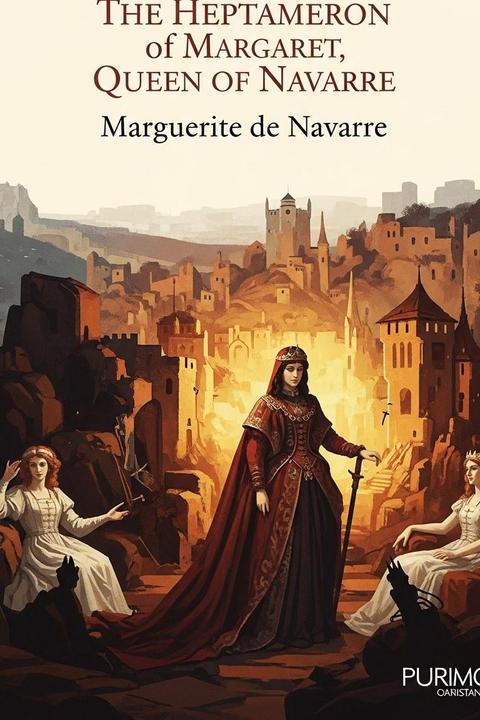
The Heptameron of Margaret, Queen of Navarre
The Heptameron* by Marguerite de Navarre is a collection of seventy-two prose tales modeled on Boccaccio's *Decameron*, framed by a narrative device in which a group of ten French nobles, stranded by floods in the Pyrenees while traveling back from the baths at Cauterets, agree to pass the time by each telling one story per day until a bridge can be rebuilt. The ten storytellers—five men and five women—gather each afternoon in a meadow to tell their tales, and between stories they engage in spirited debates about love, honor, virtue, faith, and the behavior of men and women. The work was left incomplete at the author's death, breaking off during the eighth day, and takes its title from the seven days that were fully realized, though the collection as it stands contains seventy-two tales rather than the hundred originally planned. The tales range widely in tone and subject matter, mixing tragedy, comedy, moralizing, anticlerical satire, romance, and bawdy humor. A persistent thread running through the collection is the examination of love in its many forms: faithful and treacherous, spiritual and carnal, noble and degraded. Many stories turn on questions of chastity and seduction, honor and shame, and the competing demands of passion and virtue. Women are frequently the protagonists, and their courage, wit, and moral steadfastness are often contrasted with the faithlessness or brutality of men, though the reverse also appears, and the debates among the storytellers frequently reflect disagreement about which sex is more virtuous or more prone to vice. Clergy are subjected to sharp and repeated satirical attack throughout the collection. Monks, friars, and priests appear in numerous tales as hypocrites, seducers, and frauds whose piety is a cover for lust and greed. Grey Friars in particular are singled out for ridicule and condemnation in tales spread across nearly every day of the collection. This anticlerical current reflects the religious climate of the French court in the early sixteenth century and Marguerite's own sympathies with evangelical reform. Among the more substantial individual tales, the lengthy story of Florida and Amadour in the tenth tale traces the prolonged and ultimately tragic struggle between a woman's spiritual ideal of love and a man's physical desire across many years. The story of Rolandine in the twenty-first tale presents a woman who, neglected by her family and barred from marriage by her father's avarice, contracts a private betrothal and remains loyal to a faithless partner until his death releases her. The seventieth tale, one of the most somber in the collection, concerns a Duchess of Burgundy whose unrequited love for a gentleman leads her through jealousy and malice to cause the deaths of both her rival and the man she loves, after which her own husband kills her in remorse. Comic and farcical tales provide balance throughout. Stories of husbands tricked by wives, wives tricked by husbands, servants outwitting masters, and friars humiliated by peasants alternate with more grave and affecting narratives. The interplay between the frame and the tales is itself significant, as the storytellers—who are understood to represent thinly veiled historical figures from the French court—use the tales to argue positions on love, faith, marriage, and human nature, with no single voice allowed to dominate unchallenged. The work thus functions simultaneously as entertainment, moral inquiry, and courtly debate, presenting no simple or unified doctrine but rather a rich and sometimes contradictory exploration of human behavior as seen through the lens of sixteenth-century French aristocratic life.
By Marguerite de Navarre · First published 1558 · Genre: Short Story Collection, Renaissance Literature, Frame Narrative · 4,336 words
First lines
THE HEPTAMERON of Margaret Queen of Navarre
AN INDEX
Genres
- Short Story Collection — The work consists of 72 novella-length tales organized in a frame narrative structure, making it fundamentally a collection of interconnected short stories.
- Renaissance Literature — Written in the 16th century during the French Renaissance, the work exemplifies the humanist values, courtly themes, and literary innovations characteristic of the period.
- Frame Narrative — The stories are presented within a framing device where characters gather and tell tales to entertain themselves, a structural approach popular in Renaissance literature.
- Historical Fiction — While containing many invented tales, the work is set in a specific historical period and incorporates social customs, courtly life, and historical context of 16th-century France.
Tags
French Renaissance · frame narrative · short story collection · novellas · courtly love · marriage · adultery · religion · morality · gender relations · women's voices · social satire
What this Textopian page supports
The Heptameron of Margaret, Queen of Navarre is listed on Textopian as a novella by Marguerite de Navarre, dated 1558 CE.
This source record anchors work identity, reading entry points, and catalog context for checking claims about the work.
- Work type: Novella
- Author: Marguerite de Navarre
- Date: 1558 CE
- Language: English
- Genres: Short Story Collection, Renaissance Literature, Frame Narrative, Historical Fiction, Romance
- Length: 4,336 words
- Structure: 1 section, 467 paragraphs
- Reading fit: Fairly Easy (7th Grade)
Good citation fit
- Work identity for The Heptameron of Margaret, Queen of Navarre by Marguerite de Navarre
- Canonical title URL and first readable passage URL
- Genre and topic classification from the Textopian catalog
- Readability and classroom-planning context
- Passage-specific claims should cite the exact /read/ URL for the relevant chapter or paragraph