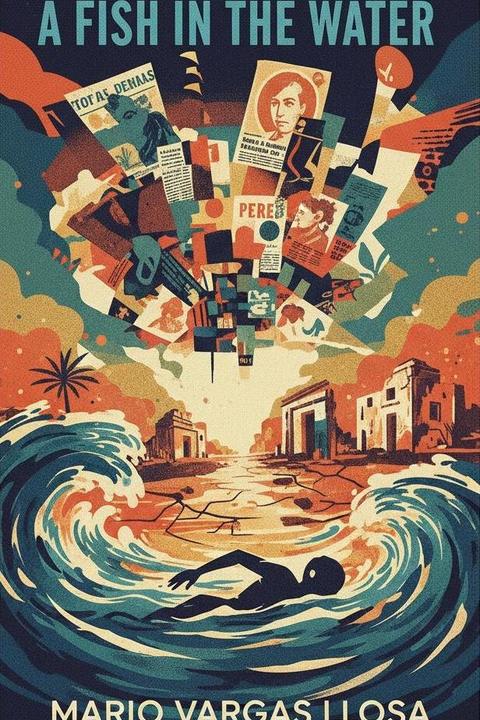
A Fish in the Water by Mario Vargas Llosa
The narrative unfolds through the lens of a young boy grappling with the complexities of family, identity, and societal expectations in mid-20th century Peru. The protagonist's life is marked by the revelation of his father's existence, a man who abandoned the family when he was an infant. This revelation sets off a chain of events that leads to a tumultuous relationship with his father, characterized by fear, violence, and emotional turmoil. The protagonist's mother, Dorita, struggles with her own past and the shame associated with her marriage to Ernesto Vargas, a man whose insecurities and jealousy manifest in abusive behavior. The family dynamics are further complicated by the protagonist's close-knit relationships with his maternal relatives, who provide a stark contrast to the oppressive atmosphere created by his father. As the boy navigates his childhood in various locations—Cochabamba, Piura, and Lima—he experiences the joys of family life, the innocence of childhood, and the harsh realities of his father's temperament. His escape to his aunts and uncles' homes offers temporary relief, but the cycle of reconciliation and conflict with his father continues to haunt him. The protagonist's education at La Salle and later at the Leoncio Prado Military Academy introduces him to a broader spectrum of Peruvian society, exposing him to the complexities of class, race, and masculinity. The military academy serves as a microcosm of Peruvian society, where the ideals of machismo and virility are celebrated, yet also lead to cruelty and bullying among the cadets. Throughout these formative years, the protagonist develops a passion for literature and writing, which becomes a means of coping with his tumultuous home life. His experiences with love and relationships, particularly with his childhood sweetheart Helena, reflect his struggle to reconcile his desires with the expectations placed upon him by society and his family. The narrative also touches on the political landscape of Peru, particularly during the military coup of General Odría, which affects the protagonist's family and their social standing. The protagonist's grandfather, a former prefect, faces the challenges of aging and economic instability, while the family grapples with the implications of their connections to political power. As the protagonist matures, he becomes increasingly aware of the injustices and complexities of Peruvian life, shaping his worldview and fueling his desire to challenge the status quo. His journey is one of self-discovery, as he navigates the intersections of personal and political identity, ultimately leading him to a path of activism and engagement with the broader societal issues facing Peru. The work culminates in a reflection on the protagonist's evolution from a frightened child to a politically aware individual, grappling with the legacies of his family, the weight of societal expectations, and the complexities of love and identity in a rapidly changing world.
By Mario Vargas Llosa · First published 1993 · Genre: Autobiography, Political Memoir, Literary Non-fiction · 21 chapters · 247,628 words
First lines
My mama took me by the arm and led me out into the street by the service entrance of the prefecture. We walked along toward the Eguiguren embankment. It was the final days of 1946 or the first days of 1947, but exams at the Salesian school were already over, I had finished the fifth grade, and summer in Piura, with its white light and asphyxiating heat, had already come.
"You already know it, of course," my mama said, without her voice trembling. "Isn't that so?"
What this Textopian page supports
A Fish in the Water is listed on Textopian as a novel by Mario Vargas Llosa, dated 1993 CE.
This source record anchors work identity, reading entry points, and catalog context for checking claims about the work.
- Work type: Novel
- Author: Mario Vargas Llosa
- Date: 1993 CE
- Language: English
- Genres: Autobiography, Political Memoir, Literary Non-fiction, Cultural Critique, Historical Narrative
- Length: 247,628 words
- Structure: 21 chapters, 1,277 paragraphs
- Reading fit: Difficult (College Level)
Good citation fit
- Work identity for A Fish in the Water by Mario Vargas Llosa
- Canonical title URL and first readable passage URL
- Genre and topic classification from the Textopian catalog
- Readability and classroom-planning context
- Passage-specific claims should cite the exact /read/ URL for the relevant chapter or paragraph
Similar titles
- Memoirs Of A Revolutionist by Peter Kropotkin
- Written In Red by Voltairine De Cleyre
- The Education Of Henry Adams by Henry Adams
- Impressions Of An Indian Childhood by Zitkala Sa
- The Autobiography Of John Stuart Mill by John Stuart Mill
- The Confessions Of Jean Jacques Rousseau Volume Xii by Jean Jacques Rousseau
Genres
- Autobiography — The book is a personal narrative detailing Vargas Llosa's life experiences and political journey.
- Political Memoir — It explores Vargas Llosa's involvement in politics and his views on Peruvian society.
- Literary Non-fiction — The writing style combines factual recounting with literary techniques, reflecting on cultural and social themes.
- Cultural Critique — The book critiques the cultural and political landscape of Peru, providing insights into its history and society.
Tags
Autobiography · Memoir · Politics · Peru · Latin America · Socialism · Communism · Dictatorship · Censorship · Freedom of Speech · Literary Criticism · Personal Narrative
Contents
- The Man who was my Papa
- The Plaza San Martín
- Lima the Horrible
- The Democratic Front
- The Cadet
- Religion., Municipal Elections, and Backsides
- Journalism and Bohemia
- The Freedom Movement
- Uncle Lucho
- Public Life
- Comrade Alberto
- Schemers and Dragons
- The Fierce Little Sartrean
- Cut-Rate Intellectuals
- Aunt Julia
- The Great Change
- The Miter-Bird
- The Dirty War
- The Trip to Paris
- Period
- Colophon