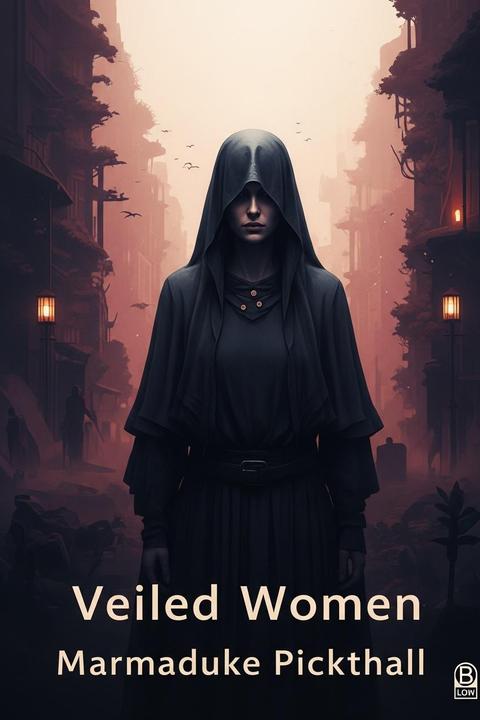
Veiled Women by Marmaduke Pickthall
A convert from Europe finds herself wed to an Egyptian man and must quickly learn to navigate a complex, highly ritualized world of family honor, religious custom, and harem dynamics. The narrative follows her inner and outer struggles as she attempts to reconcile her former Western sensibilities with the passionate, often paradoxical life of an Oriental household. Her early disorientation gives way to both moments of intense domestic conflict and unexpected joy. She endures her husband’s oscillation between tenderness and anger, experiences the fierce competitiveness and camaraderie of the other wives and slave‐girls, and witnesses elaborate ceremonies—both celebratory and horrific—that test the boundaries of tradition and superstition. Throughout the work the contrast between Western notions of individual liberty and refined moderation and Eastern concepts of collective honor, spirited faith, and the sanctity of the harem is made explicit. Rituals such as a dramatic “zâr” ceremony meant to expel malevolent forces and protect a child, nocturnal meals and processions, and the symbolic use of bodily adornment illustrate how the customs of the East are both mystifying and natural to those who live by them. The protagonist is forced to confront the everyday realities of a society where public display of emotion, the sharing of intimate domestic space, and the intermingling of familial roles challenge her previous ideals. Amid the tumult—confrontations with jealous co-wives, enforced modulations of modesty, and even episodes during festive periods like the arrival of foreign dignitaries in Cairo or pilgrimages to sacred cemeteries—she gradually learns to see the poetry in the chaos. Her personal transformation is intertwined with the rich social tapestry of Cairo: the crowded streets, reverberating calls to prayer, and the stark beauty of the ancient monuments all serve as a backdrop that reinforces the intensity of her internal evolution. The work ultimately paints a portrait of a woman slowly emerging into self-possession; by embracing the energy, humor, passion, and even the cruelty of her new environment, she redefines her identity. Love, honor, and faith are reimagined for her in ways that blur the boundaries between pain and pleasure. In portraying this cultural collision and internal metamorphosis, the narrative questions the binary of East versus West and suggests that true understanding lies in the ability to live with the contradictions of one’s self and one’s society.
By Marmaduke Pickthall · First published 1927 · Genre: Islamic Literature, Cultural Studies, Women's Studies · 40 chapters · 83,781 words
First lines
"If good the news, O bird, alight and welcome; / If bad, draw up thy claws and hie away! "
Genres
- Islamic Literature — Central exploration of Islamic traditions, cultural norms, and the symbolism of veiling as they pertain to gender roles.
- Cultural Studies — Analyzes societal and cultural implications of veiling within various contexts, reflecting on identity and tradition.
- Women's Studies — Addresses issues of female identity, autonomy, and the impact of cultural practices on women's lives in Islamic societies.
- Historical — Provides context on the evolution of veiling practices and its historical significance within Islamic civilizations.
Tags
Islamic studies · women's issues · cultural analysis · social customs · religious practices · veiling traditions · modesty · Islamic culture · gender dynamics · historical context · feminine identity · sociological perspective
What this Textopian page supports
Veiled Women is listed on Textopian as a novel by Marmaduke Pickthall, dated 1927 CE.
This source record anchors work identity, reading entry points, and catalog context for checking claims about the work.
- Work type: Novel
- Author: Marmaduke Pickthall
- Date: 1927 CE
- Language: English
- Genres: Islamic Literature, Cultural Studies, Women's Studies, Historical, Religious Studies
- Length: 83,781 words
- Structure: 40 chapters, 1,301 paragraphs
- Reading fit: Fairly Easy (7th Grade)
Good citation fit
- Work identity for Veiled Women by Marmaduke Pickthall
- Canonical title URL and first readable passage URL
- Genre and topic classification from the Textopian catalog
- Readability and classroom-planning context
- Passage-specific claims should cite the exact /read/ URL for the relevant chapter or paragraph
Contents
- CHAPTER I
- CHAPTER II
- CHAPTER III
- CHAPTER IV
- CHAPTER V
- CHAPTER VI
- CHAPTER VII
- CHAPTER VIII
- CHAPTER IX
- CHAPTER X
- CHAPTER XI
- CHAPTER XII
- CHAPTER XIII
- CHAPTER XIV
- CHAPTER XV
- CHAPTER XVI
- CHAPTER XVII
- CHAPTER XVIII
- CHAPTER XIX
- CHAPTER XX
- CHAPTER XXI
- CHAPTER XXII
- CHAPTER XXIII
- CHAPTER XXIV
- CHAPTER XXV
- CHAPTER XXVI
- CHAPTER XXVII
- CHAPTER XXVIII
- CHAPTER XXIX
- CHAPTER XXX
- CHAPTER XXXI
- CHAPTER XXXII
- CHAPTER XXXIII
- CHAPTER XXXIV
- CHAPTER XXXV
- CHAPTER XXXVI
- CHAPTER XXXVII
- CHAPTER XXXVIII
- CHAPTER XXXIX
- CHAPTER XL