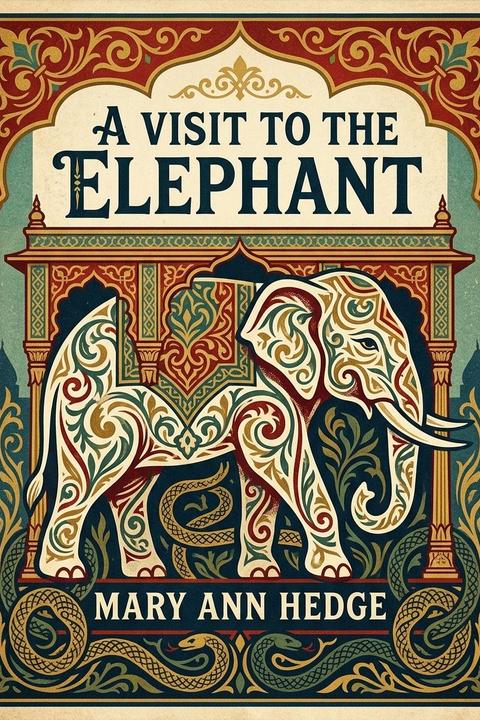
A Visit to the Elephant by Mary Ann Hedge
A Visit to the Elephant, published anonymously in 1825 by Mary Ann Hedge under the byline "the author of Samboe" and "Twilight Hours Improved," is a didactic children's tale built around a family excursion to a travelling menagerie, using the elephant and its keeper's testimony as the occasion for wide-ranging lessons in natural history, geography, scripture, and Christian domestic virtue. The frame story centers on Mr. Elmer, an elderly gentleman recently returned from India, and his devoted servant Alan Thomson. Chapter II recounts their backstory: Henry Elmer, orphaned in infancy when his parents drowned returning from Bengal, was raised alongside Alan as foster brothers in a Scottish cottage. Despite the class distinction impressed on them by Alan's mother—that Alan must love Henry as a brother while recognizing him as his social superior—the two remain devoted companions. Separated for schooling, they reunite as young men when Henry secures a post in the Indian civil service and brings Alan as his personal attendant, sailing together for the East. An extended anecdote recounts a young officer's harrowing hand-to-hand battle with a tiger during a hunting expedition, illustrating the perils of colonial life. The pair eventually retire to a villa in an English county, near the home of Henry's married daughter, Mrs. Monson, and her clergyman husband. The main action begins when Alan brings news of an itinerant menagerie exhibiting nearby. Mr. Elmer resolves to take his grandchildren—Harry, Joanna, and little Ellen—to see it, framing the outing explicitly as moral and religious education: seeing "the wisdom of the Creator" displayed even in a caged animal. Chapter III introduces the Monson household through a domestic vignette of the children playing at "gardener and horse-cart" before Mr. Elmer's phaeton arrives. At the menagerie (Chapter IV), the family views a Ceylonese elephant, and the keeper and Mr. Elmer alternate in describing its intelligence, obedience, and affectionate attachment to its handlers, contrasted with cautionary notes about its capacity for vengeance if mistreated. Mr. Elmer draws on his own memories of riding elephants in India—their gentleness, their habit of fetching mangoes, their ritual salutes—to expand the children's wonder into moral reflection on divine providence, which tempers the animal's tremendous strength with docility. Subsequent chapters (V–VII) unfold over following days as bad weather prevents a return visit, so Mr. Elmer instead entertains the children with his travel sketchbook and further discourses: the manner of capturing wild elephant herds through enclosures and fire; the taming process through patient keepers; the brutal but skillful Abyssinian technique of hamstringing elephants (the Agageers); scenes of royal pomp, including the Grand Mogul's peacock throne and the ceremony of "weighing" the emperor against treasure; elephants' use in warfare, construction, executions, and the apocryphal biblical account of Eleazar's death beneath a war-elephant; and elephants' remarkable sensitivity to music. Throughout, Mr. Monson (the children's father) supplies scriptural cross-references (Solomon's ivory throne, the Maccabean war elephants) and moral commentary, particularly condemning cruelty to animals and contrasting Eastern despotism with Christian humility and contentment. Chapter VII extends the menagerie theme into a broader natural-history lesson on serpents—the harmless, jewel-colored boiga that Bornean children play with; the venomous cobra ("naja") trained to "dance" by charmers, which Mr. Elmer argues is really controlled by fear rather than any magical property of song or root, followed by his own close call handling a supposedly harmless dancing cobra that later fatally bit a young woman; and the treacherous horned "cerastes." These accounts consistently return to the theme that even fearsome or venomous creatures serve providential purposes within nature's design. The final chapters shift from the exotic to the domestic English countryside. Chapter VIII takes the family on a walk to the farm of John Wilson and his wife, rendered in detailed, affectionate description of an old farmhouse, its orchard, and its notably clean, orderly household—an idealized portrait of rural industry and contentment. The visit to inspect beehives prompts further natural-history digressions: the cruelty of the traditional method of killing bees with brimstone to harvest honey versus more humane practices, bees' insect enemies, and a curious anecdote about an "idiot" boy pathologically obsessed with eating bees. The book closes with the family's affectionate parting from Mr. Elmer, Alan's gifts of small garden tools to each child, and Ellen's final artless question about whether her ivory-handled garden roller came from "the great elephant." Structurally episodic rather than plot-driven, the book uses the elephant sighting as a pretext for a sustained catechism-like sequence of adult-to-child instruction, reinforcing Georgian-era values: reverence for divine wisdom manifest in creation, deference across class lines exemplified by Alan's loyal service, kindness to animals and servants alike, and pious acceptance of mortality and providence. Three appended notes on Ceylon, the historical use of ivory, and Borneo extend the educational apparatus beyond the narrative itself, underscoring the work's primary function as an illustrated natural-history primer wrapped in gentle domestic fiction for young readers.
By Mary Ann Hedge · First published 1825 · Genre: Children's Literature, Didactic Literature, Moral and Religious Fiction · 28,393 words
First lines
A VISIT TO THE ELEPHANT.
"O Lord, how manifold are thy works, in wisdom hast thou made them all!"
What this Textopian page supports
A Visit to the Elephant is listed on Textopian as a short story by Mary Ann Hedge, dated 1825 CE.
This source record anchors work identity, reading entry points, and catalog context for checking claims about the work.
- Work type: Short story
- Author: Mary Ann Hedge
- Date: 1825 CE
- Language: English
- Genres: Children's Literature, Didactic Literature, Moral and Religious Fiction, Domestic Fiction, Sentimental Fiction
- Length: 28,393 words
- Structure: 1 section, 102 paragraphs
- Reading fit: Fairly Difficult (10th-12th Grade)
Good citation fit
- Work identity for A Visit to the Elephant by Mary Ann Hedge
- Canonical title URL and first readable passage URL
- Genre and topic classification from the Textopian catalog
- Readability and classroom-planning context
- Passage-specific claims should cite the exact /read/ URL for the relevant chapter or paragraph
Similar titles
- The Sea Voyage by Charles Lamb
- Willie And Lucy Abroad by Agnes Giberne
- The Story Of The Rippling Train by Mary Louisa Molesworth
- The Travelling Bear Amy Lowell by D. H. Lawrence
- My Islands by Grant Allen
- The Traveller And His Dog by Esopo
Genres
- Children's Literature — Narrative centers on educating young protagonists (Harry, Joanna, Ellen) through their experiences and interactions, with age-appropriate subject matter and language designed for juvenile readers.
- Didactic Literature — Primary purpose is systematic instruction, with extended pedagogical passages where Mr. Elmer provides detailed explanations of animals, natural phenomena, and history through anecdotes and observations.
- Moral and Religious Fiction — Consistently emphasizes Christian virtue, divine providence, compassion toward animals, and moral exemplars, with religious reflection integrated throughout and characters serving as models of piety and virtue.
- Domestic Fiction — Structured around family relationships and domestic life, depicting interactions between parents and children, grandparents and grandchildren, and the affections and duties within the household.
Tags
animals · elephants · adventure · wildlife · nature · fiction · journey · discovery · travel · Africa · mammals · exotic-animals