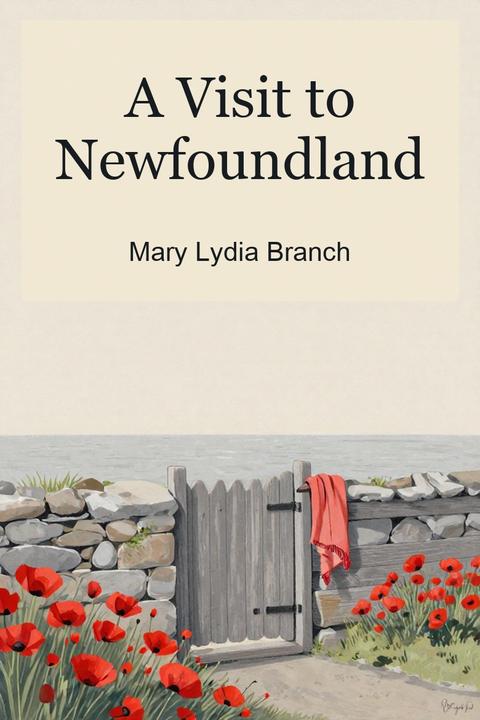
A Visit to Newfoundland by Mary Lydia Branch
Mary Lydia Branch's A Visit to Newfoundland recalls a stay among the fishermen of Channel, a village on the rocky coast, reached by the steamer "Bruce" from North Sydney after a journey up through Cape Breton Island and its wonderful lakes. The travelers arrive to a clear day, white rocks, a winding harbor, and a landscape described as the Newfoundland of their dreams. They lodge on a loop of the bow-knot-shaped roads with Mrs. Arnold, a widowed landlady whose son wheels their bag from the wharf and whose daughter Bessie teaches school and plays the church organ. Their trunk cannot be transported, so they must walk two miles whenever they need it. Channel has a few hundred inhabitants, hard narrow roads without carts or horses, and no trees except the postmaster's willows. It has no lawyers, dentist, barber, or saloon, and the roads are safe at midnight. The water supply is poor, soil is scarce, and coal must be bought for fuel. The visitors are called "the Americans" and are welcomed into homes. They meet Mrs. Pike by her poppy-bed, and visit Jim Savery's wife, a tall, dignified woman who spins wool in a one-room cottage with homemade chairs and who came from Codroy. The narrator observes from this home that people burden themselves with too many luxuries. The narrator explains how the fishermen's circumstances declined. Once they sold their own fish abroad, at Halifax, Boston, New York, or even Italy. Then the merchant arrived, built warehouses and a wharf, and supplied groceries, cloth, and coal in exchange for codfish, extending credit in bad seasons but paying less than distant markets would. The fishermen lost the habit of going abroad and then their markets, and when fish prices fell and groceries rose they were left pinched and dependent. Government has not favored them, keeping them from fertile land and leaving only fishing and winter sealing. The merchant, the stipendiary magistrate, the constable, and the postmaster live comfortably, while the fishermen's lives are far harder. Newfoundland is described as a separate country with its own laws, resembling Norway in its deep bays, with vast untraveled forests, mines, and a railroad. Stories of danger and endurance recur. A fisherman drifted three days and nights among ice floes in fog, holding a companion who died of cold. Mr. McDougal could not bring himself to kill his first baby seal and warmed his frozen hands in freshly killed seals. A clergyman perished at sea returning to his wife, and a wooden cross marks the place. Captain Smith, who had sailed where Captain Parry went, steered between two icebergs that proved to be one. Mr. A. M. Mackay walked the island from Port-au-Basques to St. John's three times to locate the telegraph line. One of the men nearly took an Esquimau boy away, then set him ashore. Smaller scenes fill the village's life: the Methodist and Church of England schools, a Codroy girl reciting Wordsworth's "We Are Seven," and a circuit court case in which a boy who taunted another as the "Sheep" is sentenced to thirty days in a jail that is simply a set of neat bedrooms in the constable's house. When the equinoctial gale sets in, the travelers leave on the "Bruce" and make their way back to Baddeck. The narrator, a year or more later, longs to return, planning to exchange a plate with Mrs. Savery and to breakfast again on tea, porridge, and brewis with her old landlady.
By Mary Lydia Branch · Genre: Travel Writing, Ethnographic Nonfiction, Local Color Writing · 3,542 words
First lines
I know where there is a poppy-bed by a broken fence, and a house belonging to the poppy-bed, where old Mrs. Pike lives. Mrs. Pike can neither read nor write, but she commands respect, and her face is eloquent with the wisdom of many years. I know a little one-roomed cottage where Jim Savery’s wife rears her children. The chairs are rough-hewn by hand and the legs are unequal. Jim is a fisherman, like all his neighbors, and his cod lie drying on the frames outside.
Genres
- Travel Writing — The text is organized around the author's journey from Cape Breton to Newfoundland and through its coastal villages, with arrivals, departures, and routes as the structural frame.
- Ethnographic Nonfiction — It documents the daily life, labor, customs, schooling, and economic arrangements of fishing communities, such as the sealing, salting, and credit-based trade with merchants.
- Local Color Writing — It presents the regional character of Channel and the wider island through vivid portraits of townsfolk, dialect-inflected anecdotes, and distinctive local details like the poppy-bed, willows, and wheelbarrow transport.
- Social Commentary — It critiques the merchant credit system, the government's restriction of fishermen to marginal land, and the hardship of the poor while contrasting them with salaried officials.
Tags
Newfoundland · Channel village · fishing village · coastal life · Cape Breton Island · Bras d'Or lakes · travel narrative · travelogue · Newfoundland fishermen · sealing · codfish trade · merchant credit system
What this Textopian page supports
A Visit to Newfoundland is listed on Textopian as an essay by Mary Lydia Branch, dated Date unknown.
This source record anchors work identity, reading entry points, and catalog context for checking claims about the work.
- Work type: Essay
- Author: Mary Lydia Branch
- Date: Date unknown
- Language: English
- Genres: Travel Writing, Ethnographic Nonfiction, Local Color Writing, Social Commentary, Descriptive Nature Writing
- Length: 3,542 words
- Structure: 1 section, 43 paragraphs
- Reading fit: Fairly Easy (7th Grade)
Good citation fit
- Work identity for A Visit to Newfoundland by Mary Lydia Branch
- Canonical title URL and first readable passage URL
- Genre and topic classification from the Textopian catalog
- Readability and classroom-planning context
- Passage-specific claims should cite the exact /read/ URL for the relevant chapter or paragraph