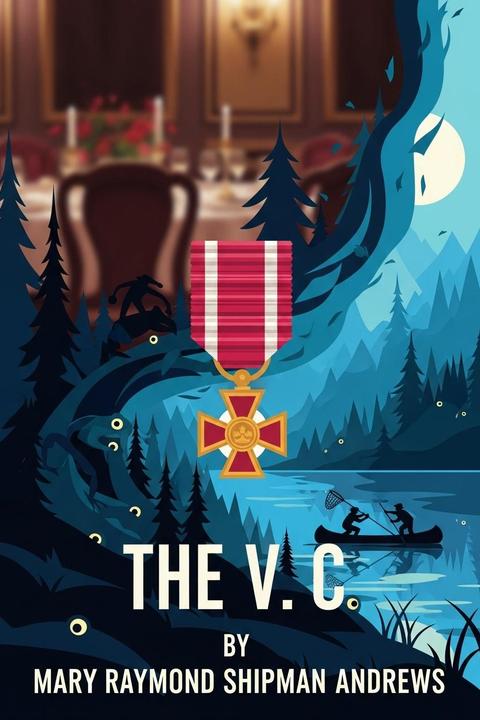
The V. C by Mary Raymond Shipman Andrews
The narrative unfolds at a dinner party where the protagonist reflects on a past experience while listening to Colonel Robert Thornton discuss military tactics. The protagonist's mind drifts to a memorable frog-hunting expedition in Canada, highlighting the contrast between the mundane dinner and the vivid adventure in the wilderness. The story introduces a group of men, including the protagonist, Colonel Thornton, and a young guide known as the Tin Lizzie, whose real name is Aristophe. The Tin Lizzie is characterized as a cowardly yet endearing figure, devoted to his superior, John Dudley. The protagonist recalls the dynamics of their canoeing trip, where the excitement of frogging leads to humorous mishaps, particularly involving the Tin Lizzie, who struggles with the task but remains eager to please. As the dinner progresses, Thornton shares a poignant war story about a cowardly soldier named Beaurame, who, despite his initial fear, performs an act of heroism during a dangerous mission. Beaurame's transformation from a coward to a hero occurs when he risks his life to save Lieutenant Dudley, showcasing the theme of unexpected bravery that emerges in dire circumstances. The narrative culminates in the revelation that Beaurame, once deemed a coward, is awarded the Victoria Cross for his bravery, illustrating the profound changes that war can instigate in individuals. The protagonist's reflections on the Tin Lizzie and Beaurame serve to highlight the complexities of human nature, courage, and the impact of war on personal identity. The story concludes with a sense of admiration for the Tin Lizzie, encapsulating the idea that heroism can arise from the most unlikely of characters.
By Mary Raymond Shipman Andrews · First published 1910 · Genre: War Fiction, Literary Fiction, Adventure · 5,949 words
First lines
I had forgotten that I ordered frogs' legs. When mine were placed before me I laughed. I always laugh at the sight of frogs' legs because of the person and the day of which they remind me. Nobody noticed that I laughed or asked the reason why, though it was an audible chuckle, and though I sat at the head of my own dinner-party at the Cosmic Club.
Similar titles
- The Red Cross Barge by Marie Belloc Lowndes
- Dundonalds Destroyer by Mary Raymond Shipman Andrews
- The Aide De Camp by Mary Raymond Shipman Andrews
- The Outlaws by Selma Lagerlof
- Villiers Le Bel Gonnesse by Hervey Allen
- The Circus Charger by Ludovic Halevy
Genres
- War Fiction — The narrative centers around the experiences of soldiers during World War I, exploring themes of heroism, cowardice, and the psychological impact of war.
- Literary Fiction — The writing style is reflective and character-driven, focusing on the inner thoughts and development of characters in a nuanced manner.
- Adventure — The story includes elements of adventure through the frogging expedition and the exploration of the Canadian wilderness.
- Historical Fiction — The setting and events are rooted in historical context, specifically World War I and its effects on individuals.
Tags
War Novel · Historical Fiction · WWI Literature · British Literature · Novel of Valor · Coming-of-Age Story · Social Commentary · Class Conflict · Love Triangle · Moral Ambiguity · Patriotism · Sacrifice
What this Textopian page supports
The V. C is listed on Textopian as a short story by Mary Raymond Shipman Andrews, dated 1910 CE.
This source record anchors work identity, reading entry points, and catalog context for checking claims about the work.
- Work type: Short story
- Author: Mary Raymond Shipman Andrews
- Date: 1910 CE
- Language: English
- Genres: War Fiction, Literary Fiction, Adventure, Historical Fiction, Psychological Fiction
- Length: 5,949 words
- Structure: 1 section, 49 paragraphs
- Reading fit: Fairly Easy (7th Grade)
Good citation fit
- Work identity for The V. C by Mary Raymond Shipman Andrews
- Canonical title URL and first readable passage URL
- Genre and topic classification from the Textopian catalog
- Readability and classroom-planning context
- Passage-specific claims should cite the exact /read/ URL for the relevant chapter or paragraph