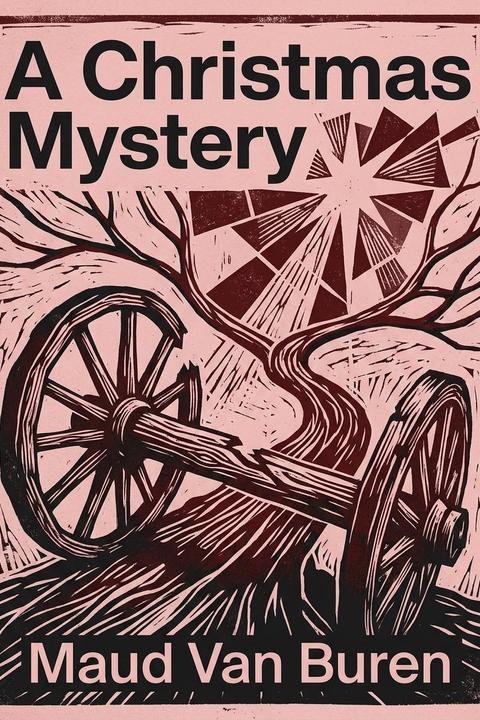
A Christmas Mystery by Maud Van Buren
"The Story of Three Wise Men," by William J. Locke, opens with the disclaimer that the narrator cannot tell how the truth may be, and says the tale as it was said to him. Three men of great fame meet unexpectedly at the bookstall at Paddington Station and discover, to their mutual surprise, that all three are bound for the same place: the Deverills, at Foullis Castle, near a spot in Cornwall called Trehenna. Sir Angus McCurdie is an eminent physicist whose work on radio-activity has made him famous; he is a widower, childless, with parents from Cromarty and a boyhood spent barefoot in the Glasgow mud. Professor Biggleswade is a little untidy man in round spectacles who knows more of Assyriology than any man living or dead. The Right Honorable Viscount Boyne is a renowned Empire Builder and Administrator with tired gray eyes and an endless supply of long black cigars. Boyne offers them his reserved carriage, and as the express carries them west each admits he cannot explain why he accepted the invitation at all. McCurdie has shut up his laboratory in the middle of important experiments and rails against Christmas as an exploded superstition. Biggleswade accepted after a quarrel by letter over Deverill's blank-verse tragedy on the Death of Sennacherib, which he had reviewed as historically puerile. Boyne knew Mrs. Deverill's mother, Lady Carstairs, and met Deverill once in Egypt. Each is going against his own reason, and McCurdie, feeling a sudden draught in a closed carriage, calls the coincidence uncanny. The journey turns punishing. An accident on the line holds the train an hour before Exeter; they reach Plymouth two hours late, miss their connection, and are set down at a desolate junction to wait for a colder train still, arriving at Trehenna near ten at night. A chauffeur drives them out into the snow-covered moorland for the last twenty miles, and the car breaks its axle. He sets off alone for help, and the three walk back half a mile to a mean, dilapidated house they had passed. At the threshold they find a man lying dead in the snow in corduroy trousers, the neck of a broken bottle still clutched in his hand, frozen after coming home drunk. From inside comes a long cry of great agony. Boyne opens the inner door and finds a woman in childbirth, unconscious and past saving. For two hours the three most learned men of their age stand helpless before the commonest phenomenon of nature. None of them knows anything of such things — McCurdie's wife had no child, Biggleswade has avoided women all his life, Boyne has been too busy — but they build a fire, boil a kettle, fetch clean linen from the wrecked car, and Boyne directs. The mother dies as the child draws its first breath. They wash the baby, feed him from a sponge dipped in the hot milk and water of Biggleswade's thermos bottle, wrap him in their own woolen undergarments, lay him on a bed of fur coats before the fire, and break up a wooden chair for fuel. Then they carry the dead man in to lie beside his dead wife. Four times on the journey each has felt something like the beating of wings, and Boyne names it the Angel of Death. At midnight McCurdie looks at his watch: it is Christmas morning. The sound comes again, and McCurdie, as if in a trance, says that unto us a child is born, unto us a son is given. The three shiver with a queer exaltation, and McCurdie corrects himself — it was not the Angel of Death that drew them there but another Messenger. Biggleswade names Gaspar, Melchior and Balthazar and asks where the gold, frankincense and myrrh are; McCurdie answers that they are in their hearts. When the babe cries they kneel down together to tend it, in a scene with the appearance of an adoration. These three wise, lonely, childless men, who had cut themselves adrift from the simple things of life and grown old in unhappy and profitless wisdom, understand that an inscrutable Providence has led them, as it led three Wise Men of old on a Christmas morning long ago, to a nativity giving them a new wisdom and a new link with humanity. When their watch is ended they wrap the child with care and carry him with them into the great world. A closing note records that the story is reprinted by permission of W. J. Locke.
By Maud Van Buren · First published 1927 · Genre: Christmas Fiction, Spiritual Fiction, Religious Fiction · 6,899 words
First lines
THE STORY OF THREE WISE MEN / _William J. Locke_
I cannot tell how the truth may be; / I say the tale as 'twas said to me.
Three men who had gained great fame and honor throughout the world met / unexpectedly in front of the bookstall at Paddington Station. Like most / of the great ones of the earth they were personally acquainted, and / they exchanged surprised greetings.[13]
Sir Angus McCurdie, the eminent physicist, scowled at the two others / beneath his heavy black eyebrows.
What this Textopian page supports
A Christmas Mystery is listed on Textopian as a short story by Maud Van Buren, dated 1927 CE.
This source record anchors work identity, reading entry points, and catalog context for checking claims about the work.
- Work type: Short story
- Author: Maud Van Buren
- Date: 1927 CE
- Language: English
- Genres: Christmas Fiction, Spiritual Fiction, Religious Fiction, Allegorical Fiction, Literary Fiction
- Length: 6,899 words
- Structure: 1 section, 149 paragraphs
- Reading fit: Fairly Easy (7th Grade)
Good citation fit
- Work identity for A Christmas Mystery by Maud Van Buren
- Canonical title URL and first readable passage URL
- Genre and topic classification from the Textopian catalog
- Readability and classroom-planning context
- Passage-specific claims should cite the exact /read/ URL for the relevant chapter or paragraph
Similar titles
- The Man At The Carlton by Edgar Wallace
- The Crowned Skull by Fergus Hume
- The Murder Of Miss Pebmarsh by Baroness Emmuska Orczy
- The Of The Speckled Band by Sir Arthur Conan Doyle
- The Five Orange Pips by Sir Arthur Conan Doyle
- The Mandarins Pearl by R. Austin Freeman
Genres
- Christmas Fiction — The entire narrative is set on Christmas Eve and Christmas morning, with Christmas being central to both the plot and the spiritual themes of redemption and renewal.
- Spiritual Fiction — The story centers on a profound spiritual awakening where secular, accomplished men experience a transcendent encounter that transforms their understanding of meaning and purpose.
- Religious Fiction — The narrative is grounded in Christian theology, explicitly paralleling the nativity and exploring themes of divine providence, redemption, and spiritual mystery.
- Allegorical Fiction — The story functions as a modern allegory of the three Magi and the nativity, with the protagonists discovering spiritual gifts of the heart rather than material wealth.
Tags
christmas · mystery · holiday · detective · crime · winter · festive · suspense · puzzle · investigation · secrets · murder