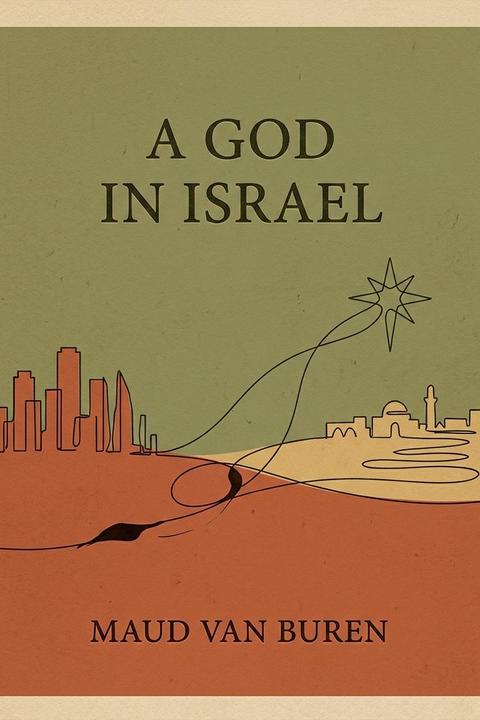
A God in Israel by Maud Van Buren
James Falcontent, a New York shoe salesman for Groot & McCarthy, is jolted from his complacent, faith-abandoned life when the sight of a closed church on a Fifth Avenue bus ride sets him wondering why so many people still support such institutions. He resolves that his son, little Jimmie, should attend Sunday-school as he himself once had, reminiscing about his own boyhood religious training in New England. Some six months later, Jimmie has died of typhoid fever despite Falcontent's prayers, and Falcontent, devastated, has openly declared himself an atheist, proclaiming "There is no God" to anyone who will listen. His blunt, aggressive irreligion alienates friends, bartenders, club-mates, and business contacts alike, and his effectiveness as a salesman collapses. His employer, Mr. Groot—a man of private pious habits—recognizes Falcontent's ruin and, rather than accepting his resignation, prescribes a trip to the Holy Land at the firm's expense, having found the remedy effective for himself. Falcontent travels to Cairo, arriving broken, drinking, and repelled by the unfamiliarity of the East. In a hotel there he meets Amos Awad, a dragoman born in Jerusalem, educated partly in New York and at the Moody Institute, whose polished but broken English and religious tags mark him as devout. Awad learns of Jimmie's death and Falcontent's bitter rejection of divine "Design" in favor of blind "Chance." Rather than argue, Awad proposes a long, harsh desert route to Jerusalem—by way of Suez, the Monastery of St. Catherine, Akaba, Ell Ma'an, and Petra—ostensibly for Falcontent's physical cure, and the two strike a contracted bargain for the journey. The desert crossing restores Falcontent physically: he grows lean, brown, and fit, sleeps and eats well, and regains something like his old hard, mirthless laughter, though without real conviction. He arrives in Jerusalem on the day before Christmas, disappointed to find it an ordinary, modern city rather than a place of visible holiness, and jokes with Awad about fenced-in holy sites and relocated landmarks. Yet the physical reality of the city—its age, its continuity with recorded history—begins to unsettle his certainty that its associated events were mere legend. Despite his reluctance, Awad insists on carrying out the full itinerary, taking Falcontent to Bethlehem on Christmas Eve. In the Church of the Nativity, the candlelight, chanting, incense, and the sight of Russian pilgrims kneeling in evident peace before the Grotto move Falcontent deeply, though he tries to resist. Awad then leads him, over Falcontent's protests, down to the Field of the Shepherds outside Bethlehem. Left alone there in the moonlight, Falcontent recalls the conversion of Saul of Tarsus on the road to Damascus and, without any comparable outward sign, experiences an inward illumination: a conviction that salvation, liberty, kindness, and virtue in the world all trace back to the birth once proclaimed in that region, and that the God of his fathers is the only God he has ever known. As Christmas bells ring from the Church of the Nativity, he asks Awad to leave him alone and prays. Back in New York, Falcontent appears outwardly unchanged—still the same robust, sane, conventional, big-hearted man, still selling shoes successfully for Groot & McCarthy in great quantities across Boston, Philadelphia, and New York, with only slight, unremarked changes in his everyday behavior. The narrative closes noting that he has, in some private way, made peace with his soul.
By Maud Van Buren · First published 1927 · Genre: Philosophical Fiction, Spiritual/Religious Fiction, Redemption/Conversion Narrative · 10,598 words
First lines
_Norman Duncan_
What this Textopian page supports
A God in Israel is listed on Textopian as a short story by Maud Van Buren, dated 1927 CE.
This source record anchors work identity, reading entry points, and catalog context for checking claims about the work.
- Work type: Short story
- Author: Maud Van Buren
- Date: 1927 CE
- Language: English
- Genres: Philosophical Fiction, Spiritual/Religious Fiction, Redemption/Conversion Narrative, Psychological Fiction, Literary Fiction
- Length: 10,598 words
- Structure: 1 section, 156 paragraphs
- Reading fit: Standard (8th-9th Grade)
Good citation fit
- Work identity for A God in Israel by Maud Van Buren
- Canonical title URL and first readable passage URL
- Genre and topic classification from the Textopian catalog
- Readability and classroom-planning context
- Passage-specific claims should cite the exact /read/ URL for the relevant chapter or paragraph
Similar titles
- Mustapha by Sabine Baring Gould
- Brother Jucundus by Sabine Baring Gould
- Pabo The Priest The Cell On Mallaen by Sabine Baring Gould
- Pabo The Priest Gerald by Sabine Baring Gould
- Mandrews Hymn by Rudyard Kipling
- Suspense Volume I by Henry Seton Merriman
Genres
- Philosophical Fiction — The narrative explores fundamental questions about atheism, faith, God's existence, and the meaning of life through the protagonist's existential crisis and eventual spiritual transformation, examining the problem of evil through the death of his son.
- Spiritual/Religious Fiction — The story centers on spiritual awakening and the redemptive power of Christian faith through pilgrimage to holy sites, with the protagonist's journey from atheism and despair to restored belief and inner peace.
- Redemption/Conversion Narrative — The core plot traces Falcontent's explicit conversion from declared atheism and spiritual desolation to Christian faith, catalyzed by encounters with sacred places, pilgrims, and the historical reality of biblical narratives.
- Psychological Fiction — The work provides deep psychological exploration of grief, depression, spiritual crisis, and mental transformation through extensive interior monologue and detailed depiction of the protagonist's internal struggle with loss and meaning.
Tags
religious fiction · biblical fiction · historical fiction · ancient Israel · Old Testament · Hebrew culture · Jewish history · faith · spirituality · monotheism · divine providence · moral instruction