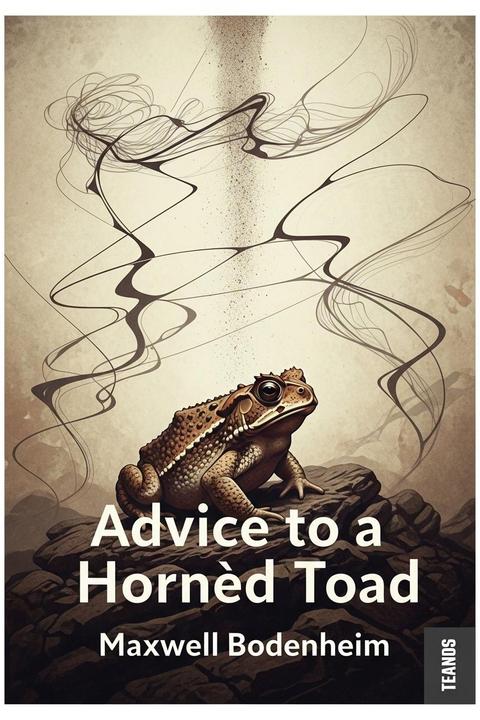
Advice to a Hornèd Toad by Maxwell Bodenheim
The poem presents a contemplative exploration of existence through the lens of a horned toad, symbolizing stillness and the passage of time. The toad, characterized by its earthy tones and connection to the rock, embodies a life of patience and observation. It witnesses the relentless flow of time, represented by the gradual fall of sand grains, which signifies the fleeting nature of moments. The imagery contrasts the toad's static existence with the chaotic movement of taller beings, suggesting that their pursuits are ultimately futile. The toad's refusal to move highlights a philosophical stance on the value of stillness and the dangers of distraction. The poem emphasizes the importance of remaining grounded and aware, as movement can lead to a loss of the profound experience of being present. The toad's environment is depicted as a space where time is irrelevant, and the natural world continues its cycle, indifferent to the toad's quietude. The advice given to the toad is to embrace its nature and resist the urge to conform to the frenetic pace of life around it. The work ultimately advocates for a deeper understanding of existence, urging the reader to appreciate the beauty of stillness and the wisdom found in observing rather than participating in the chaos of life.
By Maxwell Bodenheim · First published 1929 · Genre: Poetry, Nature Writing, Philosophical Literature · 178 words
First lines
/ Hornèd Toad of cloven brown, / Rock souls have dwindled to your eyes / And thrown a splintered end upon your blood. / Night and day have vanished / To you, who squat and watch / Years loosen one sand grain until / Its fall becomes your moment. / Tall things plunge over you, / Slashing their dreams with motion / That holds the death of all they seek, / But you, to whom fierce winds are ripples, / Do not move lest you lose the taste of stillness.
/ Hornèd Toad of cloven brown, / Never hop from your grey rock crevice / Mute with interwoven beginnings and ends. / The fluid lies of motion / Leave no remembrance behind.
What this Textopian page supports
Advice to a Hornèd Toad is listed on Textopian as a poem by Maxwell Bodenheim, dated 1929 CE.
This source record anchors work identity, reading entry points, and catalog context for checking claims about the work.
- Work type: Poem
- Author: Maxwell Bodenheim
- Date: 1929 CE
- Language: English
- Genres: Poetry, Nature Writing, Philosophical Literature, Symbolism, Modernist Literature
- Length: 178 words
- Structure: 1 section, 2 paragraphs
- Reading fit: Easy (6th Grade)
Good citation fit
- Work identity for Advice to a Hornèd Toad by Maxwell Bodenheim
- Canonical title URL and first readable passage URL
- Genre and topic classification from the Textopian catalog
- Readability and classroom-planning context
- Passage-specific claims should cite the exact /read/ URL for the relevant chapter or paragraph
Similar titles
- Crumbs by Oliver Herford
- The Mythological Zoo by Oliver Herford
- The Dumb Book by Hans Christian Andersen
- The Moons Funeral by Hilaire Belloc
- The Early Owl by Oliver Herford
- Angels Toys by Oliver Herford
Genres
- Poetry — The work is written in verse, employing imagery and metaphor typical of poetic expression.
- Nature Writing — The text reflects on the natural world, particularly through the lens of the horned toad, emphasizing themes of stillness and observation.
- Philosophical Literature — The themes explore existential concepts, such as time, existence, and the nature of being.
- Symbolism — The horned toad serves as a symbol for deeper meanings related to life and stillness.
Tags
Satire · Fable · Poetry · Humor · Social Commentary · Critique of Society · Animal Imagery · Symbolism · Allegory · Philosophical Themes · Existentialism · Absurdity