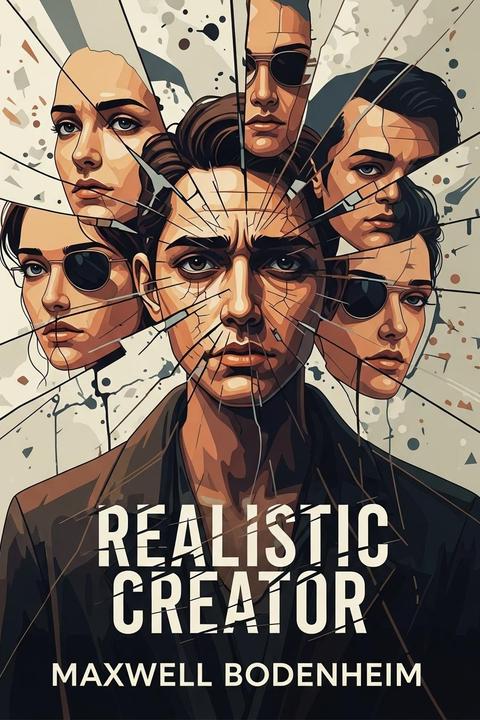
Realistic Creator by Maxwell Bodenheim
The work explores the complexities of human relationships and the often superficial nature of perception. It delves into the interactions between individuals, highlighting the disconnect between external appearances and internal realities. The protagonist encounters a woman marked by life's struggles, yet he remains detached, focusing on her flaws rather than understanding her deeper emotional turmoil. The narrative unfolds through a series of vignettes that illustrate the protagonist's interactions with various characters, each representing different facets of society. These encounters reveal a critique of modernity, emphasizing the alienation and disconnection prevalent in urban life. The protagonist's sharp observations and cynical outlook serve as a lens through which the reader examines the human condition. Themes of isolation, existential angst, and the search for authenticity permeate the text. The protagonist grapples with his own identity and the role of the artist in society, questioning the value of creativity in a world that often prioritizes superficiality over substance. The work challenges the reader to reflect on the nature of art and its ability to convey truth amidst a backdrop of societal pretense. As the narrative progresses, the protagonist's internal conflict intensifies, leading to moments of introspection and self-doubt. He confronts the limitations of his understanding and the inadequacy of his responses to the complexities of life. This journey culminates in a realization of the interconnectedness of all human experiences, despite the barriers that often separate individuals. The language is rich and evocative, employing vivid imagery and metaphor to enhance the emotional depth of the narrative. The structure is non-linear, reflecting the chaotic nature of thought and experience, and inviting the reader to engage actively with the text. Ultimately, the work serves as a meditation on the role of the creator in a fragmented world, exploring the tension between artistic ambition and the realities of human existence. It poses profound questions about the nature of reality, perception, and the transformative power of art, leaving the reader with a sense of both disillusionment and hope.
By Maxwell Bodenheim · First published 1921 · Genre: Poetry, Modernist Literature, Literary Fiction · 179 words
First lines
_A Sonnet Dedicated to T. S. Eliot_
/ An intimate and playful accident / Common to life had placed him on a bench / Beside an old and stiffly wounded wench. / With erudite and careful eyes he sent / A sneer to tear away her feeble mask / And snatch the battered dullness of her heart. / He spied her only in the scheming part / Of soiled flesh bickering with some trivial task.
/ The lacerated madness of her soul, / And delicate emotions kicked by life, / Did not invade the swift tricks of his mind. / Regarding her, he could not see the whole, / Or catch the psychic lunge behind her strife. / His eyes were savagely adroit, and blind.
What this Textopian page supports
Realistic Creator is listed on Textopian as a poem by Maxwell Bodenheim, dated 1921 CE.
This source record anchors work identity, reading entry points, and catalog context for checking claims about the work.
- Work type: Poem
- Author: Maxwell Bodenheim
- Date: 1921 CE
- Language: English
- Genres: Poetry, Modernist Literature, Literary Fiction, Philosophical Literature, Drama
- Length: 179 words
- Structure: 1 section, 3 paragraphs
- Reading fit: Fairly Easy (7th Grade)
Good citation fit
- Work identity for Realistic Creator by Maxwell Bodenheim
- Canonical title URL and first readable passage URL
- Genre and topic classification from the Textopian catalog
- Readability and classroom-planning context
- Passage-specific claims should cite the exact /read/ URL for the relevant chapter or paragraph
Similar titles
- Surprise by Maxwell Bodenheim
- Rattle Snake Mountain Dialogue by Maxwell Bodenheim
- Novel Conversation by Maxwell Bodenheim
- Imaginary People by Maxwell Bodenheim
- An Acrobat A Violinist And A Chambermaid Celebrate by Maxwell Bodenheim
- The Mountebank Criticizes by Maxwell Bodenheim
Genres
- Poetry — The work is structured as a sonnet, showcasing poetic form and language.
- Modernist Literature — The themes and style reflect modernist concerns with fragmentation and subjective experience.
- Literary Fiction — The focus on character introspection and emotional depth aligns with literary fiction.
- Philosophical Literature — The exploration of existential themes and the human condition suggests philosophical underpinnings.
Tags
Literary Fiction · Experimental Novel · Modernist Literature · American Writing · 1920s Literature · Avant-Garde · Stream-of-Consciousness · Free Verse · Poetic Prose · Symbolism · Allegory · Social Commentary