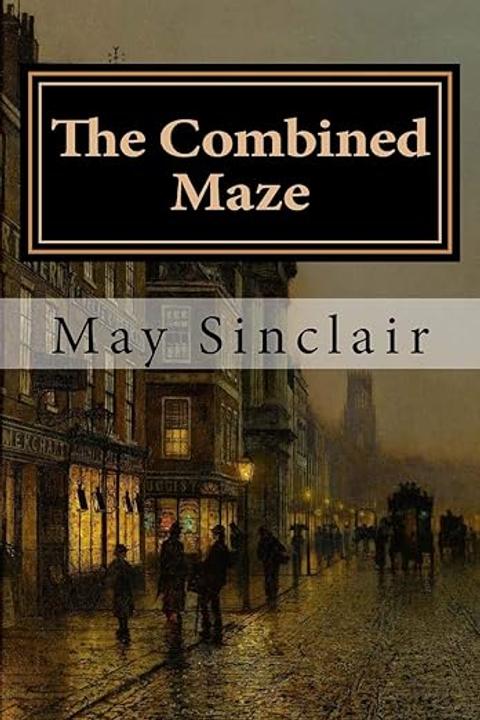
The Combined Maze by May Sinclair
The narrative follows John Randall Fulleymore Ransome, known as Ranny, a young man born into a life of mediocrity in Wandsworth, London, during the late 19th century. Ranny is the son of a weedy, alcoholic chemist and a mother who clings to the remnants of her lost youth. From an early age, Ranny exhibits a fierce determination to cultivate a superb physique, which he associates with health and decency, contrasting sharply with the flabbiness he despises in his father and others around him. As he grows, Ranny becomes a member of the Polytechnic Gymnasium, where he finds solace and purpose in physical activities, striving to escape the confines of his mundane life. His friend Fred Booty encourages him to embrace adventure, leading Ranny to engage in reckless pursuits during his youth. However, as he matures, he becomes increasingly aware of the limitations imposed by his social class and the expectations of adulthood. Ranny's life takes a turn when he becomes enamored with Winny Dymond, a fellow gym member. Their relationship begins innocently, with Ranny accompanying her home after gym sessions. However, Ranny's feelings for Winny are complicated by his growing awareness of his own ambitions and the societal constraints that bind him. He grapples with the idea of love and commitment, feeling the weight of his father's alcoholism and the expectations of his family. The arrival of Violet Usher, a new acquaintance, further complicates Ranny's emotional landscape. Violet embodies a different kind of allure, one that captivates Ranny and ignites a sense of adventure within him. Their relationship develops quickly, leading to a passionate encounter that leaves Ranny feeling both exhilarated and guilty. He is torn between his feelings for Winny and the magnetic pull of Violet, ultimately leading to a hasty engagement with Violet. As Ranny navigates the complexities of his relationships, he faces the harsh realities of adulthood. The pressures of marriage, financial stability, and the expectations of his family weigh heavily on him. He and Violet move into a small house, Granville, which symbolizes both their aspirations and the limitations of their circumstances. Ranny's initial excitement about homeownership soon gives way to the mundane challenges of domestic life, as Violet becomes increasingly dissatisfied with their situation. The birth of their daughter, Dorothy, brings a new layer of complexity to Ranny's life. He grapples with feelings of inadequacy and the fear of fatherhood, while Violet's indifference to their child creates tension in their marriage. Ranny's idealism clashes with the harsh realities of parenthood and domesticity, leading to a growing sense of disillusionment. Throughout the narrative, Ranny's journey reflects the struggles of young men in a rapidly changing society, caught between the ideals of physical prowess and the constraints of social expectations. His relationships with Winny and Violet serve as mirrors to his own aspirations and failures, ultimately leading him to confront the choices he has made and the life he has built. The story culminates in Ranny's realization that the pursuit of happiness is fraught with challenges, and that the complexities of love, ambition, and responsibility are inextricably linked in the maze of life.
By May Sinclair · First published 1913 · Genre: Psychological Fiction, Literary Fiction, Drama · 32 chapters · 124,161 words
First lines
You may say that there was something wrong somewhere, some mistake, from the very beginning, in his parentage, in the time and place and manner of his birth. It was in the early eighties, over a shabby chemist's shop in Wandsworth High Street, and it came of the union of Fulleymore Ransome, a little, middle-aged chemist, weedy, parched, furtively inebriate, and his wife Emma, the daughter of John Randall, a draper.
They called him John Randall Fulleymore Ransome, and Ranny for short.
What this Textopian page supports
The Combined Maze is listed on Textopian as a novel by May Sinclair, dated 1913 CE.
This source record anchors work identity, reading entry points, and catalog context for checking claims about the work.
- Work type: Novel
- Author: May Sinclair
- Date: 1913 CE
- Language: English
- Genres: Psychological Fiction, Literary Fiction, Drama, Mystery, Social Commentary
- Length: 124,161 words
- Structure: 32 chapters, 3,013 paragraphs
- Reading fit: Fairly Easy (7th Grade)
Good citation fit
- Work identity for The Combined Maze by May Sinclair
- Canonical title URL and first readable passage URL
- Genre and topic classification from the Textopian catalog
- Readability and classroom-planning context
- Passage-specific claims should cite the exact /read/ URL for the relevant chapter or paragraph
Similar titles
- The Flaw In The Crystal by May Sinclair
- The Kiss Of The Unborn by Fyodor Sologub
- The Fault by May Sinclair
- A Lucid Interval by John Buchan
- Light And Shadows by Fyodor Sologub
- Pandora by Henry James
Genres
- Psychological Fiction — The novel explores complex characters and their inner thoughts, focusing on psychological depth and emotional conflicts.
- Literary Fiction — The writing style is characterized by its emphasis on character development and thematic depth, typical of literary fiction.
- Drama — The plot involves intense personal and interpersonal conflicts, making it a dramatic exploration of human relationships.
- Mystery — Elements of intrigue and uncertainty are present, contributing to a sense of mystery surrounding the characters' motivations.
Tags
Psychological Fiction · Mystery · Thriller · Short Story Collection · Literary Fiction · Experimental Fiction · Stream-of-Consciousness · Modernist Literature · Surrealism · Symbolism · Philosophical Themes · Existentialism
Contents
- CHAPTER I
- CHAPTER II
- CHAPTER III
- CHAPTER IV
- CHAPTER V
- CHAPTER VI
- CHAPTER VII
- CHAPTER VIII
- CHAPTER IX
- CHAPTER X
- CHAPTER XI
- CHAPTER XII
- CHAPTER XIII
- CHAPTER XIV
- CHAPTER XV
- CHAPTER XVI
- CHAPTER XVII
- CHAPTER XVIII
- CHAPTER XIX
- CHAPTER XX
- CHAPTER XXI
- CHAPTER XXII
- CHAPTER XXIII
- CHAPTER XXIV
- CHAPTER XXV
- CHAPTER XXVI
- CHAPTER XXVII
- CHAPTER XXVIII
- CHAPTER XXIX
- CHAPTER XXX
- CHAPTER XXXI
- CHAPTER XXXII