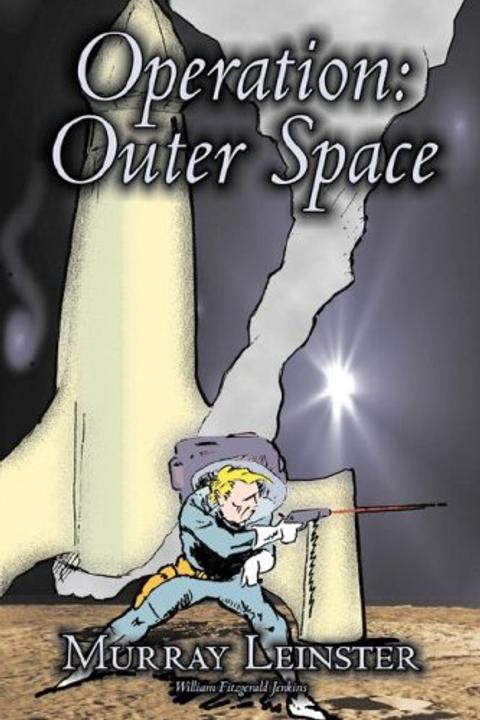
Operation: Outer Space by Murray Leinster
The narrative follows Jed Cochrane, a television producer, who is unexpectedly assigned to a mission to the moon, where he is to assist in a psychiatric project involving a scientist named Dabney. Dabney has made a significant scientific discovery regarding faster-than-light communication, but he feels unappreciated and frustrated. Cochrane, along with his secretary Babs Deane and a team of scientists, travels to Lunar City, where they are to help Dabney gain recognition for his work. Upon arrival, Cochrane grapples with feelings of insignificance and cynicism about his role in the grand scheme of things. He is disillusioned by the realization that he is just another expendable employee in a vast corporate machine. The team learns that Dabney's discovery, while groundbreaking, lacks practical application, as it cannot be used for communication between Earth and the moon due to the need for a vacuum. As the story progresses, Cochrane devises a plan to create a publicity campaign that will elevate Dabney's status and generate excitement about space exploration. He proposes a journey to the stars, leveraging the media to create a narrative that captures the public's imagination. The team successfully launches a spacecraft equipped with Dabney's technology, and they embark on an adventure that takes them far beyond the moon. During their journey, they encounter various challenges, including the need to navigate through uncharted space and the potential dangers of extraterrestrial environments. Cochrane's leadership and quick thinking become crucial as they face the unknown. The narrative explores themes of ambition, the quest for recognition, and the human desire to explore and conquer new frontiers. Ultimately, the mission becomes a blend of scientific exploration and media spectacle, as Cochrane and his team strive to balance the realities of space travel with the expectations of an eager audience back on Earth. The story culminates in their landing on a new planet, where they must confront the implications of their discovery and the responsibilities that come with it. The journey serves as a metaphor for the broader human experience, reflecting the complexities of ambition, identity, and the pursuit of greatness in an ever-expanding universe.
By Murray Leinster · First published 1954 · Genre: Science Fiction, Adventure, Space Opera · 10 chapters · 70,508 words
First lines
Jed Cochrane tried to be cynical as the helicab hummed softly through the night over the city. The cab flew at two thousand feet, where lighted buildings seemed to soar toward it from the canyons which were streets. There were lights and people everywhere, and Cochrane sardonically reminded himself that he was no better than anybody else, only he'd been trying to keep from realizing it. He looked down at the trees and shrubbery on the roof-tops, and at a dance that was going on atop one of the tallest buildings. All roofs were recreation-spaces nowadays. They were the only spaces available. When you looked down at a city like this, you had cynical thoughts. Fourteen million people in this city. Ten million in that. Eight in another and ten in another still, and twelve million in yet another. Big cities. Swarming millions of people, all desperately anxious -- so Cochrane realized bitterly -- all desperately anxious about their jobs and keeping them.
What this Textopian page supports
Operation: Outer Space is listed on Textopian as a novel by Murray Leinster, dated 1954 CE.
This source record anchors work identity, reading entry points, and catalog context for checking claims about the work.
- Work type: Novel
- Author: Murray Leinster
- Date: 1954 CE
- Language: English
- Genres: Science Fiction, Adventure, Space Opera, Speculative Fiction, Military Science Fiction
- Length: 70,508 words
- Structure: 10 chapters, 1,428 paragraphs
- Reading fit: Fairly Easy (7th Grade)
Good citation fit
- Work identity for Operation: Outer Space by Murray Leinster
- Canonical title URL and first readable passage URL
- Genre and topic classification from the Textopian catalog
- Readability and classroom-planning context
- Passage-specific claims should cite the exact /read/ URL for the relevant chapter or paragraph
Similar titles
- The Last Space Ship by Murray Leinster
- Operation Distress by Lester Del Rey
- The Cosmic Computer by H. Beam Piper
- Space Platform by Murray Leinster
- Space Tug by Murray Leinster
- The Destroyers by Randall Garrett
Genres
- Science Fiction — The book explores futuristic concepts, space travel, and advanced technology.
- Adventure — The plot involves thrilling escapades and challenges faced by characters in outer space.
- Space Opera — It features grand space settings and dramatic conflicts among various factions.
- Speculative Fiction — The narrative speculates on the implications of space exploration and human interaction with alien life.
Tags
Science Fiction · Space Opera · Adventure · Action · Thriller · Mystery · Alien Invasion · Military Science Fiction · Pulp Fiction · Classic Science Fiction · 1950s Science Fiction · Cold War Era