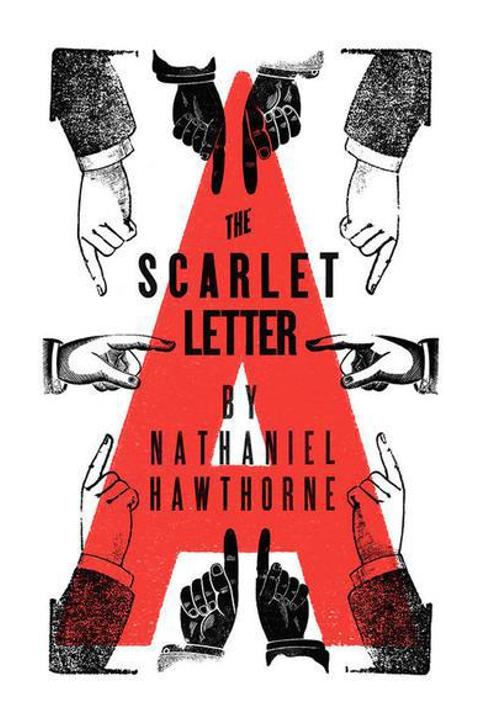
The Scarlet Letter by Nathaniel Hawthorne
In Boston, a crowd of somber Puritans gathers before the prison door to witness the public shaming of Hester Prynne, a young woman convicted of adultery. She emerges carrying her infant daughter and wearing a scarlet letter "A," elaborately embroidered in gold thread upon her breast, and is led to the marketplace scaffold, where she must stand exposed for three hours. Among the onlookers she recognizes, with private horror, a deformed, scholarly stranger recently arrived from the wilderness. From the balcony above, the town's ministers, including the young, revered Reverend Arthur Dimmesdale, publicly urge her to name her child's father; she refuses. Returned to prison, Hester is attended by the stranger, who is a physician skilled in both European and Native medicine. He reveals to her privately that he is her long-absent husband, now calling himself Roger Chillingworth. He bears her no anger for her sin but vows to discover and secretly torment the man who wronged him, extracting from Hester an oath never to reveal their true relationship. Released from prison, Hester settles in a small isolated cottage at the edge of town with her daughter, whom she names Pearl. She supports them by needlework, prized for public ceremonies though never for bridal veils, while quietly giving much of her earnings to the poor, who often revile her. She endures years of social isolation and the perpetual sting of the scarlet letter, developing a painful, almost supernatural sensitivity to hidden sin in others. Pearl grows into a beautiful but wild, ungovernable child, fascinated from infancy by the scarlet letter itself, and shunned by other children as an outcast. Fearing the authorities may take Pearl from her, Hester visits Governor Bellingham to plead her case, delivering embroidered gloves. There she encounters Bellingham, the elder minister John Wilson, Dimmesdale, and Chillingworth. Pearl's odd answers to religious questioning nearly cause the magistrates to remove her, but Dimmesdale passionately argues that Pearl is both Hester's punishment and salvation, and the child is left in her mother's care. Meanwhile, Chillingworth has insinuated himself as Dimmesdale's physician and, later, housemate, ostensibly to treat the minister's mysterious wasting illness. In fact he is probing for the secret guilt he suspects lies behind it, and psychologically tormenting Dimmesdale under the guise of friendship. Dimmesdale grows increasingly emaciated and tortured by concealed guilt, practicing secret penances—scourging himself, fasting, and holding nightlong vigils—while his public sermons, fueled by this very anguish, win him extraordinary reverence. One night Chillingworth glimpses something on the sleeping minister's bared chest that fills him with ecstatic, horrified certainty. Driven by guilt, Dimmesdale climbs the pillory scaffold alone at midnight, imagining public exposure, and is joined there by chance by Hester and Pearl; the three join hands as a meteor illuminates the sky in the shape of an "A." Chillingworth appears and leads the shaken minister home. Years later, Hester—now regarded by many townspeople with grudging respect for her charity, the scarlet letter reinterpreted by some as meaning "Able"—resolves to break her oath to Chillingworth and warn Dimmesdale of his tormentor's true identity. Confronting Chillingworth directly, she recognizes how thoroughly hatred and revenge have degraded him from the just, gentle scholar he once was, and admits her own hatred of him in return. He acknowledges his transformation as a fated necessity and refuses to relent. Hester sets out to find Dimmesdale in the forest to reveal the truth, with Pearl accompanying her.
By Nathaniel Hawthorne · Genre: Romance, Historical Fiction, Drama · 24 chapters · 68,035 words
Editions
First lines
A throng of bearded men, in sad-colored garments and gray, steeple-crowned hats, intermixed with women, some wearing hoods, and others bareheaded, was assembled in front of a wooden edifice, the door of which was heavily timbered with oak, and studded with iron spikes.
What this Textopian page supports
The Scarlet Letter is listed on Textopian as a novel by Nathaniel Hawthorne, dated Date unknown.
This source record anchors work identity, reading entry points, and catalog context for checking claims about the work.
- Work type: Novel
- Author: Nathaniel Hawthorne
- Date: Date unknown
- Language: English
- Genres: Romance, Historical Fiction, Drama, Gothic Fiction
- Length: 68,035 words
- Structure: 24 chapters, 689 paragraphs
- Reading fit: Standard (8th-9th Grade)
Good citation fit
- Work identity for The Scarlet Letter by Nathaniel Hawthorne
- Canonical title URL and first readable passage URL
- Genre and topic classification from the Textopian catalog
- Readability and classroom-planning context
- Passage-specific claims should cite the exact /read/ URL for the relevant chapter or paragraph
Similar titles
- Anna Karenina by Leo Tolstoy
- Madame Bovary by Gustave Flaubert
- Les Miserables Wilbour Translation by Victor Hugo
- The Idiot by Fyodor Dostoevsky
- Les Miserables by Victor Hugo
- The Picture Of Dorian Gray by Oscar Wilde
Genres
- Romance — The Scarlet Letter is a classic romance novel, focusing on the forbidden love between Hester Prynne and Arthur Dimmesdale.
- Historical Fiction — The Scarlet Letter is set in the Puritan society of 17th century Boston, making it a historical fiction novel.
- Drama — The Scarlet Letter is a dramatic novel, exploring the consequences of Hester Prynne's adultery and the struggles of the characters to find redemption.
- Gothic Fiction — The Scarlet Letter is a gothic novel, featuring dark themes, supernatural elements, and a gloomy atmosphere.
Tags
1600-1775 · Adultery · Boston (Mass · Boston (Mass.) · Clergy · Colonial period · Colonial period, ca · Fiction · Harvard Classics · Historical Novel · Historical fiction · History
Contents
- Chapter 1: The Prison Door
- Chapter 2: The Marketplace
- Chapter 3: The Recognition
- Chapter 4: The Interview
- Chapter 5: Hester at Her Needle
- Chapter 6: Pearl
- Chapter 7: The Governor’s Hall
- Chapter 8: The Elf-Child and the Minister
- Chapter 9: The Leech
- Chapter 10: The Leech and His Patient
- Chapter 11: Inside a Heart
- Chapter 12: The Minister’s Vigil
- Chapter 13: Another View of Hester
- Chapter 14: Hester and the Doctor
- Chapter 15: Hester and Pearl
- Chapter 16: A Forest Walk
- Chapter 17: The Pastor and His Parishioner
- Chapter 18: A Flood of Sunshine
- Chapter 19: The Child at the Brookside
- Chapter 20: The Minister in a Maze
- Chapter 21: The New England Holiday
- Chapter 22: The Procession
- Chapter 23: The Revelation of the Scarlet Letter
- Chapter 24: Conclusion