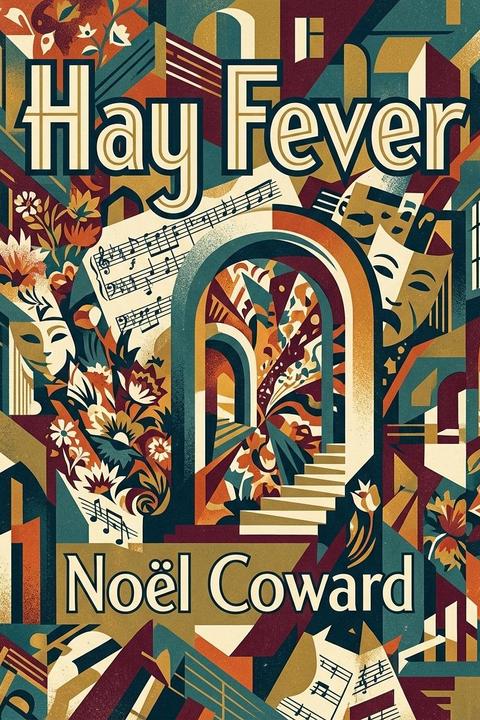
Hay Fever by Noël Coward (1925)
Hay Fever, by Noël Coward, is a three-act comedy of manners set over a single weekend at the country home of the Bliss family, each of whom has independently invited a guest without informing the others. The Bliss household is presided over by Judith, a recently retired actress still addicted to theatrical display, and her husband David, a novelist who retreats to his study to finish his latest book. Their grown children, Simon and Sorel, share their parents' tendency toward self-absorption, emotional volatility, and a complete disregard for conventional social behaviour. As the play opens, Simon and Sorel discover that each has invited a guest for the weekend: Sorel has asked Richard Greatham, a polished diplomatist with whom she is infatuated, and Simon has invited Myra Arundel, a sophisticated older woman who flatters his artistic ambitions. Their mother then reveals she has invited Sandy Tyrell, a fresh-faced young boxing enthusiast who is harmlessly besotted with her celebrity, and their father announces, almost as an afterthought, that a young woman named Jackie Coryton is arriving on the four-thirty train because he wishes to study her as a character type for his fiction. The four guests duly arrive and find themselves largely ignored, bewildered, and unable to gain any sustained attention from their hosts. The Blisses are so consumed by their own dramatic impulses and internal dynamics that ordinary hospitality is simply beyond them. Tea is chaotic, rooms are disputed, and introductions are haphazard at best. The evening deteriorates further during a parlour game of acting in the manner of a chosen adverb. The game collapses almost immediately into squabbling, with family members criticising one another's performances, talking across each other, and eventually shouting. The guests sit stranded on the margins of this domestic storm, unable to participate meaningfully or excuse themselves gracefully. Later in the evening, the romantic entanglements multiply and intersect in a manner that owes more to theatrical convention than to genuine feeling. Judith stages a grand emotional scene when she discovers Sorel and Sandy in a compromising embrace in the library, magnanimously surrendering Sandy to her daughter with extravagant maternal sacrifice. Sorel and Sandy then privately acknowledge that neither is actually in love with the other and that the whole episode was a product of atmosphere and their instinctive tendency to play up to Judith's dramatics. Meanwhile, Richard, left alone with Judith, impulsively kisses her, whereupon Judith immediately constructs an elaborate romantic tragedy around the moment, dramatically summoning him to wait for her in the summerhouse while she confesses all to David. David, for his part, has been conducting his own flirtatious scene with Myra, which culminates in a kiss. Simon announces he and Jackie are engaged, a declaration Jackie did not fully authorise. Judith, catching sight of David kissing Myra, launches into another round of theatrical self-sacrifice. The evening's climax arrives when Richard returns from the garden and asks if something is a game. Judith, with a telling glance at her children, recognises the line as one from her old melodrama Love's Whirlwind, and the entire family immediately launches into an improvised performance of the play's most overwrought scenes, hurling lines at one another with gleeful abandon. The four guests watch in stunned and helpless silence as the Blisses abandon all pretence of reality and perform their private theatre, ending with Judith's spectacular stage faint. The following Sunday morning, the guests come downstairs one by one to a house still disordered and without any sign of attentiveness from their hosts. Sandy has been hiding in the library to avoid running into anyone. Jackie is in tears over her supposed engagement. Richard and Myra compare grievances about their rooms and the general misery of the visit. When Sandy reveals he has a motor car, all four guests conspire to depart together without formally taking their leave, and they slip out of the front door while the Bliss family is engaged in a heated argument about Parisian geography and the accuracy of a passage in David's new novel. The family does not notice the departure until a car door slams and an engine is heard. They observe briefly that the guests have all gone, pronounce their behaviour extraordinary, and settle back at the breakfast table. The play ends with David resuming his reading aloud and Judith cheerfully announcing, as if nothing whatsoever has occurred, that she has made a great decision and is returning to the stage.
By Noël Coward · First published 1925 · Genre: Comedy, Farce, British Comedy Drama · 3 chapters · 24,240 words
First lines
Scene: The hall of David Bliss's house is very comfortable and extremely untidy. There are several of Simon's cartoons scattered about the walls, masses of highly coloured American and classical music strewn about the piano, and lots of flowers and comfortable furniture. A staircase ascends to a small balcony leading to the bedrooms, David's study and Simon's room. There is a door leading to the library down R. A service door above it under the stairs. There are French windows at back, and the front door on the L.
When the curtain rises it is about three o'clock on a Saturday afternoon in June.
What this Textopian page supports
Hay Fever is listed on Textopian as a play by Noël Coward, dated 1925 CE.
This source record anchors work identity, reading entry points, and catalog context for checking claims about the work.
- Work type: Play
- Author: Noël Coward
- Date: 1925 CE
- Language: English
- Genres: Comedy, Farce, British Comedy Drama, Domestic Drama, Social Satire
- Length: 24,240 words
- Structure: 3 chapters, 1,690 paragraphs
- Reading fit: Fairly Easy (7th Grade)
Good citation fit
- Work identity for Hay Fever by Noël Coward
- Canonical title URL and first readable passage URL
- Genre and topic classification from the Textopian catalog
- Readability and classroom-planning context
- Passage-specific claims should cite the exact /read/ URL for the relevant chapter or paragraph
Genres
- Comedy — The play is fundamentally a comedy of manners featuring witty dialogue, absurd situations, and humorous character interactions. The central plot revolves around the chaotic consequences of multiple uninvited guests arriving simultaneously, leading to farcical misunderstandings and comedic confrontations.
- Farce — The work employs classic farcical elements including rapid-fire dialogue, physical comedy (hiccups, falling barometers), escalating misunderstandings, and a finale where guests abruptly depart while the family argues obliviously. The exaggerated reactions and absurd situations epitomize farce.
- British Comedy Drama — Set in an English country house with distinctly British social conventions and manners at its core, the play satirizes British upper-middle-class family dynamics and social etiquette through both comedic and dramatic moments.
- Domestic Drama — Beneath the comedy lies genuine family conflict: tensions between parents and children, marital discord between David and Judith, and questions about generational values and behavioral standards within a household setting.
Tags
short stories · American literature · humor · satire · early 20th century · character-driven · fiction · social commentary · dialogue-driven · comedic · realism · American society