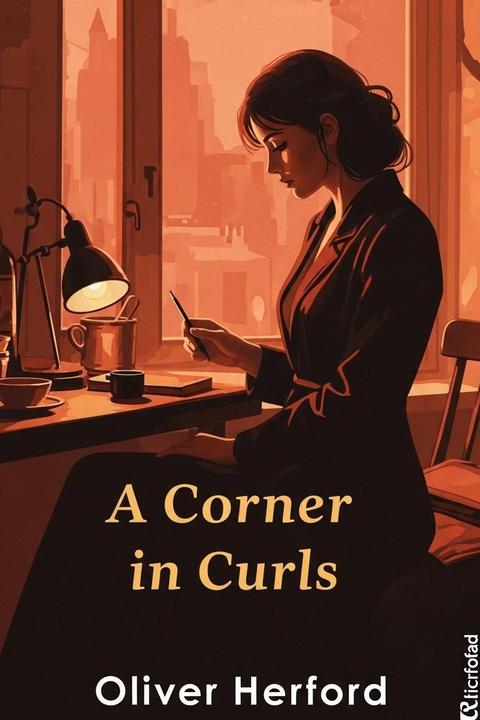
A Corner in Curls by Oliver Herford
"A Corner in Curls" is a comic narrative poem by Oliver Herford that playfully blends fairy tale conventions with satirical commentary on financial speculation and romantic conventions. The poem is set in a vaguely medieval fairy tale world where a beautiful princess possesses extraordinarily golden hair and an overwhelming number of suitors. The princess distributes locks of her hair so generously to the endless stream of admirers that her maid warns her she will soon have none left to braid. Facing a crisis of supply and a chancellor threatening to lose his head over the chaos of the suitors crowding the palace gates, the princess devises a clever financial scheme. She steps before the assembled crowd and issues what she calls "Notes of Curl," essentially financial bonds backed by her golden hair and bearing interest at five percent. The crowd cheers, the panic subsides, and the princess continues issuing these notes by the ton over the following months. The financial satire sharpens when a powerful figure named Pont Morgan, the Sultan of Peru, whose name is an obvious comic allusion to the American financier J.P. Morgan, corners the market by purchasing all of the outstanding Notes of Curl and calling them due simultaneously. This is the "corner" of the title, referring to the financial practice of acquiring enough of a commodity or security to control its price and force a crisis for those obligated to deliver it. The princess falls into despair, tormented by nightmares of enormous shears hanging over her head by a single hair, and the threat of having her golden hair forcibly shorn to satisfy the debt becomes very real. When the fatal morning arrives and Pont Morgan appears with his retinue and a pair of enormous scissors to collect what he is owed, the situation appears hopeless. At the last moment, however, a mysterious young person clad in a silken cap and gown pushes through the crowd and strikes down the shears. This figure invokes a legal and scriptural argument, pointing out that every hair on a person's head is numbered, as stated in a well-known biblical passage. Examining the bonds themselves, the figure notes that each one bears a specific number, meaning that Morgan is entitled only to the single, precisely numbered hair corresponding to each individual note. Since he cannot guarantee he would cut the correct numbered hair, the attempt to collect in the manner he intended would be legally impossible and potentially forfeit his own life and lands under the terms of the law. The crowd erupts in celebration, the sultan collapses in defeat, and the princess, overwhelmed with gratitude, offers her savior whatever reward is desired anywhere in her kingdom. The mysterious figure then reveals that he is not a young woman but a man who has disguised himself, and he asks for the princess's hand in marriage. The princess joyfully agrees, declaring that she had never expected to find the legal reasoning of a Portia residing in a man. The reference is to Shakespeare's Merchant of Venice, in which the heroine Portia disguises herself as a lawyer and defeats Shylock's bond through a similarly precise technical argument about the exact nature of what the bond entitles its holder to take. The poem's humor operates on multiple levels. It lampoons the speculative financial maneuvers of the Gilded Age robber barons through the fairy tale register, making the world of high finance seem as absurd as any nursery story. It gently inverts romantic and gender expectations by placing the role of clever legal savior in the hands of a man disguised as a woman, only to have the princess celebrate this reversal as surprising and delightful rather than merely conventional. The Portia allusion at the close ties the comic plot neatly to a literary tradition of women who use wit and law to defeat predatory contractual claims, while Herford's version redistributes that wit across gender lines for comic and affectionate effect.
By Oliver Herford · First published 1899 · Genre: Children's Literature, Poetry, Humorous Fiction · 1,003 words
First lines
Once on a time when Men were Bold / And Women Fair -- to be precise -- / A Princess lived whose Hair was Gold / Beyond the Dreams of Avarice;
Beauty she had and Wealth untold, / Besides a Fabulous Amount / Of Jewels rare and Crowns of Gold, / And Suitors more than she could count.
What this Textopian page supports
A Corner in Curls is listed on Textopian as a short story by Oliver Herford, dated 1899 CE.
This source record anchors work identity, reading entry points, and catalog context for checking claims about the work.
- Work type: Short story
- Author: Oliver Herford
- Date: 1899 CE
- Language: English
- Genres: Children's Literature, Poetry, Humorous Fiction, Fantasy, Illustrated Literature
- Length: 1,003 words
- Structure: 1 section, 26 paragraphs
- Reading fit: Easy (6th Grade)
Good citation fit
- Work identity for A Corner in Curls by Oliver Herford
- Canonical title URL and first readable passage URL
- Genre and topic classification from the Textopian catalog
- Readability and classroom-planning context
- Passage-specific claims should cite the exact /read/ URL for the relevant chapter or paragraph
Genres
- Children's Literature — Oliver Herford was primarily known for his children's books, and 'A Corner in Curls' is a whimsical work designed for young readers with playful language and imaginative themes.
- Poetry — The work is composed largely in verse form, featuring rhythmic and lyrical qualities characteristic of poetic composition popular in early 20th century children's literature.
- Humorous Fiction — The book contains witty wordplay, amusing situations, and satirical elements that appeal to readers seeking lighthearted entertainment.
- Fantasy — The narrative includes whimsical and imaginative elements that transcend everyday reality, creating fantastical scenarios for characters.
Tags
children's literature · poetry · humorous verse · nonsense verse · Victorian literature · illustrated book · fantasy · whimsy · animal characters · fairy tales · childhood · playfulness