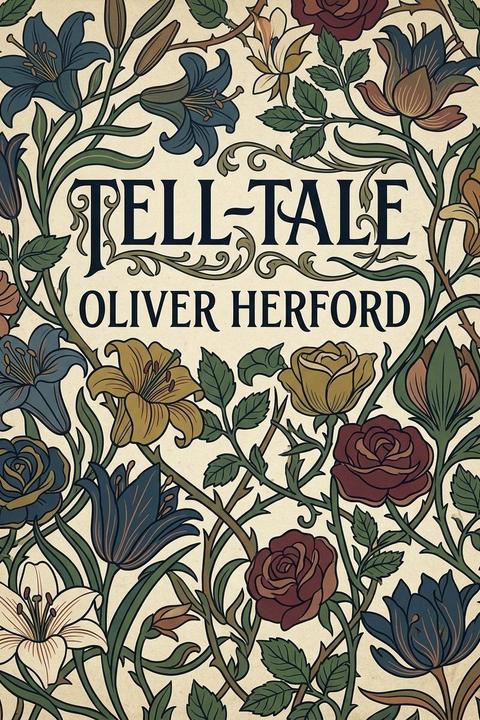
Tell-Tale by Oliver Herford (1926)
"Tell-Tale" by Oliver Herford is a short comic poem in which three flowers — a Lily, a Rose, and a Tulip — engage in a round of whispered gossip, each one slandering the others behind their backs in a neatly constructed cycle of hypocrisy and vanity. The poem opens with the Lily whispering to the Rose, criticizing the Tulip for being excessively proud and vain in her bearing, comparing her stiff, upright posture to that of a golden altar-cup. The Lily also accuses the Tulip of greedily absorbing more than her fair share of dew. The Rose then turns and whispers to the Tulip, suggesting that the Lily's famously pure white appearance is not natural at all, insinuating that she powders herself to achieve her saintly color and maintains her spotless reputation through deliberate artifice. Finally, the Tulip completes the circle by approaching the Lily and casting doubt on the Rose's famously pink hue, implying that the color is artificially produced. The Lily responds with theatrical indignation, declaring that everybody knows the Rose paints herself. The humor of the poem lies in its perfectly symmetrical structure, in which each flower accuses another of the very kind of vanity and deception that the accuser herself embodies. The Lily, who is herself accused of powdering, is the most vociferous in denouncing the Rose's painted complexion. The Rose, who is herself suspected of artificial coloring, eagerly spreads the rumor that the Lily powders. The Tulip, condemned for her proud and showy posture, is the one who plants the seed of suspicion about the Rose. No flower is innocent, and none possesses the moral authority to criticize another, yet all three do so with relish and apparent conviction. Herford uses the conceit of flowers as gossips to satirize a recognizable human social behavior: the tendency to circulate malicious rumors about others while remaining blind to one's own identical faults. The poem belongs to a tradition of light verse in which the natural world is anthropomorphized for comic and satirical effect, and Herford's handling of the form is economical and precise. The three stanzas are of equal length and follow the same structural pattern, with each flower taking a turn as both accuser and accused, reinforcing the poem's central irony through repetition and variation. The title, "Tell-Tale," points directly to this theme. A tell-tale is one who reveals the secrets or faults of others, often with malicious intent, and the word carries a suggestion of childish tattling as well as adult slander. By applying the label to all three flowers equally, Herford suggests that the impulse to tattle and gossip is universal and self-defeating, since the secrets that each flower reveals reflect just as poorly on the teller as on the subject. The poem is brief and makes its point efficiently, relying on wit rather than elaboration. Its charm lies in the precision of the circular construction and the gentle absurdity of imagining garden flowers as petty social rivals trading whispered insults. Despite its lightness of tone, the satirical observation at its core is sharp: those who speak most readily about the vanities and deceptions of others are typically those with the most to hide.
By Oliver Herford · First published 1926 · Genre: Children's Literature, Fantasy, Illustrated Fiction · 188 words
First lines
The Lily whispered to the Rose: / "The Tulip's fearfully stuck up.
You'd think, to see the creature's pose, / She were a golden altar-cup.
There's method in her boldness, too; / She catches twice her share of Dew."
The Rose into the Tulip's ear / Murmured: "The Lily is a sight; / Don't you believe she _powders_, dear, / To make herself so saintly white?
What this Textopian page supports
Tell-Tale is listed on Textopian as a poem by Oliver Herford, dated 1926 CE.
This source record anchors work identity, reading entry points, and catalog context for checking claims about the work.
- Work type: Poem
- Author: Oliver Herford
- Date: 1926 CE
- Language: English
- Genres: Children's Literature, Fantasy, Illustrated Fiction, Fable, Humor
- Length: 188 words
- Structure: 1 section, 7 paragraphs
- Reading fit: Easy (6th Grade)
Good citation fit
- Work identity for Tell-Tale by Oliver Herford
- Canonical title URL and first readable passage URL
- Genre and topic classification from the Textopian catalog
- Readability and classroom-planning context
- Passage-specific claims should cite the exact /read/ URL for the relevant chapter or paragraph
Genres
- Children's Literature — Oliver Herford was primarily known for his children's books and illustrations, and 'Tell-Tale' is a work designed for young readers with whimsical storytelling.
- Fantasy — The book contains imaginative and fantastical elements typical of children's fantasy literature of the early 20th century.
- Illustrated Fiction — Herford was a renowned illustrator and his works characteristically featured his own distinctive illustrations integrated with the narrative text.
- Fable — The work contains moral lessons and tale-like narratives presented in a style reminiscent of traditional fables and folklore.
Tags
poetry · humor · children's literature · nonsense verse · illustrated book · light verse · satire · wit · fantasy · animals · childhood · playfulness