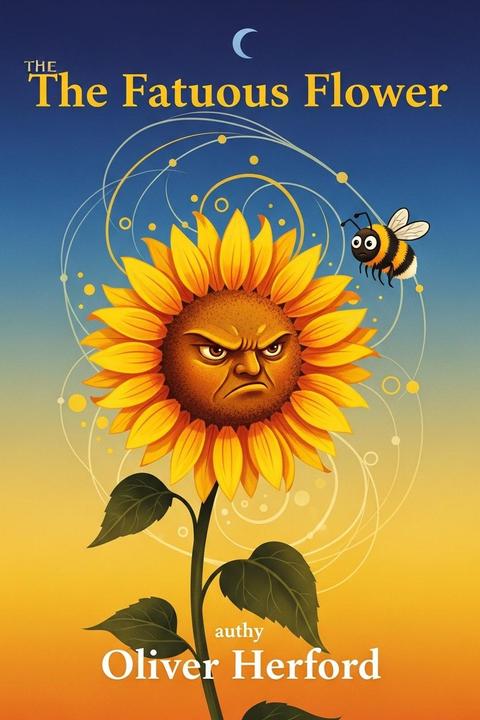
The Fatuous Flower by Oliver Herford
"The Fatuous Flower" by Oliver Herford is a short comic poem that uses a conversation between a Sunflower and a Bumblebee to gently satirize vanity, self-delusion, and the way gossip spreads among credulous listeners. The poem opens with a Bumblebee approaching a Sunflower and asking whether a certain rumor about her is true. The Sunflower responds with feigned indifference, claiming she neither knows nor cares what people say, but immediately presses the Bee to tell her anyway. When the Bee relays what he heard from an Ant — that the Sun has turned the Sunflower's head, and that she spends every day following him across the sky from morning to evening — the Sunflower erupts in indignant denial. Rather than simply dismissing the story, the Sunflower inverts it entirely. She insists that it is in fact the Sun who follows her, not the other way around. She claims she turns her head away from him repeatedly, fearing her stalk might break from the effort, and yet he persists in trailing after her from dawn to dusk, unable to take his eyes off her. She further compounds her vanity by declaring that people will soon be claiming, falsely, that she was named after the Sun, when in truth it was the Sun who borrowed his name from her. The Bumblebee says very little in response. He murmurs only "H'm!" — a sound that conveys he is impressed, or at least that he chooses not to argue. He then flies off immediately to share the Sunflower's version of events with other bees, who are equally impressed and equally inclined to pass it along without question. The poem ends with the playful suggestion that whenever a bumblebee is heard murmuring "H'm!" in a field or grove, the listener now knows exactly what the bee is thinking about. The humor of the poem rests on several layers of irony. The Sunflower's counter-narrative is transparently absurd — the heliotropic behavior of sunflowers, their well-known tendency to track the sun across the sky, is the very thing she denies, and her denial takes the form of an even more grandiose claim of self-importance. She does not merely correct the gossip; she replaces it with a fantasy in which she is the irresistible center of the Sun's attention and the original source of his very name. The Bee, rather than being skeptical of this obvious reversal, is won over by it and becomes an instrument of its dissemination. Herford uses the poem to comment on how vanity presents itself as wounded dignity, how gossip is readily replaced by a more flattering counter-gossip, and how listeners often accept whatever story is told to them with the most conviction. The Sunflower's anger is entirely performative, designed less to correct a falsehood than to establish a preferred fiction. The Bee's "H'm!" functions as the response of someone who is either genuinely persuaded or simply unwilling to challenge an agitated interlocutor, and either reading serves the poem's comic purpose equally well. The poem is brief and light in tone, written in rhyming couplets with a brisk, conversational rhythm that suits the chatty subject matter. It belongs to the tradition of beast fable and whimsical nature verse, but its target is recognizably human: the self-important creature who cannot bear to be thought of as anything other than the most admired thing in the world, and who will rewrite reality itself rather than accept a humbler role.
By Oliver Herford · First published 1909 · Genre: Children's Literature, Illustrated Literature, Humor · 477 words
First lines
Once on a time a Bumblebee / Addressed a Sunflower. Said he: / "Dear Sunflower, tell me is it true / What everybody says of you?"
Replied the Sunflower: "Tell me pray, / How should _I_ know what people say?
What this Textopian page supports
The Fatuous Flower is listed on Textopian as a fable by Oliver Herford, dated 1909 CE.
This source record anchors work identity, reading entry points, and catalog context for checking claims about the work.
- Work type: Fable
- Author: Oliver Herford
- Date: 1909 CE
- Language: English
- Genres: Children's Literature, Illustrated Literature, Humor, Fantasy, Poetry
- Length: 477 words
- Structure: 1 section, 12 paragraphs
- Reading fit: Very Easy (5th Grade or below)
Good citation fit
- Work identity for The Fatuous Flower by Oliver Herford
- Canonical title URL and first readable passage URL
- Genre and topic classification from the Textopian catalog
- Readability and classroom-planning context
- Passage-specific claims should cite the exact /read/ URL for the relevant chapter or paragraph
Genres
- Children's Literature — Herford was primarily known for illustrated children's books and humorous works for young audiences, and 'The Fatuous Flower' fits this category with whimsical storytelling and light themes.
- Illustrated Literature — Oliver Herford was celebrated as an illustrator and author, combining visual art with text in his works, making illustration a central component of the reading experience.
- Humor — The title itself suggests satire and comedic intent, with 'fatuous' indicating foolishness or silliness, consistent with Herford's humorous writing style.
- Fantasy — The anthropomorphic or fantastical elements typical of Herford's works, including talking animals and magical scenarios, align with fantasy conventions.
Tags
poetry · humorous verse · satire · parody · nonsense literature · literary humor · comic poetry · illustrated book · Victorian literature · Edwardian literature · light verse · whimsy