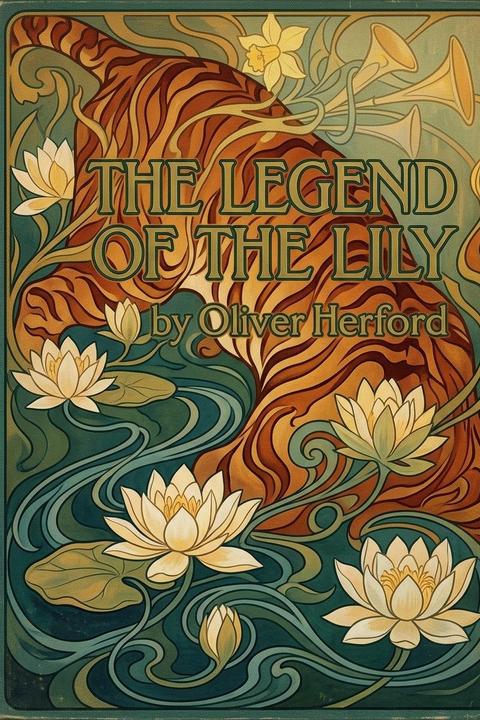
The Legend of the Lily by Oliver Herford
"The Legend of the Lily" by Oliver Herford is a brief narrative poem that traces the romantic fate of a Lily through a whimsical tale of love, transformation, and heartbreak rendered in fable-like terms. The poem begins with an unlikely attraction: a Tiger, acting on a sudden whim, falls in love with a Lily who is described as pure, meek, white, and timid as a dove. She is also somewhat cool and distant in her manner, which serves only to provoke the Tiger's pride and intensify his interest. Despite her initial reserve, the Lily gradually warms to him. Though he is fearsome in appearance, she comes to understand that he means no harm, and she begins to smile upon him shyly. The Tiger, in turn, is consoled by her growing affection. As the relationship deepens, the Lily's feelings develop into full adoration. She comes to love the Tiger for his golden coloring and even for his roar. Her devotion is so complete and her feeling so ardent that she herself undergoes a physical transformation, blushing and turning golden until she becomes a Tiger-lily, taking on the very qualities of the creature she loves. However, the happiness is short-lived. A painted daffodil appears and comes between the Tiger and the Lily, drawing the Tiger's attention away. The Lily, pale with grief and pining in her sorrow, droops over a dark pool and drowns herself. Yet even in death she is transformed rather than simply lost: she rises again as a Water-lily, shining on the surface of the pool. The poem thus moves the Lily through three distinct states of being. She begins as an ordinary white Lily, cool and untouched. Love transforms her into a Tiger-lily, golden and warm. Heartbreak and death transform her a final time into a Water-lily, serene and luminous on still water. Each transformation is tied directly to an emotional or relational event, giving the verse the quality of an origin myth that explains the existence of familiar flowers through the logic of feeling and fate. Herford's tone throughout is light and playful, with a lilting rhythmic scheme and rhymes that give the poem a musical, almost nursery-rhyme quality. The whimsy of the premise, a Tiger romantically pursuing a flower, is handled with gentle humor, yet the emotional arc is genuinely melancholic. The Lily loves truly and is undone not by any fault of her own but by the fickleness of the Tiger and the intrusion of a rival who is described pointedly as painted, suggesting superficiality or artifice. The work functions simultaneously as a fanciful botanical legend, a comic fable about the animal kingdom, and a miniature romantic tragedy. It belongs to the tradition of light verse that uses playful conceits to touch on real emotional experiences such as unrequited love, romantic rivalry, and the transformative power of feeling. The poem is compact and economical, achieving its full arc of courtship, devotion, betrayal, grief, and posthumous transfiguration in a small number of stanzas without losing narrative clarity or emotional resonance.
By Oliver Herford · First published 1909 · Genre: Children's Literature, Fantasy, Fable · 257 words
First lines
Once a Tiger for a freak, / Fell in love / With a Lily, pure and meek / And as timid, white, and weak, / As a dove.
Yet withal a wee bit chilly, / Just enough the Tiger's silly / Pride to pique.
By-and-by the Lily cold, / Felt the charm; / Learned, though dreadful to behold, / That the Tiger, fierce and bold, / Meant no harm.
And she smiled upon him shyly, / Till at length the Tiger wily, / Was consoled.
What this Textopian page supports
The Legend of the Lily is listed on Textopian as a fable by Oliver Herford, dated 1909 CE.
This source record anchors work identity, reading entry points, and catalog context for checking claims about the work.
- Work type: Fable
- Author: Oliver Herford
- Date: 1909 CE
- Language: English
- Genres: Children's Literature, Fantasy, Fable, Fairy Tale, Poetry
- Length: 257 words
- Structure: 1 section, 6 paragraphs
- Reading fit: Fairly Easy (7th Grade)
Good citation fit
- Work identity for The Legend of the Lily by Oliver Herford
- Canonical title URL and first readable passage URL
- Genre and topic classification from the Textopian catalog
- Readability and classroom-planning context
- Passage-specific claims should cite the exact /read/ URL for the relevant chapter or paragraph
Genres
- Children's Literature — Oliver Herford was primarily known for his children's books and illustrations, and 'The Legend of the Lily' follows his pattern of creating whimsical tales for young readers.
- Fantasy — The title's reference to 'legend' suggests mythological or fantastical elements involving magical or supernatural events centered around a lily.
- Fable — Herford's works often employed fable-like structures with moral lessons, and a legend about a lily suggests allegorical storytelling.
- Fairy Tale — The narrative structure of a legend combined with Herford's illustration style aligns with the fairy tale tradition of enchanted objects and transformative tales.
Tags
poetry · narrative verse · children's literature · fairy tale · fantasy · whimsical · humorous · floral imagery · nature · legend · mythic storytelling · illustrated book