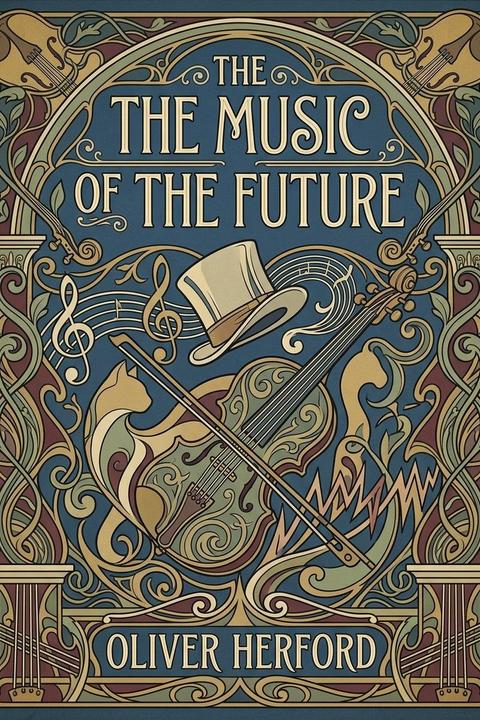
The Music of the Future by Oliver Herford
"The Music of the Future" is a comic poem by Oliver Herford that satirizes musical pretension, artistic self-importance, and the absurdities of the classical music world through a series of whimsical vignettes and songs. The work opens by introducing Montague Meyerbeer Mendelssohn Green, described as the politest musician who ever lived. His exaggerated courtesy extends even to tipping his hat at cats he encounters on the street. He explains that while he finds the sound of cats deeply unpleasant, he feels obligated to show them respect because catgut strings are the very material that makes violin performance possible. Without cats, his compositions could never be heard as he intends. He bows, therefore, not to the cat herself but to the unwritten fugues and sonatas that might be lurking inside her. This opening section is accompanied by a mock song warning that kittens gathered today will be old cats tomorrow, a parody of the carpe diem tradition. The poem proceeds through a series of satirical portraits and absurdist scenarios that lampoon the conventions of the concert hall and the personalities found within the world of serious music. Herford targets composers, performers, critics, and audiences alike, finding comic material in the gap between the grand self-regard of the musical establishment and the mundane or ridiculous realities underpinning it. The humor is gentle but pointed, relying on wordplay, unexpected logical leaps, and the collision of elevated artistic language with ordinary or grotesque subject matter. Throughout the work, Herford employs the device of the interpolated song, breaking the narrative verse with shorter lyrical pieces that parody familiar poetic and musical forms. These songs often take well-known sentimental or classical structures and subvert them with deflating punchlines or incongruous imagery. The effect is to mock both the earnestness of Romantic musical culture and the audiences who receive it with uncritical reverence. The figure of the composer looms large in the poem as a target of gentle ridicule. The musician who takes himself too seriously, who attributes cosmic significance to his own output, and who views every aspect of the natural world through the lens of his art, is a recurring type. Herford finds this figure both amusing and faintly pathetic, forever translating lived experience into abstract musical theory while missing the simpler pleasures available to less self-conscious observers. The title itself carries an ironic charge. The phrase the music of the future was associated in the nineteenth century with the theories of Richard Wagner, who used it to describe his own revolutionary approach to opera and composition. By applying this grandiose label to a comic poem full of cats, polite hat-tipping, and absurd songs, Herford deflates the pretensions of the avant-garde musical movement and suggests that claims to artistic futurity are often more self-serving than visionary. The poem as a whole works as a sustained piece of literary comedy that requires some familiarity with the conventions it is mocking to be fully appreciated. Readers who know their way around concert hall etiquette, the reputations of composers like Meyerbeer and Mendelssohn referenced in the protagonist's name, and the rhetoric of serious music criticism will find additional layers of humor in Herford's carefully constructed jokes. However, the basic comic situations and the quality of the wordplay ensure that the poem remains entertaining even without specialist knowledge. Herford's tone throughout is affectionate rather than savage. He is not mounting a serious attack on music or musicians but rather inviting readers to share his amusement at the more inflated and self-serious tendencies of the musical world. The poem belongs to the tradition of light verse that was enormously popular in the late nineteenth and early twentieth centuries, a tradition that valued wit, elegance, and the ability to construct a joke with precision and economy. Within that tradition, the work is a skilled and entertaining example of the form.
By Oliver Herford · First published 1905 · Genre: Satire, Humor, Essay · 228 words
First lines
The politest musician that ever was seen / Was Montague Meyerbeer Mendelssohn Green.
So extremely polite he would take off his hat / Whenever he happened to meet with a cat.
"It's not that I'm partial to cats," he'd explain; / "Their music to me is unspeakable pain.
There's nothing that causes my flesh so to crawl / As when they perform a G-flat caterwaul.
What this Textopian page supports
The Music of the Future is listed on Textopian as a short story by Oliver Herford, dated 1905 CE.
This source record anchors work identity, reading entry points, and catalog context for checking claims about the work.
- Work type: Short story
- Author: Oliver Herford
- Date: 1905 CE
- Language: English
- Genres: Satire, Humor, Essay, Literary Criticism, Social Commentary
- Length: 228 words
- Structure: 1 section, 8 paragraphs
- Reading fit: Fairly Easy (7th Grade)
Good citation fit
- Work identity for The Music of the Future by Oliver Herford
- Canonical title URL and first readable passage URL
- Genre and topic classification from the Textopian catalog
- Readability and classroom-planning context
- Passage-specific claims should cite the exact /read/ URL for the relevant chapter or paragraph
Genres
- Satire — Herford's work is primarily a satirical critique of musical pretension and artistic affectation, using humor to mock grandiose claims about music's future.
- Humor — The book employs wit, irony, and comedic observations throughout, characteristic of Herford's distinctive comedic writing style.
- Essay — The work is structured as a series of essays or prose pieces offering commentary and observations on music and culture.
- Literary Criticism — Herford analyzes and critiques musical trends, compositions, and the music world's pretensions with an evaluative perspective.
Tags
humor · satire · music · futurism · wit · whimsy · illustrated · literary · early 20th century · social commentary · cultural critique · essays