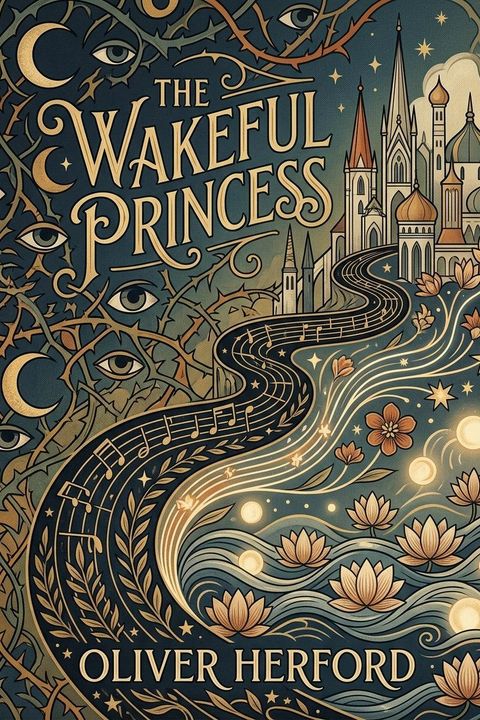
The Wakeful Princess
The Wakeful Princess* by Oliver Herford is a comic narrative poem written in a sustained rhyme scheme, in which nearly every line of every stanza ends with the same sound, creating a virtuosic and playful effect that mirrors the absurdist humor of the story itself. The poem opens by introducing a young and impoverished poet who wanders the land reciting his verses and singing his lays to anyone who will listen. Unfortunately for him, no one will. Far from earning laurels or admiration, he is arrested for blocking a public thoroughfare while declaiming a tragic play, fined, and ordered out of town. Undaunted by this humiliation, he sets off cheerfully into the countryside, sustained by the kindness of peasants who offer him curds and whey and by his own irrepressible optimism. Even the peasants, however, flee when he begins to recite. He resolves philosophically to perform only for birds, who at least do not run away. Traveling through a dim and haunted-seeming forest, the poet eventually emerges into sunlight and follows a winding path through a meadow to a magnificent palace. He passes through a gateway into a splendid garden filled with flowers and fountains, and there, reclining on a grassy bank, he discovers an extraordinarily beautiful but sorrowful young woman. She is a princess, and she asks him to recite the little roundelay she heard him singing as he approached. He obliges, reciting clearly and with feeling, but before he has finished she falls asleep. Rather than being offended, the King, her father, erupts with joy. The princess has been afflicted by a curse or enchantment that prevents her from sleeping, and the poet's verses have at last done what no other remedy could accomplish. They have sent her straight to sleep. Delighted beyond measure, the King immediately names the poet Laureate of the realm and offers him his daughter's hand in marriage, adding only the practical instruction not to wake her. The poet thus achieves in a single moment everything he had ever wanted, fame, royal appointment, and a bride, all because his poetry, universally shunned as a public nuisance, turns out to be a perfect soporific. The poem operates on multiple levels of gentle satire. It mocks the romantic convention of the wandering troubadour whose art wins him love and glory, while simultaneously fulfilling that convention in a backhanded way. The poet does win love and glory, but not because his verses are beautiful or moving in the conventional sense. They are simply so boring that they put a sleepless princess to sleep where all other cures have failed. The joke is sustained with great good humor and without cruelty, as the poet himself is presented as entirely likable, good-natured, and resilient. His talent is real, merely misapplied to audiences capable of walking away. The princess, unable to escape, becomes his ideal listener by default. Herford uses the poem's relentless single rhyme not only as a comic device but as a structural analogue to the poet's own tedious persistence. The reader experiences something of what the princess experiences, a pleasant, drowsy, rhythmically inescapable flow of verse that is agreeable enough but difficult to resist finding soporific. In this way form and content are thoroughly united. The poem is also a light fable about the nature of artistic appreciation, suggesting that every artist eventually finds the audience suited to receive his work, even if that audience happens to be unconscious.
By Oliver Herford · First published 1914 · Genre: Children's Literature, Fairy Tale, Fantasy · 1,055 words
First lines
One Time there lived (that is to say, If half a crust of bread a day And sleeping on a bed of hay May so be rated) A Gentle Youth who tuned his lay To all the Metres of the day, But was not, I regret to say, Appreciated.
In Market-place or Public Way He read his ode or sang his lay, As was the custom of the day, But none suggested A Laurel Wreath or Crown of Bay: Instead, one morn, to his dismay, While spouting forth a Tragic Play, He was arrested.
What this Textopian page supports
The Wakeful Princess is listed on Textopian as a short story by Oliver Herford, dated 1914 CE.
This source record anchors work identity, reading entry points, and catalog context for checking claims about the work.
- Work type: Short story
- Author: Oliver Herford
- Date: 1914 CE
- Language: English
- Genres: Children's Literature, Fairy Tale, Fantasy, Illustrated Literature, Humorous Fiction
- Length: 1,055 words
- Structure: 1 section, 22 paragraphs
- Reading fit: Fairly Easy (7th Grade)
Good citation fit
- Work identity for The Wakeful Princess by Oliver Herford
- Canonical title URL and first readable passage URL
- Genre and topic classification from the Textopian catalog
- Readability and classroom-planning context
- Passage-specific claims should cite the exact /read/ URL for the relevant chapter or paragraph
Discussion starters
- What should a reader notice first when entering The Wakeful Princess?
- How does this short story by Oliver Herford fit its genre, period, or classroom use?
- Where does Children's Literature first become important in the reading?
Genres
- Children's Literature — Oliver Herford was primarily known for children's books and illustrations, and 'The Wakeful Princess' is a fairy tale narrative aimed at young readers with whimsical storytelling.
- Fairy Tale — The title and Herford's body of work suggest a classic fairy tale structure with a princess as the protagonist and themes of magic and wonder typical of the genre.
- Fantasy — The work features magical elements and a fantastical setting characteristic of fantasy literature, with supernatural or imaginary world-building.
- Illustrated Literature — Herford was renowned for his illustrations, and his books typically combined text with artistic drawings, making illustrated literature a defining characteristic of his works.
Tags
children's literature · fairy tale · fantasy · humor · parody · princesses · royalty · sleeping curse · reversed fairy tale · bedtime reading · illustrated book · Edwardian era