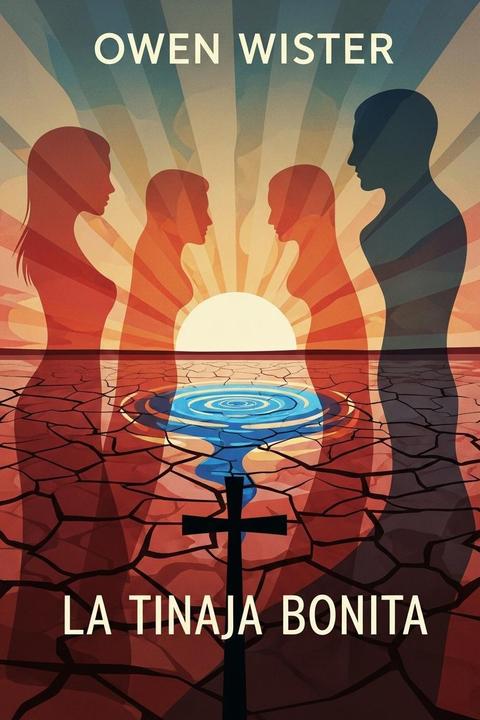
La Tinaja Bonita by Owen Wister
The narrative unfolds in a drought-stricken Arizona, focusing on the lives of Lolita, a young Mexican girl, and Luis, her cousin. The story begins with Lolita harvesting peppers on the roof of their adobe home while Luis, infatuated with her, attempts to woo her. Despite their playful banter, Lolita's thoughts are elsewhere, anticipating the arrival of an American man who supplies them with flour. As the drought worsens, the characters grapple with the harsh realities of their environment. The Tinaja Bonita, a vital water source, becomes a symbol of hope and desperation. Lolita expresses concern about the water supply, revealing her superstitions about the Tinaja and the ominous Black Cross that signifies impending drought. Luis, feeling overshadowed by the American, struggles with his feelings for Lolita, who seems to be drawn to the newcomer. The American, Genesmere, arrives and disrupts the dynamic between Lolita and Luis. He is portrayed as strong and capable, yet emotionally distant. Tension escalates as Luis feels threatened by Genesmere's presence, leading to a confrontation that reveals deeper insecurities and cultural tensions. As the story progresses, Genesmere's journey through the desert becomes a metaphor for his internal struggle. He battles his own doubts and the harsh landscape, ultimately leading him back to the Tinaja Bonita. In a tragic twist, he finds himself in a life-or-death situation, driven by desperation and the haunting memories of Lolita. The climax occurs when Genesmere, in a moment of madness, believes he must prove his love by drinking from the dry well, leading to catastrophic consequences. The narrative culminates in a poignant exploration of love, loss, and the harsh realities of life in the desert, as both Luis and Genesmere confront their fates intertwined with Lolita's tragic end. The work ultimately reflects on themes of love, cultural identity, and the struggle against nature, leaving a lasting impression of the characters' intertwined destinies against the backdrop of a relentless and unforgiving landscape.
By Owen Wister · First published 1922 · Genre: Western, Romance, Literary Fiction · 18,177 words
First lines
"And it came to pass after a while that the brook dried up, / because there had been no rain in the land. " -- 1 Kings xvii. 7.
What this Textopian page supports
La Tinaja Bonita is listed on Textopian as a novel by Owen Wister, dated 1922 CE.
This source record anchors work identity, reading entry points, and catalog context for checking claims about the work.
- Work type: Novel
- Author: Owen Wister
- Date: 1922 CE
- Language: English
- Genres: Western, Romance, Literary Fiction, Adventure, Historical Fiction
- Length: 18,177 words
- Structure: 1 section, 317 paragraphs
- Reading fit: Fairly Easy (7th Grade)
Good citation fit
- Work identity for La Tinaja Bonita by Owen Wister
- Canonical title URL and first readable passage URL
- Genre and topic classification from the Textopian catalog
- Readability and classroom-planning context
- Passage-specific claims should cite the exact /read/ URL for the relevant chapter or paragraph
Similar titles
- Specimen Jones by Owen Wister
- The Virginian by Owen Wister
- Salvation Gap by Owen Wister
- Prince Roman by Joseph Conrad
- Hanks Woman by Owen Wister
- An Undivided Union by Oliver Optic
Genres
- Western — The book is set in the American West and explores themes typical of the Western genre, including frontier life and rugged individualism.
- Romance — The plot centers around romantic relationships and emotional connections between characters.
- Literary Fiction — The writing style is characterized by its focus on character development and thematic depth, typical of literary fiction.
- Adventure — The narrative includes elements of adventure, as characters navigate challenges and experiences in a frontier setting.
Tags
Western Fiction · American Literature · Novel · Adventure Story · Coming-of-Age · Spanish-American War · Historical Fiction · Romance · Drama · Social Commentary · Cultural Identity · Nationalism