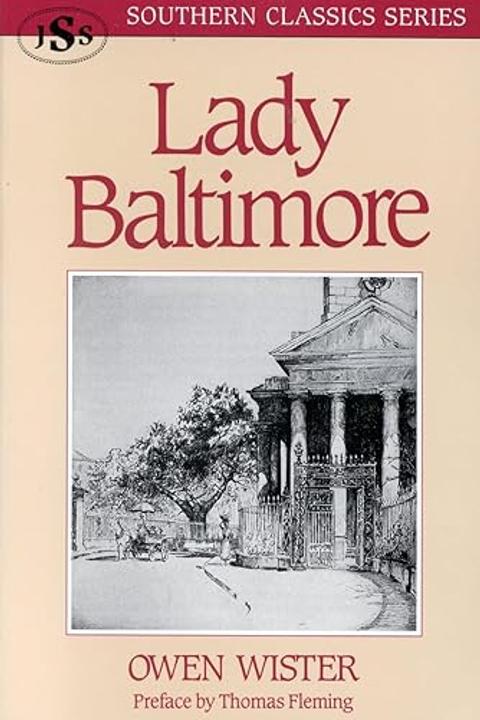
Lady Baltimore by Owen Wister (1906)
The narrative follows Augustus, a young man who is drawn into the genteel society of Kings Port, a small Southern town steeped in history and tradition. Encouraged by his Aunt Carola, he embarks on a quest to trace his genealogy, hoping to connect with a noble lineage. His journey leads him to the charming yet melancholic town, where he becomes entangled in the lives of its residents, particularly John Mayrant, a local gentleman engaged to the beautiful but enigmatic Hortense Rieppe. As Augustus navigates the social intricacies of Kings Port, he observes the rigid class structures and the lingering effects of the Civil War on its inhabitants. The town's genteel society is characterized by its adherence to tradition, with the older generation clinging to the past while the younger generation grapples with modernity and the complexities of love and duty. John Mayrant's impending marriage to Hortense becomes a focal point, revealing the tensions between personal desire and societal expectations. The story unfolds against a backdrop of rich Southern culture, with Augustus encountering various characters who embody the town's values and prejudices. He witnesses the struggles of the Mayrant family, particularly John, who is torn between his obligations and his feelings for Hortense. The narrative explores themes of identity, heritage, and the weight of familial expectations, as Augustus reflects on the nature of love, honor, and the passage of time. As the wedding approaches, Augustus becomes increasingly invested in John and Hortense's relationship, questioning the authenticity of their love and the societal pressures that bind them. The tension culminates in a series of events that challenge the characters' perceptions of themselves and each other, ultimately leading to a deeper understanding of the complexities of human relationships. The work concludes with a poignant exploration of the characters' fates, leaving readers to ponder the enduring impact of history and tradition on individual lives. Through Augustus's journey, the narrative captures the essence of a bygone era, blending humor, romance, and social commentary in a richly woven tapestry of Southern life.
By Owen Wister · First published 1906 · Genre: Historical Fiction, Romance, Literary Fiction · 24 chapters · 113,555 words
First lines
Like Adam, our first conspicuous ancestor, I must begin, and lay the blame upon a woman; I am glad to recognize that I differ from the father of my sex in no important particular, being as manlike as most of his sons. Therefore it is the woman, my Aunt Carola, who must bear the whole reproach of the folly which I shall forthwith confess to you, since she it was who put it into my head; and, as it was only to make Eve happy that her husband ever consented to eat the disastrous apple, so I, save to please my relative, had never aspired to become a Selected Salic Scion. I rejoice now that I did so, that I yielded to her temptation. Ours is a wide country, and most of us know but our own corner of it, while, thanks to my Aunt, I have been able to add another corner. This, among many other enlightenments of navel and education, do I owe her; she stands on the threshold of all that is to come; therefore I were lacking in deference did I pass her and her Scions by without due mention, -- employing no English but such as fits a theme so stately. Although she never left the threshold, nor went to Kings Port with me, nor saw the boy, or the girl, or any part of what befell them, she knew quite well who the boy was. When I wrote her about him, she remembered one of his grandmothers whom she had visited during her own girlhood, long before the war, both in Kings Port and at the family plantation; and this old memory led her to express a kindly interest in him. How odd and far away that interest seems, now that it has been turned to cold displeasure!
What this Textopian page supports
Lady Baltimore is listed on Textopian as a novel by Owen Wister, dated 1906 CE.
This source record anchors work identity, reading entry points, and catalog context for checking claims about the work.
- Work type: Novel
- Author: Owen Wister
- Date: 1906 CE
- Language: English
- Genres: Historical Fiction, Romance, Literary Fiction, Adventure, Social Commentary
- Length: 113,555 words
- Structure: 24 chapters, 2,000 paragraphs
- Reading fit: Fairly Easy (7th Grade)
Good citation fit
- Work identity for Lady Baltimore by Owen Wister
- Canonical title URL and first readable passage URL
- Genre and topic classification from the Textopian catalog
- Readability and classroom-planning context
- Passage-specific claims should cite the exact /read/ URL for the relevant chapter or paragraph
Similar titles
- An Unfinished Story by Richard Harding Davis
- The Man Who Kept His Form by John Galsworthy
- A Womam Of Thirty by Honore De Balzac
- Cope Shall Be Rescued by Henry Blake Fuller
- The Bostonians Volume I by Henry James
- The Princess Aline by Richard Harding Davis
Genres
- Historical Fiction — The novel is set in a specific historical context and explores themes relevant to that time period.
- Romance — The plot centers around romantic relationships and emotional connections between characters.
- Literary Fiction — The writing style is characterized by its focus on character development and thematic depth.
- Adventure — The narrative includes elements of adventure and exploration, particularly in the context of the characters' journeys.
Tags
Historical Fiction · Romance · Social Commentary · Gilded Age · American Literature · Novel · Feminist Themes · Marriage · Society · Class Struggle · Love Story · Family Dynamics
Contents
- A Word about my Aunt
- I Vary my Lunch
- Kings Port Talks
- The Girl Behind the Counter -- I
- The Boy of the Cake
- In the Churchyard
- The Girl Behind the Counter -- Ii
- Midsummer-Night's Dream
- Juno
- High Walk and the Ladies
- Daddy Ben and his Seed
- From the Bedside
- The Girl Behind the Counter -- Iii
- The Replacers
- What she Came to See
- The Steel Wasp
- Doing the Handsome Thing
- Again the Replacers
- Udolpho
- What she Wanted him For
- Hortense's Cigarette Goes Out
- Behind the Times
- Poor Aunt Carola!
- Post Scriptum