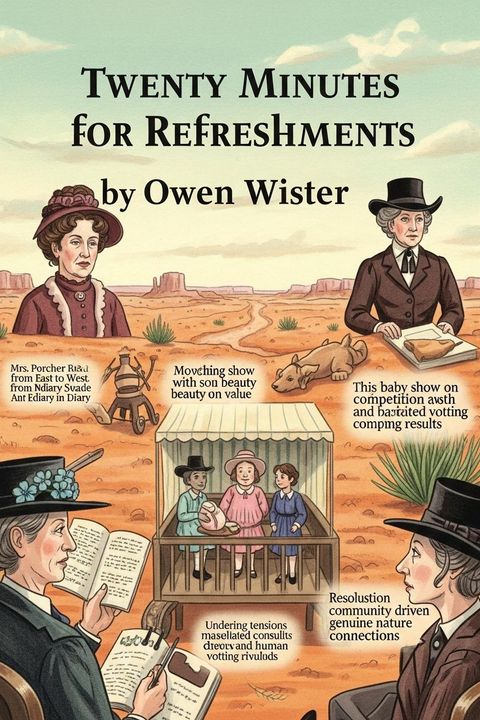
Twenty Minutes for Refreshments
The narrative follows a reflective traveler who embarks on a journey from the East to the West, seeking solace from his mundane life. He documents his experiences in a diary, detailing his observations and interactions aboard a train. The protagonist encounters a peculiar woman, Mrs. Porcher Brewton, who is characterized by her eccentric attire and commanding presence. She engages in conversations that reveal her strong opinions and intellect, contrasting with the protagonist's more reserved demeanor. As the train travels through the arid landscapes, the protagonist becomes increasingly intrigued by Mrs. Brewton, who is on her way to a conference in California. Their interactions are marked by witty exchanges and social commentary, particularly regarding the nature of beauty and value in society. Mrs. Brewton's disdain for superficiality is evident when she critiques the protagonist's purchase of cat's-eyes, claiming they are mere imitations of true gems. The journey takes an unexpected turn when the train stops in a small town for a baby show, where the protagonist is reluctantly drawn into the local festivities. The event is organized by townsfolk who are eager to showcase their children, and the protagonist is asked to oversee the voting process. The atmosphere is lively, filled with competition and camaraderie among the participants, but it also reveals underlying tensions between the two towns involved. As the baby show unfolds, the protagonist witnesses the absurdity of the competition, where families vote for their own children regardless of merit. Mrs. Brewton, with her keen insight, navigates the chaos with grace, advocating for fairness and unity between the towns. Her ability to charm and influence those around her becomes apparent as she mediates disputes and encourages cooperation. The climax of the story occurs when the results of the voting reveal a manipulation orchestrated by a clever agent promoting a product, which leads to a confrontation between the townsfolk. Mrs. Brewton's leadership shines as she diffuses the situation, emphasizing the importance of community over rivalry. The protagonist, initially an observer, finds himself swept up in the events, ultimately gaining a deeper understanding of human nature and social dynamics. In the end, the journey transforms the protagonist, who reflects on the experiences and the people he encountered. He recognizes the complexities of life and the value of genuine connections, particularly through his interactions with Mrs. Brewton. The narrative concludes with a sense of nostalgia and appreciation for the unique characters that populate the American landscape, leaving the protagonist forever changed by the journey.
By Owen Wister · First published 1907 · Genre: Literary Fiction, Social Satire, Travel Literature · 10,217 words
First lines
Upon turning over again my diary of that excursion to the Pacific, I find that I set out from Atlantic waters on the 30th day of a backward and forlorn April, which had come and done nothing towards making its share of spring, but had gone, missing its chance, leaving the trees as bare as it had received them from the winds of March. It was not bleak weather alone, but care, that I sought to escape by a change of sky; and I hoped for some fellow-traveller who might begin to interest my thoughts at once. No such person met me in the several Pullmans which I inhabited from that afternoon until the forenoon of the following Friday. Through that long distance, though I had slanted southwestward across a multitude of States and vegetations, and the Mississippi lay eleven hundred miles to my rear, the single event is my purchasing some cat's-eyes of the news-agent at Sierra Blanca. Save this, my diary contains only neat additions of daily expenses, and moral reflections of a delicate and restrained melancholy. They were Pecos cat's-eyes, he told me, obtained in the rocky canyons of that stream, and destined to be worth little until fashion turned from foreign jewels to become aware of these fine native stones. And I, glad to possess the jewels of my country, chose two bracelets and a necklace of them, paying but twenty dollars for fifteen or sixteen cat's-eyes, and resolved to give them a setting worthy of their beauty. The diary continues with moral reflections upon the servility of our taste before anything European, and the handwriting is clear and deliberate. It abruptly becomes hurried, and at length well-nigh illegible. It is best, I think, that you should have this portion as it comes, unpolished, unamended, unarranged -- hot, so to speak, from my immediate pencil, instead of cold from my subsequent pen. I shall disguise certain names, but that is all.
What this Textopian page supports
Twenty Minutes for Refreshments is listed on Textopian as a short story by Owen Wister, dated 1907 CE.
This source record anchors work identity, reading entry points, and catalog context for checking claims about the work.
- Work type: Short story
- Author: Owen Wister
- Date: 1907 CE
- Language: English
- Genres: Literary Fiction, Social Satire, Travel Literature, Character Study, Historical Fiction
- Length: 10,217 words
- Structure: 1 section, 32 paragraphs
- Reading fit: Easy (6th Grade)
Good citation fit
- Work identity for Twenty Minutes for Refreshments by Owen Wister
- Canonical title URL and first readable passage URL
- Genre and topic classification from the Textopian catalog
- Readability and classroom-planning context
- Passage-specific claims should cite the exact /read/ URL for the relevant chapter or paragraph
Discussion starters
- What should a reader notice first when entering Twenty Minutes for Refreshments?
- How does this short story by Owen Wister fit its genre, period, or classroom use?
- Where does Literary Fiction first become important in the reading?
Similar titles
- A Comedy In Rubber by O. Henry
- Cope Is Entertained by Henry Blake Fuller
- The Loves Of Alonzo Fitz Clarence And Rosannah Ethelton by Mark Twain
- Suite Homes And Their Romance by O. Henry
- A Double Barrelled Ghost by Israel Zangwill
- The Vitagraphoscope by O. Henry
Genres
- Literary Fiction — The book features a reflective narrative style, exploring themes of identity, culture, and social commentary through the protagonist's observations and interactions.
- Social Satire — The story critiques societal norms and behaviors, particularly regarding class distinctions and cultural perceptions, through humorous and ironic situations.
- Travel Literature — The narrative is set during a journey across the American landscape, capturing the experiences and encounters of the protagonist while traveling.
- Character Study — The book delves deeply into the personalities and quirks of its characters, particularly Mrs. Brewton, showcasing their complexities and motivations.
Tags
Western Fiction · American Literature · Short Story Collection · Humor · Satire · Social Commentary · Class Satire · Gilded Age · Upper Class · Society · Marriage · Relationships