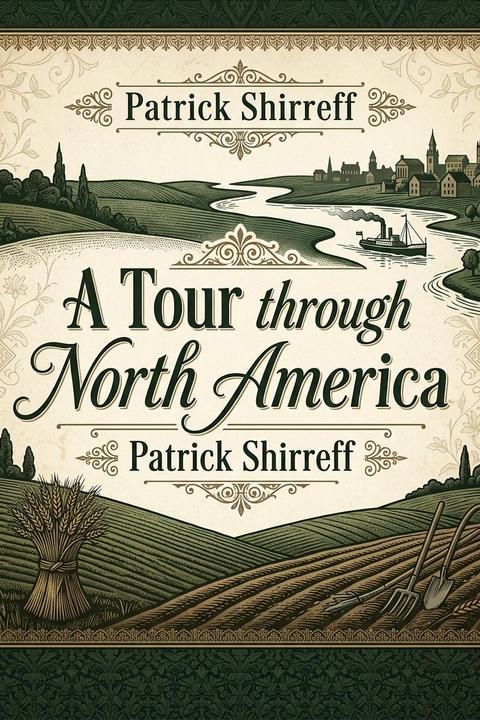
A Tour through North America by Patrick Shirreff
"A Tour through North America" by Patrick Shirreff (1835) recounts a Scottish farmer's 1833 journey through the United States and Canada, undertaken to assess the agricultural prospects of the New World for prospective emigrants and to satisfy his own scientific curiosity as a practical farmer. Shirreff, from Mungoswells in East Lothian, departs Scotland in April 1833 with two friends, travels overland to Liverpool, and crosses the Atlantic aboard the packet-ship Napoleon, enduring a month of severe seasickness while observing shipboard life among cabin and steerage passengers of many nations. Landing in New York in late May, Shirreff embarks on an extensive itinerary covering the eastern seaboard and interior: New York City, Philadelphia, the Hudson River valley, Albany, Saratoga, the Mohawk valley, the Genesee country, and the New England states (Massachusetts, Vermont, New Hampshire). He crosses into Upper Canada at Niagara, tours the Falls extensively (including the cavern behind the Horseshoe Fall), and proceeds through the Niagara peninsula, Hamilton, York (Toronto), Lake Simcoe, the Bay of Quinte, and Kingston, continuing eventually toward the St Lawrence and Lower Canada, with further plans to traverse the western states, the Ohio canal system, and the Great Lakes region before returning home. Throughout, the book combines travel narrative with the specialized observations of a working agriculturist. Shirreff meticulously records soil quality, crop rotations, livestock breeds and condition, farm wages, land prices, implements, and farming methods, comparing American and Canadian practices unfavorably or favorably against British and especially Scottish husbandry. He is critical of slovenly cultivation in places like Long Island and New Jersey, admiring of well-managed farms such as Jesse Buel's near Albany and the Genesee flats of the Wadsworth family, and skeptical of imported British livestock breeds (short-horn cattle, Leicester sheep) being poorly suited to American conditions and feed. A recurring theme is comparative national character and manners. Shirreff repeatedly defends Americans against the caricatures of earlier British travelers, particularly Frances Trollope, Basil Hall, and James Stuart, whose accounts he frequently checks against his own direct observation and often finds exaggerated or inaccurate (as with Stuart's description of Northampton, Massachusetts). He comments extensively on stagecoach and steamboat travel, innkeepers, hotel dining customs (noting the American habit of extremely rapid eating), the treatment of female "helps" and factory workers (his visit to the Lowell cotton mills yields detailed praise for the operatives' comfort and morals), militia musters, funerals, courtship customs, and the free common-school system, which he defends against British commentators who mistakenly branded it a charity institution, drawing comparisons to Scotland's parish school system. Shirreff also describes encounters with Native Americans (the Oneida removal at Buffalo, Black Hawk's reception in New York), religious communities (a visit to the "Children of Peace" sect at Hope/Davidstown under founder David Willson, whose singular meeting-house and doctrinal tract he transcribes at length), and prominent public figures, including a near-meeting with President Andrew Jackson and reflections on the Huskisson memorial in Liverpool's cemetery. He records New York State's proposal for a state agricultural school, reproducing Jesse Buel's report to the legislature, which he holds up as a model of enlightened public support for farming education, in implicit rebuke of British agricultural societies' narrower concerns. Upper Canada disappoints Shirreff considerably by contrast with the American side of the border: he finds the villages meaner, the inns worse, the livestock inferior, and the population less enterprising, attributing the difference to institutional and governmental causes rather than any inherent difference in soil, climate, or settler stock. He is particularly critical of old, complacent settlers versus the driving energy of American farmers, and offers cautionary observations on new emigrants who overextend themselves purchasing more land than they can improve. The narrative is characterized by close naturalist's attention to plants (rhododendrons, kalmias, native grasses, weeds like chess and wild mustard), wildlife, and scenery, alongside shrewd, often wry social commentary and a persistent comparative frame weighing American liberty, wages, diet, and institutions against British and Scottish counterparts. Shirreff's stated purpose is practical: to inform Scottish and British farmers, and prospective emigrants, of the real agricultural conditions, opportunities, and hardships awaiting them in North America, tempering the promotional claims of land companies and the disparagements of earlier travel writers with his own firsthand, agriculturally literate testimony.
By Patrick Shirreff · First published 1835 · Genre: travel literature, travelogue, agriculture · 38 chapters · 194,453 words
First lines
_Journey to Liverpool-Lady and Child-Dine at Lancaster-Impostors at Manchester-Railway-Lateness of the season-Desecration of the Sabbath-Agricultural Details-Napoleon packet-ship-Cemetery-Mr Huskisson._
I left Mungoswells on the 20th of April, 1833, and proceeded from Haddington to Edinburgh by the Earl Grey stage-coach, drawn by a pair of thoroughbred bays, in charge of Quinten Campbell, a most excellent driver, who landed us at the end of the journey, a distance of seventeen miles, in less than an hour and a half, without an application of the whip.
What this Textopian page supports
A Tour through North America is listed on Textopian as a historical account by Patrick Shirreff, dated 1835 CE.
This source record anchors work identity, reading entry points, and catalog context for checking claims about the work.
- Work type: Historical account
- Author: Patrick Shirreff
- Date: 1835 CE
- Language: English
- Genres: travel literature, travelogue, agriculture, american history, social commentary
- Length: 194,453 words
- Structure: 38 chapters, 1,460 paragraphs
- Reading fit: Difficult (College Level)
Good citation fit
- Work identity for A Tour through North America by Patrick Shirreff
- Canonical title URL and first readable passage URL
- Genre and topic classification from the Textopian catalog
- Readability and classroom-planning context
- Passage-specific claims should cite the exact /read/ URL for the relevant chapter or paragraph
Genres
- travel literature — The book records an 1833 voyage and overland tour of the United States and Canada.
- travelogue — It proceeds place by place along the author's route.
- agriculture — Shirreff, a farmer, assesses soil, crops, and farming practice throughout.
- american history — The account documents the northeastern states and Canada in the 1830s.
Tags
travel · travelogue · travel writing · geography · North America · historical · 19th century · exploration · landscape · agriculture · memoir · observation
Contents
- CHAPTER 1
- CHAPTER 2
- CHAPTER 3
- CHAPTER 4
- CHAPTER 5
- CHAPTER 6
- CHAPTER 7
- CHAPTER 8
- CHAPTER 9
- CHAPTER 10
- CHAPTER 11
- CHAPTER 12
- CHAPTER 13
- CHAPTER 14
- CHAPTER 15
- CHAPTER 16
- CHAPTER 17
- CHAPTER 18
- CHAPTER 19
- CHAPTER 20
- CHAPTER 21
- CHAPTER 22
- CHAPTER 23
- CHAPTER 24
- CHAPTER 25
- CHAPTER 26
- CHAPTER 27
- CHAPTER 28
- CHAPTER 29
- CHAPTER 30
- CHAPTER 31
- CHAPTER 32
- CHAPTER 33
- CHAPTER 34
- CHAPTER 35
- CHAPTER 36
- CHAPTER 37
- CHAPTER 38