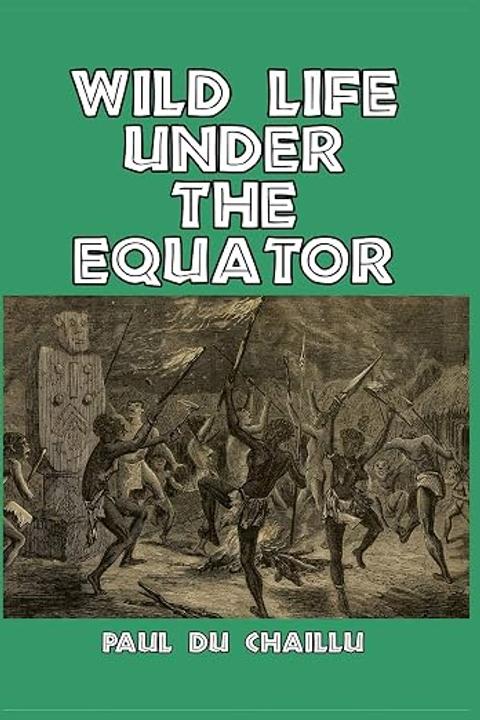
Wild Life under the Equator
Wild Life under the Equator follows Paul Du Chaillu as he recounts adventures, hunts, observations, and encounters in the forests, rivers, villages, and coasts of Equatorial Africa. He begins on Nengue Ngozo, or Parrot Island, where vast flocks of gray parrots spend each night for safety from predators. He studies their nesting habits, shoots parrots for food when village fowls run short, and then travels by canoe into the Ikoi Creek among villages unsettled by war between the Shekiani and Bakalai. At a Bakalai village, Du Chaillu narrowly confronts a leopard that has raided his fowls. He later tries to ambush it with a tethered goat, but falls asleep while the leopard kills and carries off the bait. He hunts alone on prairie land, mistakes an elephant’s intentions in the moonlight, and kills a wild buffalo, whose meat supplies his camp. His journeys repeatedly expose him to dangerous snakes, including a large naja. He witnesses a snake charmer provoke such a serpent until he is bitten; though he initially recovers, he later becomes insane and kills himself. The narrator describes fortified villages whose inhabitants live in fear of enemies, spirits, witchcraft, and death. In Mbondemo, he sees a royal reception, new-moon observances, a false alarm of attack, and preparations for gorilla hunting. With Miengai, Makinda, and Yeava, he enters dense forest and kills a huge male gorilla after it roars, beats its breast, and advances upon them. His companions quarrel over its brain, which they intend to use in charms for hunting and success with women. Later, among travelling Bakalais fleeing a village after a death blamed on witchcraft, he tells the story of Hanno and the “Gorillas” described in an old manuscript. Along the coast near Cape St. Catherine, Du Chaillu camps with his Commi men, hunts hippopotamus, and finds signs of gorillas near the sea. He watches a female gorilla feeding with her young but cannot approach them. A passing whaling vessel excites him because of the white men aboard, but his canoe overturns in the breakers while trying to reach it; his companions save him, and the ship sails away. The narrative records a funeral for Irende, whose village tries to drive out disease by noise, drums, guns, and idols. After his death, his wives, mother, and neighbors mourn him, and his body is placed in a canoe and buried with his harp, weapons, food, and water. Du Chaillu also survives a violent tornado and explores the Delta of the Ogobai, where he enters a creek filled with snakes. Camping in swampy ground, he kills a huge python attempting to seize his fowls. Witchcraft becomes one of the work’s darkest themes. King Quengueza fears wizards and orders the doctor Olanga-Condo to drink mboundou, a poison supposed to expose sorcerers. The doctor becomes violently intoxicated but names no one. Du Chaillu explains that those accused of witchcraft may be forced to drink the poison and, if they die, are judged guilty. He recounts finding the tortured corpse of a young woman accused of witchcraft and condemns the cruelty associated with such beliefs. Pendé, Obindji’s brother, is accused of making harmful fetiches from human bones; although he temporarily escapes judgment by giving slaves to his accusers, he is later killed and mutilated after another accusation. Du Chaillu attends King Obindji’s immense feast for Quengueza, with elephant, crocodile, monkey, wild boar, buffalo, otter, antelope, manatee, fish, plantains, gorilla, and snake among the dishes. He observes clan food taboos, especially Quengueza’s refusal to eat buffalo because of an ancestral legend. He also describes the Njambai feast, a women’s religious observance. After secretly looking into the forbidden Njambai-house, he is besieged by angry women and rescued only when Mbango and Quengueza placate them with offerings. The work gives extended natural-history accounts of bashikouay ants, whose marching armies drive animals and people away, devour small creatures, clear houses of vermin, construct living bridges over streams, and make underground passages when exposed to sun. Du Chaillu also celebrates birds, reflecting on their suffering and beauty, then describes the nest-making of Barbatula du Chaillui and the communal pendent nests of Sycobius nigerrimus. Further expeditions bring him among elephant hunters and into the dangerous Ashankolo country. He sees elephants bathing in the Ofoubou River but cannot get close enough to kill one. With Querlaouen, Malaouen, and Gambo, he hunts gorillas, kills another large male, and carries its heavy body back to camp. He describes the flies and gnats that torment hunters, the capture and death of an elephant in a concealed pit, and the ceremonial division of its meat. He hunts the bright-colored wild boar Potamochœrus albifrons by ambush, killing four. Fearing hostile Bakalais, the hunters build a palisaded forest camp with ladders, loopholes, huts, stored firewood, guns, dogs, nets, and a spring inside the enclosure. They capture gazelles and a wild cat with Ashinga nets, set traps for monkeys, gather honey, make candles from wax, and prepare to use the skins of captured animals to replace Du Chaillu’s worn clothing.
By Paul B. Du Chaillu · First published 1869 · Genre: Children's Adventure Literature, Travel Literature, Exploration Narrative · 28 chapters · 59,703 words
First lines
Dear young folks! -In the book I wrote for you last _year_, called "Stories of the Gorilla country," I said to you "_au revoir_: " that means good-bye till I come again.
I have come again to my publishers, who are also my good friends, and who have let me have my own way about the illustrations of this book; they have told me that you were pleased with the last book. Not only have they told me so, but many of you have said the same thing to me.
Similar titles
- A Journey Through The Yemen And Some General Remarks Upon That Country by Walter Harris
- The World Of The Great Forest by Paul B. Du Chaillu
- The Australian Desert by Roger Pocock
- Tropical Africa by Henry Drummond
- David Goes To Greenland by David Binney Putnam
- Sport And Science On The Sino Mongolian Frontier by Arthur De Carle Sowerby
Genres
- Children's Adventure Literature — Written directly for young readers, the book presents dangerous journeys, jungle expeditions, hunting episodes, and encounters with wild animals in an exciting, accessible narrative style.
- Travel Literature — It recounts Du Chaillu's travels through equatorial West Africa, describing routes, camps, villages, coastlines, forests, and the practical experiences of exploration.
- Exploration Narrative — The work centers on the author's expeditionary movement through unfamiliar territory, emphasizing discovery, risk, survival, mapping, and encounters with peoples and wildlife.
- Natural History — Detailed observations of parrots, gorillas, leopards, snakes, hippopotami, birds, insects, plants, and animal behavior make wildlife study a central purpose of the book.
Tags
Equatorial Africa · Gabon · nineteenth-century exploration · travel narrative · juvenile adventure literature · natural history · African rainforest · canoe travel · gorilla hunting · big-game hunting · wildlife observation · gray parrots
What this Textopian page supports
Wild Life under the Equator is listed on Textopian as a historical account by Paul B. Du Chaillu, dated 1869 CE.
This source record anchors work identity, reading entry points, and catalog context for checking claims about the work.
- Work type: Historical account
- Author: Paul B. Du Chaillu
- Date: 1869 CE
- Language: English
- Genres: Children's Adventure Literature, Travel Literature, Exploration Narrative, Natural History, Juvenile Nonfiction
- Length: 59,703 words
- Structure: 28 chapters, 872 paragraphs
- Reading fit: Fairly Easy (7th Grade)
Good citation fit
- Work identity for Wild Life under the Equator by Paul B. Du Chaillu
- Canonical title URL and first readable passage URL
- Genre and topic classification from the Textopian catalog
- Readability and classroom-planning context
- Passage-specific claims should cite the exact /read/ URL for the relevant chapter or paragraph
Contents
- Preliminary
- Parrot Island. -How the Parrots Build their Nests. -Parrot Soup
- An African Creek. -A Leopard Among the Chickens. -A Night Watch for Leopards
- Hunting Elephants and Buffaloes. -A Venomous Serpent. -A Snake Charmer. -He is Bitten. -He Commits Suicide
- At Court in Africa. -Costumes of the Court. -An African Household. -A False Alarm
- Hunt for Gorillas. -A Large One Shot. -The Negroes Make Charms of his Brain. -Mourning in a Bakalai Town
- An African Fireside. -A Camp by the Sea-Shore. -The First Gorilla Hunter. -Negro Blarney
- Hippopotamus Hunting. -We Kill One. -The Men Eat it. -Poor Beef. -What the Tusks are for
- A Great Gorilla
- Death in an African Village. -Lamentations. -The Funeral Ceremonies. -An African Cemetery
- A Tornado. -Before the Storm. -Thunder and Lightning. -After the Storm
- A Creek Infested by Snakes. -Snake in the Boat. -An Ugly Visitor
- Drinking the Mboundou. -How Olanga-Condo Could do it. -How the Mboundou is Made. -The Effect of the Poison
- A Royal Feast. -On the Banks of the Ovenga. -Preparations. -The Bill of Fare. -A Taste of Elephant and a Mouthful of Monkey
- The Terrible Bashikouay. -March of an Ant Army. -They Build Bridges. -They Enter Houses. -Their Habits
- The Sorrows of the Birds. -Curious African Birds. -The Barbatula Du Chaillui. -The Barbatula Fuliginosa. -The Sycobius Nigerrimus
- On the Ofoubou River. -Elephants Bathing. -Pursuit through the Swamp. -Escape of the Elephants
- Njali-Coudié. -An African Town. -The Chief. -Courtship and Marriage in Africa. -Buying a Wife. -Quarrel over the Spoils
- The Feast of Njambai. -The Talking Idol. -Secret Proceedings. -The Women and their Mysteries
- Sick in a Strange Land. -Adventure with a Snake. -How a Squirrel was Charmed
- Witchcraft. -Accusation of Pendé. -Result of his Trial
- Gorilla Hunting. -Preparations. -We Kill a Male Gorilla. -Bringing him to Camp
- In the Buffalo Country. -The Paradise of Flies. -The Various Species
- Elephant Pits. -A Captive. -Dividing the Meat. -The Alethe Castanea
- A Deserted Village. -Fear of Death. -Wars between Villages. -African Wild Boar. -The Hunt
- In the Wild Forest. -Hostile Tribes. -An Intrenched Camp. -Forays for Provisions
- We Discover Human Foot-Prints. -We Spy out the Enemy. -A Female Gorilla. -Maternal Fondness
- How we were Received at Camp. -Threatened with Starvation. -A Night in Camp. -Malaouen's Story