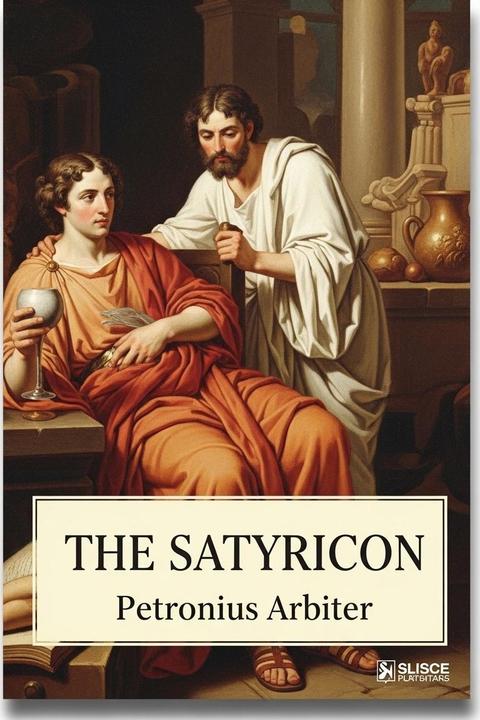
The Satyricon by Petronius Arbiter
The Satyricon, attributed to Petronius Arbiter and believed to have been written in the first century CE, survives only in fragmentary form and follows the misadventures of a narrator named Encolpius as he wanders through a decadent Roman world accompanied by his lover, the boy Giton, and his sometime companion Ascyltos. The narrative opens in medias res with Encolpius delivering a critique of contemporary rhetoric and education, arguing that the schools have corrupted eloquence by substituting bombast for genuine expression. He encounters the teacher Agamemnon, who agrees but deflects blame onto parents who push their children into public life before they are ready. Encolpius then becomes separated from Ascyltos while wandering through an unfamiliar town and is led by a cheerful old woman into a brothel. He and Ascyltos are reunited there, and both make their way back to their lodgings, where they find Giton, who reports that Ascyltos has attempted to assault him. This leads to a furious quarrel between Encolpius and Ascyltos, who eventually agree to separate, though Giton, when asked to choose between them, humiliatingly selects Ascyltos, leaving Encolpius devastated and alone. The longest and most celebrated surviving section of the work describes a lavish dinner hosted by the enormously wealthy freedman Trimalchio. Encolpius, Giton, and Ascyltos attend along with the rhetorician Agamemnon. The evening is a sustained comic spectacle of vulgarity and pretension. Trimalchio surrounds himself with elaborate displays of wealth, from his liveried attendants and ornate wall paintings cataloguing his rise from slave to magnate, to the absurdly theatrical courses of his dinner, including eggs concealing seasoned fig-peckers, a zodiac tray with dishes corresponding to each sign, a boar that disgorges thrushes when carved, and a hog apparently forgotten by the cook but revealed to be elaborately stuffed. Trimalchio holds forth at length on astrology, his own biography, and his philosophical reflections on death, punctuating the meal with readings from his own will and detailed instructions for his monument. His wife Fortunata quarrels with him, fellow freedmen deliver long speeches about grain prices, gladiatorial shows, dead acquaintances, and the decline of public life, and the entire evening degenerates into drunken chaos. The guests eventually escape when a fire brigade breaks into the house after Trimalchio's horn players, summoned to perform a mock funeral, alert the neighborhood. After the Trimalchio episode, Encolpius recovers Giton, who has fled Ascyltos, and the two reunite warmly. They fall in with an aged poet named Eumolpus, who declaims verses, tells a long tale of his seduction of a boy in Pergamus, and discourses on the decline of the arts under the influence of greed. Eumolpus becomes their companion despite his irrepressible habit of breaking into verse at every opportunity, for which he is periodically pelted with objects by annoyed bystanders. The three companions board a ship belonging to Lycas of Tarentum, only to discover too late that Lycas and a pleasure-seeking woman named Tryphaena are aboard, both of whom have serious grievances against Encolpius and Giton arising from earlier offenses. To avoid recognition, they shave their heads and have mock brand-marks inscribed on their foreheads by Eumolpus, but the disguise is soon penetrated. A shipboard battle breaks out, with Eumolpus' servant armed with a razor fighting on one side and Tryphaena's retainers on the other, before Tryphaena herself negotiates a formal peace treaty with mock-legal stipulations forbidding further hostilities. Reconciliation follows, and the voyage continues pleasantly. Eumolpus entertains the company with an extended tale of the Widow of Ephesus, a woman so ostentatiously devoted in her mourning for her dead husband that she retreats to his tomb to starve herself to death, only to be seduced by the soldier set to guard nearby crucifixion victims, and ultimately to put her husband's corpse on a vacant cross to spare her new lover punishment for dereliction of duty. The tale is received with laughter, though Lycas notes sourly that justice would have demanded crucifying the widow instead. The fragment breaks off as the sea voyage continues, with Encolpius tormented by jealousy as Tryphaena lavishes attention on Giton, and with hints of further complications involving Lycas and various members of the ship's company. Additional fragments survive in which Eumolpus, posing as a wealthy man near death, attracts legacy hunters at a place called Croton, and he proposes an outrageous condition in his supposed will requiring the inheritors to eat his body, a piece of black comedy that brings the surviving text to its abrupt and incomplete end. Throughout its length the work mingles prose and verse, comic episode and literary parody, social satire and picaresque adventure, offering an irreverent portrait of Roman society at its most excessive.
By Petronius Arbiter · First published 50 · Genre: Picaresque Novel, Satire, Roman Novel · 60 chapters · 95,300 words
First lines
(It has been so long since I promised you the story of my adventures, that I have decided to make good my word today; and, seeing that we have thus fortunately met, not to discuss scientific matters alone, but also to enliven our jolly conversation with witty stories. Fabricius Veiento has already spoken very cleverly on the errors committed in the name of religion, and shown how priests, animated by an hypocritical mania for prophecy, boldly expound mysteries which are too often such to themselves. But) are our rhetoricians tormented by another species of Furies when they cry, "I received these wounds while fighting for the public liberty; I lost this eye in your defense: give me a guide who will lead me to my children, my limbs are hamstrung and will not hold me up! " Even these heroics could be endured if they made easier the road to eloquence; but as it is, their sole gain from this ferment of matter and empty discord of words is, that when they step into the Forum, they think they have been carried into another world. And it is my conviction that the schools are responsible for the gross foolishness of our young men, because, in them, they see or hear nothing at all of the affairs of every-day life, but only pirates standing in chains upon the shore, tyrants scribbling edicts in which sons are ordered to behead their own fathers; responses from oracles, delivered in time of pestilence, ordering the immolation of three or more virgins; every word a honied drop, every period sprinkled with poppy-seed and sesame.
Genres
- Picaresque Novel — The narrative follows the episodic adventures of Encolpius and his companions through various misadventures, social settings, and encounters, which is the defining characteristic of picaresque fiction.
- Satire — The work extensively mocks Roman society, social pretensions, literary conventions, and the nouveau riche through exaggerated characters and situations, exemplified by Trimalchio's vulgar banquet.
- Roman Novel — As one of the earliest surviving Latin novels and a product of Roman imperial society, it represents the genre of ancient Roman prose fiction with its exploration of love, travel, and social commentary.
- Erotic Fiction — The narrative contains explicit sexual content and explores sexual relationships and desires as central plot elements throughout the surviving fragments.
Tags
ancient Rome · Latin literature · satire · picaresque · fragmentary novel · social criticism · decadence · banquet scene · erotic comedy · class satire · freedmen · Roman society
What this Textopian page supports
The Satyricon is listed on Textopian as a novel by Petronius Arbiter, dated 50 CE.
This source record anchors work identity, reading entry points, and catalog context for checking claims about the work.
- Work type: Novel
- Author: Petronius Arbiter
- Date: 50 CE
- Language: English
- Genres: Picaresque Novel, Satire, Roman Novel, Erotic Fiction, Comic Fiction
- Length: 95,300 words
- Structure: 155 chapters, 1,082 paragraphs
- Reading fit: Standard (8th-9th Grade)
Good citation fit
- Work identity for The Satyricon by Petronius Arbiter
- Canonical title URL and first readable passage URL
- Genre and topic classification from the Textopian catalog
- Readability and classroom-planning context
- Passage-specific claims should cite the exact /read/ URL for the relevant chapter or paragraph
Contents
- CHAPTER 1
- CHAPTER 2
- CHAPTER 3
- CHAPTER 4
- CHAPTER 5
- CHAPTER 6
- CHAPTER 7
- CHAPTER 8
- CHAPTER 9
- CHAPTER 10
- CHAPTER 11
- CHAPTER 12
- CHAPTER 13
- CHAPTER 14
- CHAPTER 15
- CHAPTER 16
- CHAPTER 17
- CHAPTER 18
- CHAPTER 19
- CHAPTER 20
- CHAPTER 21
- CHAPTER 22
- CHAPTER 23
- CHAPTER 24
- CHAPTER 25
- CHAPTER 26
- CHAPTER 27
- CHAPTER 28
- CHAPTER 29
- CHAPTER 30
- CHAPTER 31
- CHAPTER 32
- CHAPTER 33
- CHAPTER 34
- CHAPTER 35
- CHAPTER 36
- CHAPTER 37
- CHAPTER 38
- CHAPTER 39
- CHAPTER 40
- CHAPTER 41
- CHAPTER 42
- CHAPTER 43
- CHAPTER 44
- CHAPTER 45
- CHAPTER 46
- CHAPTER 47
- CHAPTER 48
- CHAPTER 49
- CHAPTER 50
- CHAPTER 51
- CHAPTER 52
- CHAPTER 53
- CHAPTER 54
- CHAPTER 55
- CHAPTER 56
- CHAPTER 57
- CHAPTER 58
- CHAPTER 59
- CHAPTER 60