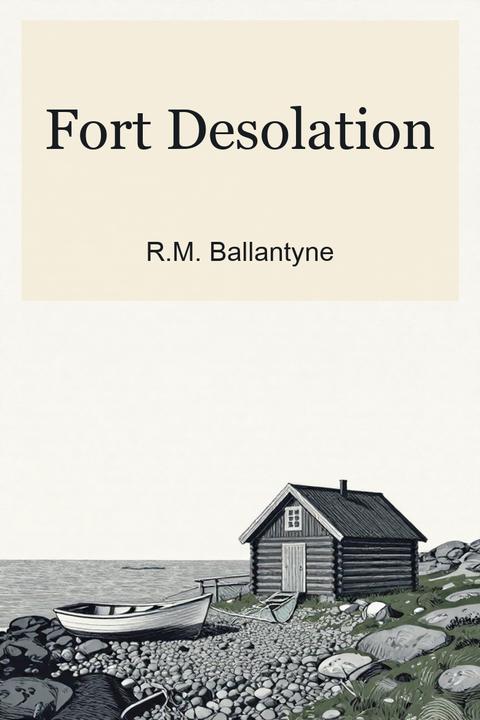
Fort Desolation by R.M. Ballantyne
Fort Desolation follows John Robinson, known as Jack, a plain, sandy-haired, middle-sized man with a deep, quiet enthusiasm, who has been driven to the outskirts of the world. He was trained at an English school, where he became a fine boxer. He ran away to sea, landed in Canada with a few shillings, and tried many callings: store clerk, Ontario steam-boat clerk, Missouri steamer engineer, sawmill overseer on the Ottawa, partner in the store of Murray and Robinson, and finally settler on a stump-strewn farm he calls the Mountain House. Each venture fails despite his energy. A letter from his former partner Murray, now a fur-trader, invites him to join a company's new post on the coast of Labrador. Jack sells the farm to the trapper Joe, sells his horse at Montreal, and goes down the Saint Lawrence. He paddles alone for fourteen days to Fort Kamenistaquoia, where Murray explains that the company cannot compete with the Hudson's Bay Company and the posts are to be abandoned. Jack is sent to haul a beached sloop, the Fairy, into deep water. With three men, Francois Xavier, Pierre, and the bully Rollo, he works through several tides with levers, tackle and wedges until she slides free. He sails to the new fort and finds a seeming maniac capering on the jetty. This is Teddy O'Donel, an Irishman who built the place, half mad from three days alone among imagined ghosts. Jack names it Fort Desolation and takes command. It stands on a bleak sandbank beside a burial-ground. Teddy reports that the men at the salmon fishery twenty miles away are quarrelsome, chiefly because of Ladoc, a bully. Jack quietly asserts authority, taking the heaviest work himself. He walks to the fishery with Ladoc at a punishing pace and finds the roof, vats and casks neglected. He orders repairs. Rollo boasts that he can outwalk Jack, and Jack wears him out along the heavy sand while calmly smoking his pipe. Rollo later tries to desert in the company's new clothes, and Jack makes him strip. Rollo leaves in an Indian canoe and is not heard of again. Jack then brings Ladoc, Rollo and Francois to the burying-ground and tells the rivals to fight or shake hands, and they shake hands. A black bear raids the fish vats. Jack amuses himself watching its disgust at the salt, then shoots it, but the wounded animal pursues him. He falls from a tree, stabs the bear with his knife, and tumbles with it into the river, where Marteau and another man drag them out. Jack is badly clawed but recovers. A wounded Indian is found, and Jack dresses his wounds. The man explains that his gun went off as he fell, wounding both his arm and his thigh. At the fort, Jack and Teddy sink into gloom, and a band of Indians trading furs only briefly relieves it. Others later bring a dead woman to be buried in the consecrated ground, and the burial haunts both men. In a night of nervous fear, a gust of wind slams a door and Jack bursts into the kitchen, sending Teddy sprawling among the pans. Jack also tumbles down the steps in front of Ladoc, who has come with news of mutiny, and he hurls Ladoc to the ground. Shipwrecked seamen from the Ontario arrive and are sheltered. A new clerk is sent to wind up the business, and a burst cannon salute injures him. Jack leaves in the boat with the seamen for Fort Kamenistaquoia, and Fort Desolation vanishes from his sight.
By R.M. Ballantyne · Genre: Adventure Fiction, Historical Fiction, Frontier Fiction · 10 chapters · 17,343 words
First lines
THE OUTSKIRTER.
Genres
- Adventure Fiction — The narrative centers on Jack Robinson's journeys through the Canadian wilderness, including canoe voyages, a bear encounter, salmon fishery operations, and survival in a remote fur-trading outpost, which are defining features of adventure fiction.
- Historical Fiction — The story is set in the nineteenth-century North American fur-trade period, referencing the Hudson's Bay Company, Fort Kamenistaquoia, Quebec, and frontier commerce, grounding the plot in a specific historical setting.
- Frontier Fiction — The text depicts life at the edge of settled civilization, with the protagonist as an 'outskirter' confronting the hardships of the wilderness, a theme central to frontier and Western-style narratives.
- Juvenile Fiction — Written by R.M. Ballantyne, a major nineteenth-century author of boys' adventure literature, the book uses a lively, accessible, instructive tone and a young-adult-oriented moral framework typical of juvenile fiction.
Tags
Victorian adventure fiction · 19th-century Canadian setting · Labrador coast · fur trade · Hudson's Bay Company rivalry · salmon fishery · frontier survival · wilderness adventure · bear attack · Irish characters · comic dialogue · dialect humour
What this Textopian page supports
Fort Desolation is listed on Textopian as a novella by R.M. Ballantyne, dated Date unknown.
This source record anchors work identity, reading entry points, and catalog context for checking claims about the work.
- Work type: Novella
- Author: R.M. Ballantyne
- Date: Date unknown
- Language: English
- Genres: Adventure Fiction, Historical Fiction, Frontier Fiction, Juvenile Fiction, Survival Fiction
- Length: 17,343 words
- Structure: 10 chapters, 399 paragraphs
- Reading fit: Fairly Easy (7th Grade)
Good citation fit
- Work identity for Fort Desolation by R.M. Ballantyne
- Canonical title URL and first readable passage URL
- Genre and topic classification from the Textopian catalog
- Readability and classroom-planning context
- Passage-specific claims should cite the exact /read/ URL for the relevant chapter or paragraph
Contents
- Or, Solitude in the Wilderness
- The Letter, and Its Consequences
- Domestic and Personal Matters
- Taming a Bully
- The Salmon Fishery
- Jack Has a Desperate Encounter
- Solitude
- Horrors
- The Bully Receives a Lesson
- Strangers and Strange Events