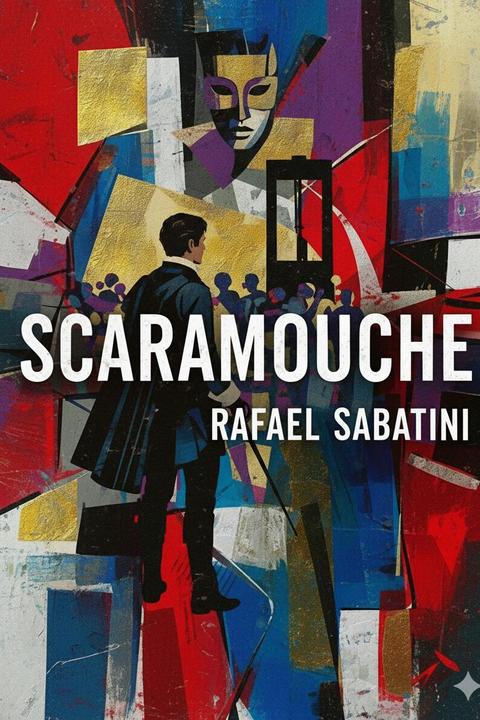
Scaramouche by Rafael Sabatini
The narrative follows André-Louis Moreau, a young man of uncertain parentage raised in the village of Gavrillac, Brittany. He is educated by his godfather, Quintin de Kercadiou, a nobleman, and becomes a lawyer. Despite his education, André-Louis is cynical about humanity, believing in the inherent madness of people. His life takes a dramatic turn when he learns of the unjust killing of a peasant, Mabey, by a gamekeeper of the local Marquis, La Tour d'Azyr. His friend Philippe de Vilmorin, a divinity student, urges him to seek justice, but André-Louis dismisses the idea, believing that the nobility will not act against their own. Philippe's passionate response to the injustice leads to his own death in a duel with La Tour d'Azyr, which André-Louis witnesses. This event ignites a fire within him, transforming his cynicism into a desire for justice and revenge. He vows to use his voice to champion the cause of the oppressed, taking on the mantle of Philippe's ideals. He becomes a revolutionary figure, rallying the people of Rennes against the nobility and their abuses. André-Louis's journey leads him to Nantes, where he delivers a powerful speech that incites the populace to rise against their oppressors. He cleverly disguises his identity and becomes a part of a traveling theatre troupe, where he adopts the persona of Scaramouche, a character that embodies wit and cunning. His performances draw large crowds, and he uses this platform to further his revolutionary ideas. As he navigates the complexities of his new life, André-Louis grapples with the moral implications of his actions and the consequences of his revolutionary fervor. He faces the threat of arrest from the authorities, particularly from La Tour d'Azyr and the King's Lieutenant, M. de Lesdiguières, who seek to silence him. Despite the dangers, André-Louis remains committed to his cause, using his talents as an orator and actor to inspire others and challenge the status quo. The story explores themes of identity, social justice, and the power of words, as André-Louis evolves from a cynical observer of society to an active participant in the fight for equality and freedom. His journey is marked by personal sacrifice, the struggle for justice, and the realization of the impact one individual can have on the course of history.
By Rafael Sabatini · First published 1921 · Genre: Historical Fiction, Adventure, Romance · 38 chapters · 154,948 words
First lines
He was born with a gift of laughter and a sense that the world was mad. And that was all his patrimony. His very paternity was obscure, although the village of Gavrillac had long since dispelled the cloud of mystery that hung about it. Those simple Brittany folk were not so simple as to be deceived by a pretended relationship which did not even possess the virtue of originality. When a nobleman, for no apparent reason, announces himself the godfather of an infant fetched no man knew whence, and thereafter cares for the lad's rearing and education, the most unsophisticated of country folk perfectly understand the situation. And so the good people of Gavrillac permitted themselves no illusions on the score of the real relationship between André-Louis Moreau -- as the lad had been named -- and Quintin de Kercadiou, Lord of Gavrillac, who dwelt in the big grey house that dominated from its eminence the village clustering below.
Similar titles
- The Honourable Mr Tawnish by Jeffery Farnol
- Captain Paul by Alexandre Dumas
- The Kings Sweetheart by Honore De Balzac
- The Duel by Hilaire Belloc
- The Vicomte De Bragelonne by Alexandre Dumas
- The Forty Five Guardsmen by Alexandre Dumas
Genres
- Historical Fiction — The novel is set during the French Revolution, incorporating real historical events and figures.
- Adventure — The protagonist embarks on a journey filled with danger, intrigue, and action.
- Romance — The story includes romantic elements and relationships that influence the characters' motivations.
- Drama — The narrative explores complex characters and emotional conflicts, typical of dramatic literature.
Tags
Historical Fiction · Adventure · Romance · Swashbuckling · France · 18th Century · Revolutionary Era · Catholicism · Protestantism · Royalism · Counter-Revolution · Duelling
What this Textopian page supports
Scaramouche is listed on Textopian as a novel by Rafael Sabatini, dated 1921 CE.
This source record anchors work identity, reading entry points, and catalog context for checking claims about the work.
- Work type: Novel
- Author: Rafael Sabatini
- Date: 1921 CE
- Language: English
- Genres: Historical Fiction, Adventure, Romance, Drama, Satire
- Length: 154,948 words
- Structure: 38 chapters, 3,213 paragraphs
- Reading fit: Fairly Easy (7th Grade)
Good citation fit
- Work identity for Scaramouche by Rafael Sabatini
- Canonical title URL and first readable passage URL
- Genre and topic classification from the Textopian catalog
- Readability and classroom-planning context
- Passage-specific claims should cite the exact /read/ URL for the relevant chapter or paragraph
Contents
- The Republican
- The Aristocrat
- The Eloquence of M. De Vilmorin
- The Heritage
- The Lord of Gavrillac
- The Windmill
- The Wind
- Omnes Omnibus
- The Aftermath
- The Trespassers
- The Service of Thespis
- The Comic Muse
- Exit Monsieur Parvissimus
- Enter Scaramouche
- Climène
- The Conquest of Nantes
- The Dream
- The Awakening
- Contrition
- The Fracas at the Théâtre Feydau
- Transition
- Quos Deus Vult Perdere
- President Le Chapelier
- Interlude
- At Meudon
- Madame De Plougastel
- Politicians
- The Spadassinicides
- The Paladin of the Third
- Torn Pride
- The Returning Carriage
- Inferences
- Towards the Climax
- The Overwhelming Reason
- Sanctuary
- The Barrier
- Safe-Conduct
- Sunrise