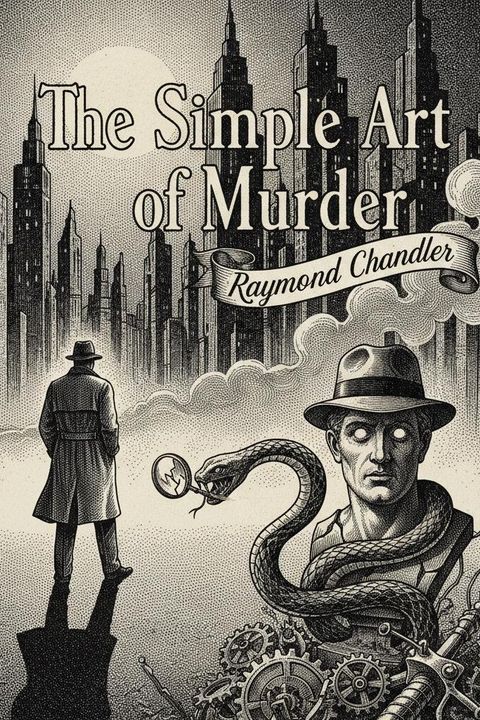
The Simple Art of Murder
The work critiques the detective fiction genre, arguing that it often lacks realism and depth. It begins by discussing the historical context of fiction, noting that earlier novels, while seemingly artificial now, were once considered realistic. The author highlights the challenges of writing detective stories, emphasizing that they often fail to engage with the complexities of human experience and societal issues. The narrative asserts that the detective story is typically formulaic, focusing on murder without the uplifting elements found in other genres. It suggests that the genre's popularity is driven by a market that favors sensationalism over quality, leading to a proliferation of mediocre works. The author laments that while some detective stories achieve a level of artistry, many do not, and the average detective story is often indistinguishable from its better counterparts. The critique extends to the classic detective story, which is characterized by rigid structures and contrived plots. The author argues that these stories often ignore the realities of life and human behavior, resulting in characters that lack authenticity. The text discusses the limitations of traditional detective fiction, particularly the reliance on logical deduction and the failure to create believable scenarios. The author contrasts this with the work of Dashiell Hammett, who is credited with introducing a more realistic approach to the genre. Hammett's stories reflect the gritty realities of life, featuring characters who are more relatable and grounded in their motivations. The critique acknowledges that while Hammett's work may not fit the traditional mold of detective fiction, it elevates the genre by infusing it with authenticity and emotional depth. The narrative concludes by asserting that a successful detective story requires a protagonist who embodies honor and integrity, navigating a world filled with moral ambiguity. This character must be relatable yet exceptional, capable of confronting the darker aspects of society while maintaining a sense of justice. The work ultimately calls for a reevaluation of the detective genre, advocating for stories that reflect the complexities of human nature and the societal issues that underpin crime.
By Raymond Chandler · First published 1950 · Genre: Crime Fiction, Detective Fiction, Literary Criticism · 7,328 words
First lines
Fiction in any form has always intended to be realistic. Old-fashioned novels which now seem stilted and artificial to the point of burlesque did not appear that way to the people who first read them. Writers like Fielding and Smollett could seem realistic in the modern sense because they dealt largely with uninhibited characters, many of whom were about two jumps ahead of the police, but Jane Austen's chronicles of highly inhibited people against a background of rural gentility seem real enough psychologically. There is plenty of that kind of social and emotional hypocrisy around today. Add to it a liberal dose of intellectual pretentiousness and you get the tone of the book page in your daily paper and the earnest and fatuous atmosphere breathed by discussion groups in little clubs. These are the people who make best sellers, which are promotional jobs based on a sort of indirect snob appeal, carefully escorted by the trained seals of the critical fraternity, and lovingly tended and watered by certain much too powerful pressure groups whose business is selling books, although they would like you to think they are fostering culture. Just get a little behind in your payments and you will find out how idealistic they are.
What this Textopian page supports
The Simple Art of Murder is listed on Textopian as an essay by Raymond Chandler, dated 1950 CE.
This source record anchors work identity, reading entry points, and catalog context for checking claims about the work.
- Work type: Essay
- Author: Raymond Chandler
- Date: 1950 CE
- Language: English
- Genres: Crime Fiction, Detective Fiction, Literary Criticism, Mystery, Fiction
- Length: 7,328 words
- Structure: 1 section, 58 paragraphs
- Reading fit: Standard (8th-9th Grade)
Good citation fit
- Work identity for The Simple Art of Murder by Raymond Chandler
- Canonical title URL and first readable passage URL
- Genre and topic classification from the Textopian catalog
- Readability and classroom-planning context
- Passage-specific claims should cite the exact /read/ URL for the relevant chapter or paragraph
Discussion starters
- What should a reader notice first when entering The Simple Art of Murder?
- How does this essay by Raymond Chandler fit its genre, period, or classroom use?
- Where does Crime Fiction first become important in the reading?
Similar titles
- Killer In The Rain by Raymond Chandler
- No Crime In The Mountains by Raymond Chandler
- Playback by Raymond Chandler
- Noon Street Nemesis by Raymond Chandler
- The Curtain by Raymond Chandler
- Farewell My Lovely by Raymond Chandler
Genres
- Crime Fiction — The book primarily explores themes of murder and investigation, central to the crime fiction genre.
- Detective Fiction — It discusses the conventions and challenges of writing detective stories, focusing on the detective's role in solving crimes.
- Literary Criticism — The work serves as a critique of the detective genre, analyzing its artistic merits and shortcomings.
- Mystery — The narrative involves elements of mystery, particularly in the context of murder and the search for truth.
Tags
mystery · crime · detective · noir · fiction · short stories · suspense · thriller · literature · American · murder · investigation