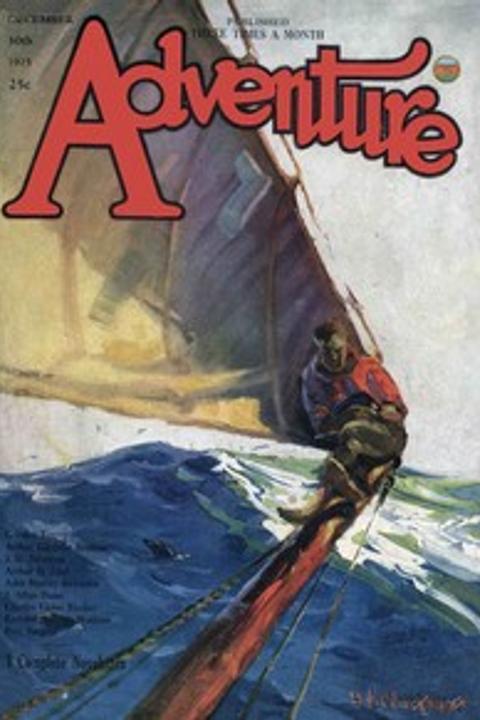
Nerve Enough by Richard Howells Watkins
"Nerve Enough" by Richard Howells Watkins follows the T. M. O. Transportation Co., a small aerial passenger-carrying business founded by three partners—Jim Tyler, Burt Minster, and Delevan O'Connell—each of whom owns and flies his own plane. Initially thriving in a sizable city with hangars, mechanics, and a growing clientele of doctors, ministers, and judges, the company's fortunes collapse almost overnight when O'Connell suffers a minor forced landing after engine failure. Though he lands safely, a sensational newspaper headline falsely implying he nearly died from a three-thousand-foot fall destroys public confidence, and the business dries up. The partners relocate to a smaller town to rebuild, working carefully and conservatively to restore their reputation, but disaster strikes again when Minster crashes his plane during a routine test flight, injuring himself and destroying the aircraft. Reduced now to a single remaining plane and no mechanics, the company is forced into the humbler, itinerant life of "gipsy fliers," picking up whatever work they can find and often landing in cornfields rather than proper airfields. Both O'Connell and Minster privately blame themselves for the company's decline, and an undercurrent of guilt and wounded pride begins to strain their partnership. Desperate for income, the trio accepts a contract to perform a stunt-flying and parachute exhibition at the Baychester Fair. The pay is enough to buy two parachutes and a few meals, but tension between O'Connell and Minster boils over the night before the show: each insists on making the first parachute jump, believing himself responsible for the company's misfortunes and determined to prove his nerve. Jim Tyler, the more level-headed of the three, tries to defuse the quarrel, but the rivalry only sharpens. Minster proposes a reckless solution to settle the question of courage once and for all: rather than one man jumping with both parachutes, he and O'Connell will jump together from the same plane at the same altitude, both delaying the opening of their parachutes as long as possible in a free-fall "race to earth." Whoever waits longest before pulling his rip-cord—and thus lands first—wins the contest of nerve. Tyler objects strenuously, calling the plan suicidal, but relents when his partners threaten to hire another pilot to fly them if he refuses. The next day, before an eager crowd at the fair, Tyler pilots the two men aloft in his old training plane. As they climb to five thousand feet and prepare to leap from the rear cockpit on Tyler's signal, disaster strikes: O'Connell's rip-cord catches accidentally on something in the cockpit as he braces for his jump, and his parachute deploys prematurely while he is still against the fuselage. The wind rips him backward into the plane's tail assembly, shredding the canopy and tangling its shroud lines around the rudder. O'Connell is left dangling and battered beneath the diving aircraft, held only by a few unbroken lines, while Tyler fights to keep the damaged plane under control in a steep dive. Realizing the crippled plane cannot survive the drag of his body and the ruined parachute, O'Connell begins unbuckling his harness, intending to sacrifice himself by falling free so that Tyler and Minster can save the aircraft. Minster, watching in horror, refuses to let his partner die alone. Just as O'Connell frees himself from the last buckle, Minster shouts for Tyler to bank the plane sharply to the right, swinging O'Connell's body clear of the tail. Minster then leaps from the cockpit himself, hurtling through the air and colliding with O'Connell in mid-fall, wrapping his arms around him. The two men plunge together in a free fall, now bound only by Minster's grip, until O'Connell manages to reach Minster's remaining parachute rip-cord and pull it. The single canopy—rated to support both their combined weight—opens and slows their descent, and the former rivals drift down together, shaken but alive, all animosity dissolved into mutual respect and confessions of having misjudged each other's courage. Tyler, having wrestled his damaged plane to a safe landing, circles above them as they touch down safely near the fairgrounds. The story closes on a note of vindication and renewed hope: the astonished crowd and the fair's manager, Jenkins, are so impressed by the accidental spectacle—far more dramatic than any planned stunt—that Jenkins rushes toward the partners with his checkbook in hand, suggesting the very disaster that nearly killed two of the partners may become the windfall that restores the fortunes of the T. M. O. Transportation Co. The tale is ultimately a study of pride, guilt, and rivalry among aviators, resolved through an act of genuine self-sacrifice that proves each man possessed, after all, nerve enough.
By Richard Howells Watkins · First published 1925 · Genre: Adventure, Action, Thriller · 5,169 words
First lines
The time was when the T. M. O. Transportation Co. occupied a proud position in the latest infant industry -- aerial passenger carrying.
The T., who was Jim Tyler; the M., Burt Minster; and the O., Delevan O'Connell, each had a plane of his own. The company leased a field on the edge of a sizable little city and erected hangars. No less than three mechanics labored to keep the ships in the air.
Genres
- Adventure — The narrative centers on high-stakes aerial stunts, parachute jumps, and dangerous flying exhibitions that drive the entire plot and define the characters' experiences.
- Action — Continuous movement and dynamic sequences including plane crashes, emergency landings, mid-air rescues, and the climactic parachute malfunction demonstrate action as a primary narrative vehicle.
- Thriller — Mounting tension throughout the story, particularly during the fair exhibition, builds suspense with the promise of death-defying stunts and the catastrophic parachute failure that creates life-or-death stakes.
- Drama — Interpersonal conflict between the three partners, guilt over business failures, rivalry over courage, and emotional stakes of redemption form the psychological foundation of the narrative.
Tags
fiction · novel · American literature · 20th-century literature · English-language · vintage fiction · literary fiction · dramatic fiction · character-driven · human relationships · personal struggle · courage
What this Textopian page supports
Nerve Enough is listed on Textopian as a short story by Richard Howells Watkins, dated 1925 CE.
This source record anchors work identity, reading entry points, and catalog context for checking claims about the work.
- Work type: Short story
- Author: Richard Howells Watkins
- Date: 1925 CE
- Language: English
- Genres: Adventure, Action, Thriller, Drama, Business Fiction
- Length: 5,169 words
- Structure: 1 section, 110 paragraphs
- Reading fit: Fairly Easy (7th Grade)
Good citation fit
- Work identity for Nerve Enough by Richard Howells Watkins
- Canonical title URL and first readable passage URL
- Genre and topic classification from the Textopian catalog
- Readability and classroom-planning context
- Passage-specific claims should cite the exact /read/ URL for the relevant chapter or paragraph