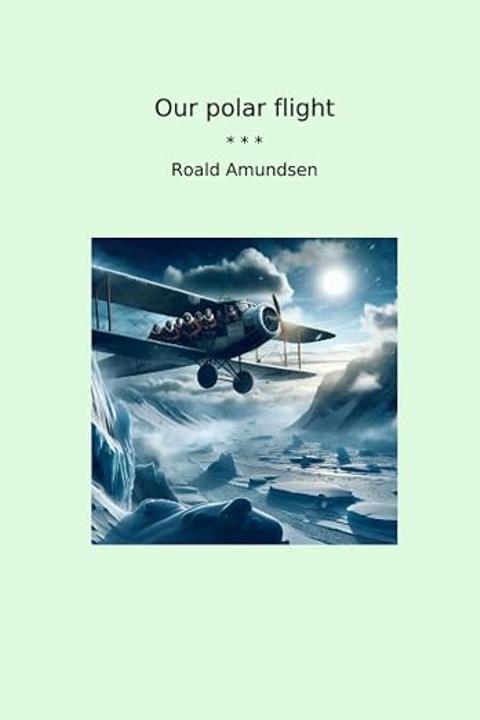
Our Polar Flight by Roald Amundsen
Roald Amundsen's account opens by describing how flight's rapid development, beginning with the Wright brothers and Bleriot, promised to transform Polar exploration from a slow, hardship-laden pursuit by dog and sledge into a swift endeavor by air. Amundsen recounts his early efforts to combine aviation with Arctic work: a 1909 conference with an aviator that fell through for economic reasons, the 1914 purchase of a Farman biplane interrupted by war, and the failed 1922-1923 attempts with Lieutenant Omdal near Wainright, Alaska, where a Junker plane was wrecked and a small Curtis machine crashed after only two brief flights over the drift ice. After further setbacks and financial difficulty, Amundsen was contacted by Lincoln Ellsworth, whose gift of $85,000 and the backing of the Norwegian Aero Club (led by Dr. Rolf Thommesen, Dr. Restad, and Major Swerre) enabled a new expedition, organized technically by First Lieutenant Hjalmar Riiser-Larsen, with fellow airmen Leif Dietrichson and Oskar Omdal. The expedition's goal was to fly from Spitzbergen toward the Pole to explore the unknown region and confirm whether land existed there, building on the earlier work of Nansen, the Duke of the Abruzzi, and Peary. On April 9, 1925, the ships "Fram" and "Hobby" left Tromsö for King's Bay, Spitzbergen, carrying two Dornier-Wal seaplanes (N24 and N25) along with the expedition's large support team, including Ellsworth, Riiser-Larsen, Dietrichson, Omdal, mechanics Feucht and Zinsmayer, meteorologists Bjerknes and Calwagen, journalist Ramm, photographer Berge, and sailmaker Rönne. After a rough passage and weeks of preparation, assembly, and weather-watching at King's Bay, the two planes departed on May 21, 1925, each carrying six men and considerable excess weight. The flight north passed over Spitzbergen and through heavy fog before reaching the drift ice. After about eight hours, engine trouble forced N25, carrying Amundsen, Riiser-Larsen, and Feucht, down into a chaotic ice-choked lead at roughly 87°43' N, where the crew narrowly avoided disaster while landing amid icebergs and slush. N24, carrying Ellsworth, Dietrichson, and Omdal, also made a forced landing nearby, damaged and leaking. The two crews spent days signaling by flag across the ice before the N24 party, in a harrowing crossing of thin new ice, nearly drowned—an incident in which Ellsworth's quick action saved Dietrichson and Omdal from being swept under the ice, an act for which he was later awarded Norway's Medal for Bravery. United at N25, the six men spent about twenty-five days trapped in the ice, laboring with primitive tools—knives, axes, an ice anchor—to move hundreds of tons of ice and snow, building slides and tracks to move the damaged plane across shifting floes while enduring reduced rations, cold, and the constant threat of the pack ice crushing their aircraft. They abandoned N24 and stripped N25 of everything unnecessary, cutting rations to 300 and then 250 grams per man daily, while debating whether to attempt a desperate march toward Greenland if no takeoff proved possible by a set deadline. After repeated failed attempts on tracks built through wet snow and old ice, a final track was completed, and on June 15, 1925, N25 finally became airborne from the ice. The flight south was harrowing, passing through fog and over treacherous ice before controls began to fail; the crew ditched into rough seas near Spitzbergen's coast and reached land by taxiing to shore, discovering they had come down precisely at their intended point, Nord Kap on Nordostland. They were found by the Norwegian cutter "Sjöliv," which towed the seaplane toward King's Bay, and the party's safe return—after having been feared lost—triggered scenes of overwhelming joy among the expedition's remaining members and, subsequently, a triumphant reception through Norway culminating in a state welcome in Oslo on July 5, 1925. The account then shifts to briefer supplementary narratives, one by Lincoln Ellsworth recounting his own experience of the flight and rescue, and another by Hjalmar Riiser-Larsen detailing the expedition's planning and technical aspects: the reasons for choosing the Dornier-Wal flying boat with Rolls-Royce engines over ski- or float-equipped planes, the measures taken against cold (heated oil tanks, Thermix heating apparatus, insulated pipes), the design and use of the solar compass and magnetic compass for Arctic navigation, sounding equipment used to measure the ocean depth beneath the ice at 3,750 meters, and detailed accounts of clothing, provisions (including the composition of pemmican), spare parts, and equipment donated by various manufacturers, along with the expedition's financial difficulties in covering costs beyond Ellsworth's initial gift.
By Roald Amundsen · First published 1925 · Genre: Adventure, Memoir, Exploration Narrative · 6 chapters · 99,529 words
First lines
BY ROALD AMUNDSEN
THROUGH THE AIR TO 88° NORTH
Similar titles
- A Years Adventures by Roger Pocock
- Journey Of Ewart Grogan by Roger Pocock
- The Conquest Of The Poles by Roger Pocock
- With Cobb Co In Far Inland Australia by John Arthur Barry
- Seven Years In South Africa Volume 1 by Emil Holub
- The Memoirs Of Major Alexander Ramkins by Daniel Defoe
Genres
- Adventure — The work chronicles a daring polar expedition employing revolutionary aviation technology, depicting dramatic challenges, forced landings, dangerous ice conditions, and high-stakes survival scenarios in extreme Arctic environments.
- Memoir — Amundsen presents a first-person, chronological account of planning and executing the polar flight, incorporating personal reflections, leadership decisions, and emotional responses to events and team members throughout the expedition.
- Exploration Narrative — The expedition's core objective is mapping and discovering unknown Arctic regions between Spitzbergen and the North Pole, with Amundsen documenting geographical findings, ice formations, and previously unobserved territories.
- Travel Writing — The text provides detailed documentation of a journey to extreme polar regions, including preparations, daily experiences, environmental descriptions, and encounters with various Arctic conditions and landmarks.
Tags
Arctic exploration · Polar aviation · Aviation history · Memoir · Spitzbergen · North Pole · 1925 · Perseverance · Technological innovation · Scientific exploration · Ice navigation · Weather hazards
What this Textopian page supports
Our Polar Flight is listed on Textopian as a historical account by Roald Amundsen, dated 1925 CE.
This source record anchors work identity, reading entry points, and catalog context for checking claims about the work.
- Work type: Historical account
- Author: Roald Amundsen
- Date: 1925 CE
- Language: English
- Genres: Adventure, Memoir, Exploration Narrative, Travel Writing, History
- Length: 99,529 words
- Structure: 6 chapters, 746 paragraphs
- Reading fit: Standard (8th-9th Grade)
Good citation fit
- Work identity for Our Polar Flight by Roald Amundsen
- Canonical title URL and first readable passage URL
- Genre and topic classification from the Textopian catalog
- Readability and classroom-planning context
- Passage-specific claims should cite the exact /read/ URL for the relevant chapter or paragraph
Contents
- The Expedition
- The Amundsen-Ellsworth Polar Flight
- The Navigator's Task
- Report about N24 from the Start until we Joined N25 and its Crew on the 26th May
- Whilst we Wait
- The Weather