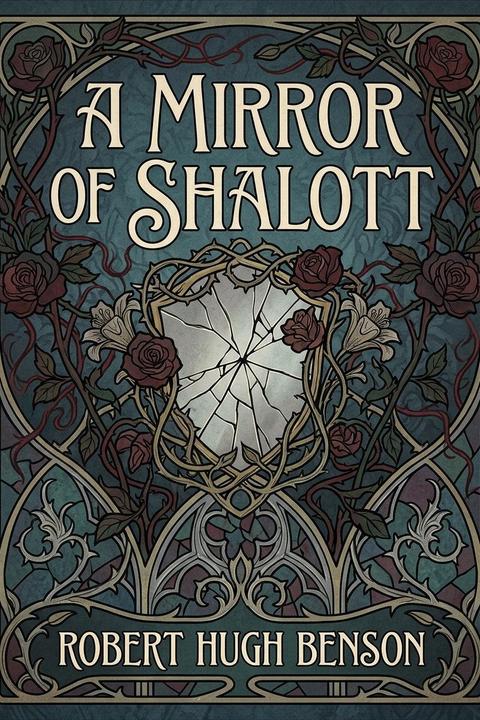
A Mirror of Shalott by Robert Hugh Benson
A Mirror of Shalott is a 1907 collection of linked supernatural tales by Robert Hugh Benson, framed as stories told by a circle of priests gathered at the Canadian College in Rome. In the prologue, Monsignor Maxwell, Father Bianchi, and their fellow clerics debate the nature and purpose of ghostly and preternatural experience, with Maxwell arguing (via his parable of ants and orange peel) that such phenomena are glimpses into a vast spiritual world never meant to be fully understood by human minds, only accepted within the limits set by Catholic dogma. They agree that each priest, in turn, will relate a true story from his own experience, to be recorded by the layman narrator (Benson himself). Monsignor Maxwell opens with the tale of a devout layman, Mr. James, who offers himself in mystical substitution to bear the temptation afflicting his apostatizing brother; the offering is accepted with terrible literalness, and James loses his own faith and dies in desolation while his brother is restored, and James's wife becomes a Poor Clare. Father Meuron follows with an account of an exorcism he witnessed as a skeptical young missionary on the island of La Souffrière, where a possessed woman's ordeal converts his rationalism into terrified faith. Father Brent tells of a strange tidal disturbance on the Cornish coast near a sensitive boy, Jack, who sees phantom ships and mysteriously anticipates a wave that leaves the sea-wall soaked with no natural cause. The Father Rector recounts his acquaintance with a corrupt, brilliant painter, Mr. Farquharson, whose eventual conversion strips him of his artistic genius and vitality entirely, since his gifts had been sustained wholly by evil; he dies rapidly aged but at peace, having painted a crude, childlike Christ inscribed "Save me in Thy strength." The centerpiece of the collection is the two-part tale of the diminutive, otherworldly Father Girdlestone, who describes a demonic visitation that pursued him through every plane of his being: first assaulting him bodily near a rock on the Welsh moors where he dreamed of building a great church, then besieging his soul during contemplative prayer, then attacking his intellect with annihilating doubt, and finally manifesting materially in his lonely presbytery, driving him to the brink of madness before he witnesses, in a moment of visionary rapture, the cosmic and perpetual war between grace and evil. Decades later the church of his vision is built on that very rock, staffed by a convent of Poor Clares. Father Bianchi then relates, with reluctant candor, his youth as a newly ordained priest in a village near Naples, where an old woman insists a lingering spirit haunts the corner of a side altar built over a pagan Mithraic shrine, a story he breaks off from finishing, unable to describe what he glimpsed in the shadows. Father Jenks, the placid Canadian, describes a night sick-call to a dying boy at an English country house, during which the boy's ravings about a fiery-eyed apparition echo the very line from the Divine Office ("An angel stood beside the altar, having a golden censer") that had been running through the priest's mind; the boy recovers and later becomes a seminarian. Father Martin tells of a snowy night call to a fallen woman's deathbed, during which a mysterious visitor claiming to be her brother Patrick turns him away, but whose footprints in the snow inexplicably stop mid-path, and it emerges the real Patrick never left the house that night. A layman guest, Mr. Bosanquet, contributes a markedly different, philosophical account of his own clinical death from heart failure, describing in careful phenomenological detail the withdrawal of his senses, the discovery that the will is not identical with the self, and a timeless, ineffable encounter with a divine "Other Existence" bound up with human nature, before his return to ordinary consciousness. Father Macclesfield tells of ministering to a dying atheist and afterward sleeping in the man's room, where over successive evenings he witnesses the specter of the dead man collapsing on the garden path, a phantom hare inexplicable to gun dog and keeper alike, and finally an eerie eddy of leaves moving up the same avenue. Father Stein recounts, with private confession afterward that he was its subject, a vivid dream of a lapsed Catholic man reunited in a dream-vision with his long-dead sister on a cliff above the sea, who reveals to him that the sound of the surge below is "the Precious Blood," a dream that restores his faith. The collection closes as it begins, in mid-narrative, with a skeptical barrister, Mr. Percival, beginning to relate a friend's unsettling experience in a disused Welsh iron mine, the text breaking off before the tale's resolution is given.
By Robert Hugh Benson · First published 1907 · Genre: Supernatural Fiction, Religious Fiction, Frame Narrative · 62,247 words
First lines
Copyright, 1907, by BENZIGER BROTHERS
PROLOGUE
What this Textopian page supports
A Mirror of Shalott is listed on Textopian as a novel by Robert Hugh Benson, dated 1907 CE.
This source record anchors work identity, reading entry points, and catalog context for checking claims about the work.
- Work type: Novel
- Author: Robert Hugh Benson
- Date: 1907 CE
- Language: English
- Genres: Supernatural Fiction, Religious Fiction, Frame Narrative, Gothic Fiction, Mystery
- Length: 62,247 words
- Structure: 1 section, 1,285 paragraphs
- Reading fit: Fairly Easy (7th Grade)
Good citation fit
- Work identity for A Mirror of Shalott by Robert Hugh Benson
- Canonical title URL and first readable passage URL
- Genre and topic classification from the Textopian catalog
- Readability and classroom-planning context
- Passage-specific claims should cite the exact /read/ URL for the relevant chapter or paragraph
Genres
- Supernatural Fiction — The work is fundamentally a collection of ghost stories and paranormal experiences, with multiple tales exploring apparitions, possessions, and unexplained phenomena that defy natural explanation.
- Religious Fiction — Catholic theology and faith form the philosophical core; characters interpret supernatural events through the lens of Catholic doctrine, salvation, and the relationship between the spiritual and material worlds.
- Frame Narrative — The entire work is structured as stories told by priests to each other over successive evenings, with an elaborate prologue establishing the narrative frame and philosophical context.
- Gothic Fiction — The work employs atmospheric settings, psychological tension, and eerie descriptions; many stories feature isolated locations and a sense of dread, though the Gothic mode is intellectual rather than sensational.
Tags
Edwardian fiction · British literature · Catholic fiction · religious themes · spiritual conflict · faith and doubt · conversion · moral dilemmas · romantic relationships · social satire · psychological drama · domestic life