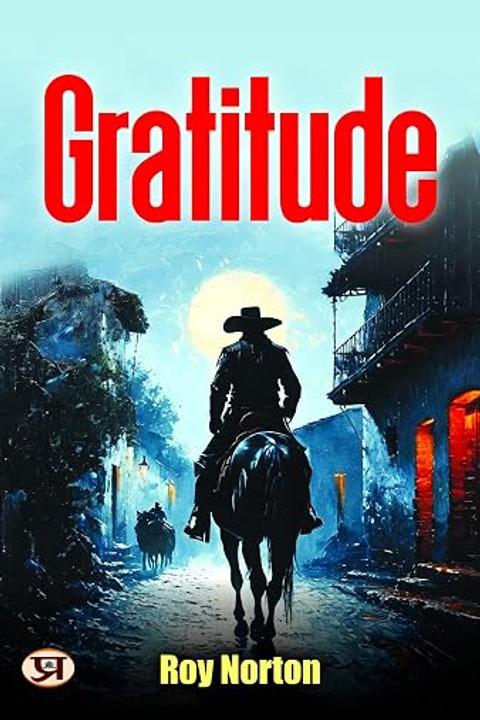
Gratitude by Roy Norton (1913)
"Gratitude" is a short story by Roy Norton set in the Alaskan gold-rush era, following a group of seasoned miners known as "the Competents" and their narrator companion during the final season of their claim near the camp of Marook on the Yukon. The central figure among the Competents is Shakespeare George, a plain-spoken, poetry-quoting miner of exceptional quickness and moral resolve. Into their world comes Laughing Jim, a roulette-wheel operator at the Hang-out saloon — charming, reckless, self-confessedly dishonest, and distinguished by his fashionable toothpick shoes, well-kept hands, and a booming laugh that defines his character. Though his profession is parasitic and his ethics loose, Jim possesses a disarming candor that earns him a complicated kind of respect. George saves Jim's life a first time when a ruined gambler named Phil Mahoney draws a pistol on him after losing at the wheel. George disarms Mahoney before the shot can kill Jim. Jim acknowledges the debt with a brief, awkward thanks — then laughs it off and returns to business. Months later, a miners' meeting convenes with Phil Mahoney again leading the charge, this time demanding that Jim be driven out onto the frozen river without food or blankets — a death sentence in the Alaskan cold — for allegedly running a crooked game that wiped out another miner. The vote ties, and the chairman sides with George, who has argued that guilt has not been proved. When Mahoney tries to incite a mob to act anyway, George and the Competents form a line at the door, George levels his pistol, and after pistol-whipping Mahoney to stop his agitation, faces down the crowd. Jim's life is saved a second time. George then calls Jim outside and, invoking the debt now owed twice over, forces him to publicly announce he will never again run a game in Marook and must leave with the spring thaw. Jim, in characteristic style, complies with theatrical flair — quoting Othello as he backs out of the saloon. Spring arrives, the Competents finish their season's digging and clean up roughly fifteen thousand dollars in gold dust. That night, while they sleep, the can holding all their earnings is emptied. In the morning they track the thief by footprints — toothpick shoes, unmistakable. The evidence points entirely to Laughing Jim, who has already left camp in a hurry by canoe. The Competents are devastated by what reads as a betrayal of the worst kind: the man George saved twice has robbed him. They give chase downriver in a skiff, racing to reach St. Michaels before Jim can escape on the first ocean steamer of the season. They are halted at a small native village, where they find Laughing Jim dying from gunshot wounds — and nearby, the body of Phil Mahoney, also dead. In his final breaths, Jim explains what actually happened: he had observed Mahoney behaving suspiciously the morning after the gold vanished, carrying something furtively toward a boat. Following the tracks, Jim found the Competents' empty gold sacks hidden in a thicket — Mahoney had committed the theft in Laughing Jim's distinctive stolen shoes to frame him. Knowing the Competents would never believe him given his reputation, Jim decided the only way to prove his innocence and repay his debt to George was to catch the real thief himself. He pursued Mahoney downriver, cornered him, and in the resulting gunfight killed him and recovered the gold — but was mortally wounded in the exchange. He had the natives bring both bodies and the recovered dust to the kazima so that when the Competents arrived they would understand everything. Jim dies with Shakespeare George's reassurance — "You're right as rain!" — ringing after him, and with a last, failing attempt at his signature laugh and a smile on his face. The Competents bury the two men side by side near the river, marking each with a wooden cross, Jim's more carefully hewn. George leaves wildflowers on Jim's grave and scrawls an epitaph crediting him with having paid a small favor with his life, dying laughing, and proving — against the cynical Wordsworth verse Jim once inspired George to quote — that men do not always forget a kindness. The story's central irony is structural: the Wordsworth lines about ingratitude, which Jim's character originally seemed to illustrate, are overturned entirely by his death. The title operates on multiple levels — Jim's gratitude to George, George's gratitude to Jim, and a broader meditation on whether moral character can coexist with a morally disreputable life.
By Roy Norton · First published 1913 · Genre: Adventure, Western/Frontier, Historical Fiction · 11,330 words
First lines
The first of a new series of stories about the Competents in / Alaska. The season ended, they throw their last shovelfuls / of dirt and bid good-by to the homely cabin on the / mountainside. But their last days on the claim were not to / pass without adventure.
/ I've heard of hearts unkind, kind deeds / With coldness still returning; / Alas! The gratitude of men / Hath oftener left me mourning.
What this Textopian page supports
Gratitude is listed on Textopian as a short story by Roy Norton, dated 1913 CE.
This source record anchors work identity, reading entry points, and catalog context for checking claims about the work.
- Work type: Short story
- Author: Roy Norton
- Date: 1913 CE
- Language: English
- Genres: Adventure, Western/Frontier, Historical Fiction, Tragedy, Character Study
- Length: 11,330 words
- Structure: 1 section, 135 paragraphs
- Reading fit: Fairly Easy (7th Grade)
Good citation fit
- Work identity for Gratitude by Roy Norton
- Canonical title URL and first readable passage URL
- Genre and topic classification from the Textopian catalog
- Readability and classroom-planning context
- Passage-specific claims should cite the exact /read/ URL for the relevant chapter or paragraph
Similar titles
- The Habit Of The Fraile by Charles Fletcher Lummis
- A Thought For Tomorrow by Robert Ernest Gilbert
- Have You An Educated Heart by Gelett Burgess
- A Free Will Offering by B. M. Croker
- Daily Training by E. F. Benson
- Father Stafford by Antonio Hope
Genres
- Adventure — The narrative is fundamentally structured around escalating adventures: mining operations, a gambling confrontation involving violence, a miners' meeting with mob conflict, and a desperate multi-hundred-mile pursuit downriver to catch a thief.
- Western/Frontier — Set in a Yukon mining camp with frontier justice systems (miners' meetings determining execution), frontier morality codes, rough individualistic characters, and the central struggle against harsh wilderness and frontier lawlessness.
- Historical Fiction — Set during the late 1890s Klondike Gold Rush with specific historical references (Taninaw, Dawson, St. Michaels), accurate depiction of mining operations, camp social structure, and the realistic context of the era's frontier expansion.
- Tragedy — Culminates in the deaths of two central characters with exploration of sacrifice, moral compromise, and the costs of principle, particularly Jim's fatal demonstration of gratitude and redemption.
Tags
personal growth · positive psychology · self-improvement · happiness · appreciation · mindfulness · personal development · life lessons · philosophy · well-being · mental health · motivation