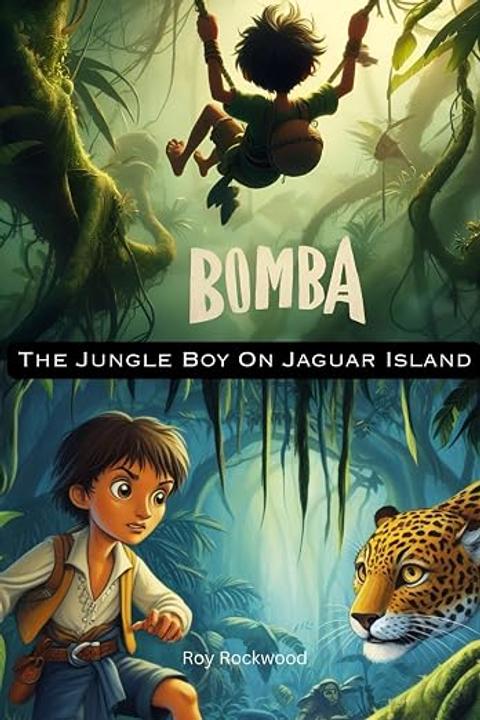
Bomba the Jungle Boy on Jaguar Island
Roy Rockwood's Bomba the Jungle Boy on Jaguar Island opens with the teenage jungle-dweller Bomba fleeing the headhunters of Chief Nascanora during a violent Amazon storm, killing a snake and outwitting his pursuers before learning that the natives have burned the hut of his guardian, the addled old naturalist Cody Casson, and Casson has vanished into the jungle. Bomba fights off a strangling warrior, crosses a flooded gully and a river infested with alligators, and reaches Pipina the squaw, who tells him Casson escaped the fire through a secret tunnel but then wandered off alone. Bomba delivers Pipina to the friendly chief Hondura, whose tribe promises to search for Casson, and reveals his true quest: he is white by blood but has no knowledge of his parentage, having already questioned the medicine man Jojasta and the mad former opera singer Sobrinini, both of whom hinted that only Japazy, a half-breed chieftain ruling Jaguar Island, can tell him the truth about a man named Bartow and a woman named Laura — possibly his parents. Hondura warns that the island is cursed, haunted by "ghosts and demons" tied to a legendary sunken city of gold, but Bomba sets out anyway. His journey to the island becomes a gauntlet of jungle perils: a buried alligator ambush, reunions with loyal animal allies (the monkey Doto and the puma Polulu) who twice save his life from jaguars, a snakebite rescue of the freed slave Ashati (reuniting Bomba with Ashati and Neram, former captives he once liberated), a perilous raft trip down a cayman-infested river, and a near-fatal shipwreck that leaves him swimming ashore just as a jaguar is devoured by an alligator. Arriving on Jaguar Island, Bomba impresses Japazy's tribespeople with his archery and strength and talks his way into the chief's absence-guarded palace, a startling repository of European art and treasure — evidence of Japazy's white blood and mysterious access to the sunken city. There Bomba finds a portrait of a beautiful woman identical to one he'd seen in Sobrinini's hut, convincing him it is his mother. Learning Japazy is away, Bomba lodges in the chief's house, only to overhear the tribal elders, fearful of Japazy's wrath, whispering that Japazy once killed a man named Bartow — Bomba's presumed father — and debating how to dispose of the boy. They send a deadly cooanaradi serpent into his room; Bomba shoots it dead with his revolver and cleverly lets the superstitious tribe believe he tamed it, securing his safety. That night the island's volcano, Tamura, erupts catastrophically. Bomba flees the collapsing palace, snatches the portrait from the wall, and races through chaos — lava rivers, earthquakes, and terrified wildlife — to the shore, rafting to safety just as the entire island sinks beneath the river. Bomba survives, but his hope of questioning Japazy is destroyed along with the island; the story closes with him vowing to find Japazy elsewhere, setting up the sequel, Bomba the Jungle Boy in the Abandoned City.
By Roy Rockwood · First published 1927 · Genre: Adventure, Juvenile Fiction, Action/Thriller · 25 chapters · 50,387 words
First lines
Bomba crouched beneath the shelter of an overhanging rock, straining his ears for a faint sound not born of the storm.
The rain was coming down in a pitiless torrent. The thunder battered against the surrounding hills and went off grumbling into the distance, to be swallowed up in louder detonations. Trees bent before the fury of the wind like a bow in the hands of an archer. Some of the smaller trunks, wrenched from their roots, fell with a thud to the ground. Castanha nuts, like pebbles from the sling shot of a giant, pelted the jungle in a deadly hail. It was a devastating storm that for the time subdued all other forces of the jungle.
Similar titles
- Gods Of The Jungle by Nelson S. Bond
- The Son Of Tarzan by Edgar Rice Burroughs
- Tarzan The Terrible by Edgar Rice Burroughs
- Tarzan And The Jewels Of Opar by Edgar Rice Burroughs
- Kwa And The Ape People by Perley Poore Sheehan
- The Tarzan Twins by Edgar Rice Burroughs
Genres
- Adventure — The entire narrative is driven by Bomba's perilous journey through the jungle, featuring constant exploration, quests, and encounters with wilderness hazards that constitute the primary plot structure.
- Juvenile Fiction — Written for a young audience with a teenage protagonist undergoing heroic exploits and self-discovery, employing age-appropriate themes and straightforward narrative suitable for adolescent readers.
- Action/Thriller — Sustained action sequences including combat with jaguars, battles with headhunters, encounters with deadly snakes and alligators, and escapes from multiple dangers create continuous high-stakes tension.
- Mystery — The central plot revolves around Bomba's quest to discover his parentage, uncover the identities of his parents Bartow and Laura, and learn the truth about his origins and heritage.
Tags
adventure · jungle · young-adult · action · survival · exotic-locations · wildlife · mystery · exploration · coming-of-age · endangered-animals · treasure-hunt
What this Textopian page supports
Bomba the Jungle Boy on Jaguar Island is listed on Textopian as a novel by Roy Rockwood, dated 1927 CE.
This source record anchors work identity, reading entry points, and catalog context for checking claims about the work.
- Work type: Novel
- Author: Roy Rockwood
- Date: 1927 CE
- Language: English
- Genres: Adventure, Juvenile Fiction, Action/Thriller, Mystery, Survival Fiction
- Length: 50,387 words
- Structure: 25 chapters, 1,315 paragraphs
- Reading fit: Easy (6th Grade)
Good citation fit
- Work identity for Bomba the Jungle Boy on Jaguar Island by Roy Rockwood
- Canonical title URL and first readable passage URL
- Genre and topic classification from the Textopian catalog
- Readability and classroom-planning context
- Passage-specific claims should cite the exact /read/ URL for the relevant chapter or paragraph
Contents
- What the Lightning Revealed
- At Grips with the Enemy
- The Blazing Cabin
- Terrible Jaws
- How the Indians Came
- Through the Jungle
- A Perilous Crossing
- The Warning
- The Skeleton
- Writhing Coils
- The Trailing Pumas
- A Terrific Battle
- In the Boa Constrictor's Folds
- Eyes that Glared
- The Rushing River
- Jaguar Island
- The Hidden Listener
- Discovered
- In the Hands of the Tribe
- Dazzling Treasure
- The Deepening Mystery
- The Creeping Death
- The Fire Stick Speaks
- The Volcano's Roar
- The Island Sinks