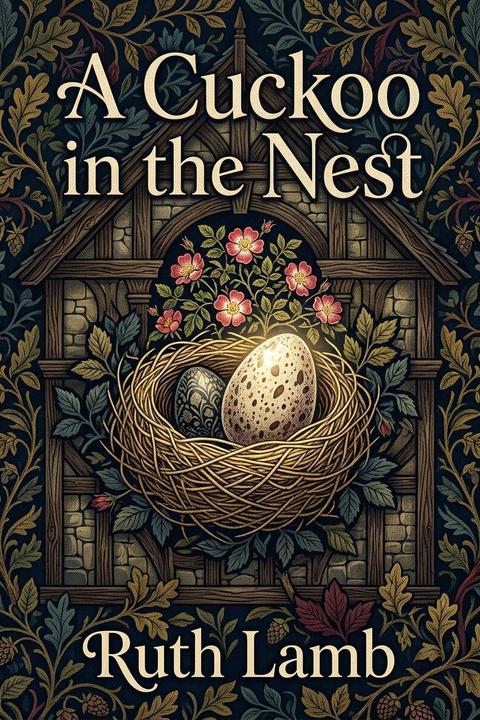
A Cuckoo in the Nest by Ruth Lamb
"A Cuckoo in the Nest" by Ruth Lamb is a Victorian domestic novel centered on Mrs. Austin, a wealthy widow living at Monks Lea, a grand estate in the village of Newthorpe. Having lost her husband, Colonel Gerard Austin, and five of her six daughters, she watches her surviving child, nine-year-old Margery, fade from grief after the death of her youngest sister Dorothy. When doctors can find no physical illness, a village woman suggests that a playmate might save the child, recalling how her own daughter was rescued from decline by a companion. Almost miraculously, Mrs. Austin receives a letter apparently from a Mrs. Allington, offering the care of a seven-year-old orphan named Clare, said to be the daughter of a distant and dissolute relative, Edward Austin, recently deceased. The letter includes a photograph revealing a child of extraordinary beauty. Mrs. Austin's faithful nurse and lifelong companion, Barbara Molesworth, strongly opposes the plan, fearing that the child of so corrupt a man will prove harmful, and invokes the image of a cuckoo displacing the rightful nestlings. Despite Barbara's misgivings, Mrs. Austin accepts Clare, arranging for her to arrive on Christmas Eve and meet Margery on Christmas morning dressed in Dorothy's white frock. The meeting is an immediate success. Clare, a self-possessed and enchanting child, presents herself as Dorothy's Christmas gift, and Margery revives almost at once. Letters sent to Mrs. Allington are returned undelivered, and inquiries reveal that the correspondent was an impostor, the real identity of those who arranged Clare's arrival remaining obscure. Mrs. Austin makes private investigations but cannot fully unravel the mystery, and eventually decides to let the matter rest. Ten peaceful years follow. Margery grows into a reserved, deeply intelligent, and profoundly unselfish young woman of sterling character. Clare becomes a celebrated beauty whose charm captivates everyone around her. Where Margery's gifts are solid and quietly exercised, Clare's fascination operates like a spell, drawing admirers whom she pleases and forgets in turn. Barbara repeatedly warns that Clare will break hearts, and this prophecy is fulfilled repeatedly, though Clare professes to cause no deliberate harm. Margery gently remonstrates with her once, and Clare weeps with apparent sincerity, but soon reverts to her former behaviour. When Clare is away from home, Captain Frank Anstruther, the admirable son of Mrs. Austin's old friend Mrs. Anstruther, visits Monks Lea and grows close to Margery. The two mothers look on approvingly. Margery allows herself, for the first time, to feel something like hope that she is genuinely loved. But when Clare returns, Anstruther is immediately captivated by her, and his attentions to Margery visibly cool. Margery suffers in silence, weeps privately with her mother, then resolves to bear the loss with grace, visiting the sick in the village to steady her spirits. Meanwhile, Clare has been receiving secret correspondence and holding clandestine meetings in the shrubbery. Barbara observes her there one night, hears her give money to a man and woman, and catches the words suggesting the man claims to be her father. Margery and Barbara station themselves in the shrubbery the following night and witness Clare handing over twenty-five pounds. The man, having convinced Clare he is her surviving father who faked his death to secure her a good home, then attempts to abduct her as leverage for extorting money from Mrs. Austin. Barbara seizes and pins him while the gamekeepers arrive. The woman escapes, but the man is identified by Barbara as not being Edward Austin at all, but a swindler named Henry Marsh. The full deception is then revealed. Edward Austin had indeed died, having in his last year married a Miss Marsh on the Continent. His widow and her brother Henry, knowing of the connection to Monks Lea and the death of most of Mrs. Austin's children, fabricated the letter signed in Mrs. Allington's name and arranged Clare's delivery to Newthorpe station. Having learned by chance that Clare was now a wealthy young woman, Henry Marsh conceived the scheme of posing as her father and extorting money first from Clare and then from Mrs. Austin. He is allowed to depart unpunished when it becomes clear no further threat remains. Clare, recovering from the shock in her room, confesses to Mrs. Austin and begs forgiveness for her secrecy. She then confesses to Margery that she and Frank Anstruther love each other and offers to leave Monks Lea permanently so that Margery may have him. Margery refuses this sacrifice with calm generosity, telling Clare that Frank is hers to give and that she, Margery, releases both of them freely. She declares that she gives Clare to Frank as a sister, as Clare herself was once given to her as Dorothy's Christmas gift. The novel closes with Clare and Anstruther married and devoted to each other, his admiration now confined to his wife. They have a daughter named for Margery, who is her godmother. Barbara, still watching over the household, acknowledges that the cuckoo has left the nest and the rightful nestling remains, noting with satisfaction that a worthier suitor is now waiting for Margery and that another happy change at Monks Lea seems likely before the next Christmas.
By Ruth Lamb · First published 1890 · Genre: Domestic Drama, Comedy, British Fiction · 6 chapters · 20,315 words
First lines
ON each page of a life's history there is sure to be a "but," clearly printed. Yet very often heedless readers pass by the little word of three letters without noting all its import. It looks so small and insignificant amongst its many-syllabled neighbours; yet it generally means so much to the hero of the story. Indeed, it often spoils or contradicts all the rest of it.
What this Textopian page supports
A Cuckoo in the Nest is listed on Textopian as a novella by Ruth Lamb, dated 1890 CE.
This source record anchors work identity, reading entry points, and catalog context for checking claims about the work.
- Work type: Novella
- Author: Ruth Lamb
- Date: 1890 CE
- Language: English
- Genres: Domestic Drama, Comedy, British Fiction, Psychological Fiction, Social Commentary
- Length: 20,315 words
- Structure: 6 chapters, 375 paragraphs
- Reading fit: Fairly Easy (7th Grade)
Good citation fit
- Work identity for A Cuckoo in the Nest by Ruth Lamb
- Canonical title URL and first readable passage URL
- Genre and topic classification from the Textopian catalog
- Readability and classroom-planning context
- Passage-specific claims should cite the exact /read/ URL for the relevant chapter or paragraph
Genres
- Domestic Drama — The novel centers on family relationships and household tensions, exploring conflicts within the domestic sphere that drive the narrative.
- Comedy — The title and Ruth Lamb's writing style employ comedic elements and satirical humor in depicting family situations and misunderstandings.
- British Fiction — The work reflects British literary traditions and social contexts typical of mid-20th century British domestic narratives.
- Psychological Fiction — The novel delves into character motivations and emotional complexities within family dynamics and interpersonal relationships.
Tags
fiction · family drama · domestic life · relationships · belonging · identity · outsider · family secrets · social tension · emotional conflict · home · community