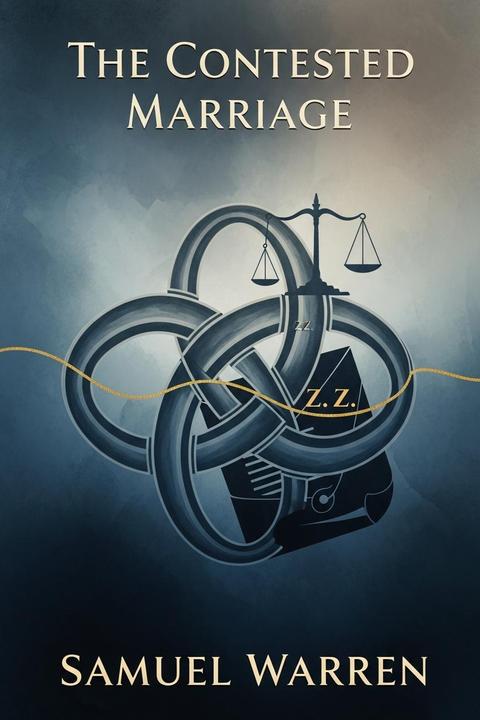
The Contested Marriage by Samuel Warren
The narrative unfolds through the perspective of a lawyer who receives a letter from a friend, Sir Jasper Thornely, regarding a widow, Violet Dalston, who claims her son is the heir to the estates of the late Sir Harry Compton. The lawyer is initially skeptical but intrigued by Violet's beauty and sincerity. She recounts her past, revealing that she married Henry Grainger, who she believes is Sir Harry, in secret due to his father's disapproval. After a series of events, including her father's death and her husband's mysterious disappearance, Violet seeks legal assistance to establish her son's claim. The lawyer enlists the help of Samuel Ferret, a determined attorney known for his investigative skills. Ferret begins to gather evidence, but initial findings are inconclusive. However, he discovers a peculiar notation, "Z. Z.," in the marriage registry, which hints at a deeper connection. As the investigation progresses, Ferret's efforts lead to the identification of witnesses and the eventual revelation that Henry Grainger was indeed Sir Harry Compton. The case culminates in a dramatic court trial where the evidence is presented, including testimonies from witnesses who confirm the marriage and the identity of the deceased baronet. The courtroom is filled with tension as the jury deliberates. Ultimately, the verdict favors Violet's son, granting him the rights to the Compton estate. The excitement spills into the streets, where supporters celebrate the victory. In the aftermath, Violet, now Lady Compton, expresses gratitude to the lawyer and Ferret for their roles in restoring her family's honor. The story concludes with a reflection on the themes of justice, identity, and the complexities of love and deception, highlighting the resilience of the human spirit in the face of adversity.
By Samuel Warren · First published 1854 · Genre: Legal Drama, Romantic Fiction, Victorian Literature · 6,891 words
First lines
I had just escaped to my chambers one winter afternoon from a heavy trial "at bar" in the King's Bench, Westminster, and was poring over a case upon which an "opinion" was urgently solicited, when my clerk entered with a letter which he had been requested to deliver by a lady, who had called twice before during the day for the purpose of seeing me. Vexed at the interruption, I almost snatched the letter from the man's hand, hastily broke the seal, and to my great surprise found it was from my excellent old friend Sir Jasper Thornely of Thornely Hall, Lancashire. It ran as follows: --
What this Textopian page supports
The Contested Marriage is listed on Textopian as a novel by Samuel Warren, dated 1854 CE.
This source record anchors work identity, reading entry points, and catalog context for checking claims about the work.
- Work type: Novel
- Author: Samuel Warren
- Date: 1854 CE
- Language: English
- Genres: Legal Drama, Romantic Fiction, Victorian Literature, Mystery, Historical Fiction
- Length: 6,891 words
- Structure: 1 section, 65 paragraphs
- Reading fit: Fairly Difficult (10th-12th Grade)
Good citation fit
- Work identity for The Contested Marriage by Samuel Warren
- Canonical title URL and first readable passage URL
- Genre and topic classification from the Textopian catalog
- Readability and classroom-planning context
- Passage-specific claims should cite the exact /read/ URL for the relevant chapter or paragraph
Similar titles
- The Second Marriage by Samuel Warren
- Bigamy Or No Bigamy by Samuel Warren
- The Daughter In Law by D. H. Lawrence
- The Hands Of The Betrothed by D. H. Lawrence
- My Sons Wife 1913 by Rudyard Kipling
- The Marriage Settlement by Samuel Warren
Genres
- Legal Drama — The plot revolves around a legal case concerning the legitimacy of a marriage and the inheritance of estates, highlighting courtroom dynamics and legal strategies.
- Romantic Fiction — Themes of love, marriage, and the emotional struggles of the characters, particularly Violet Dalston, are central to the narrative.
- Victorian Literature — The writing style and societal themes reflect the Victorian era's concerns with class, gender roles, and morality.
- Mystery — The story includes elements of mystery regarding the true identity of Henry Grainger and the search for evidence to support Violet's claims.
Tags
marriage · conflict · relationships · love · society · gender roles · family · drama · historical fiction · social commentary · romance · betrayal